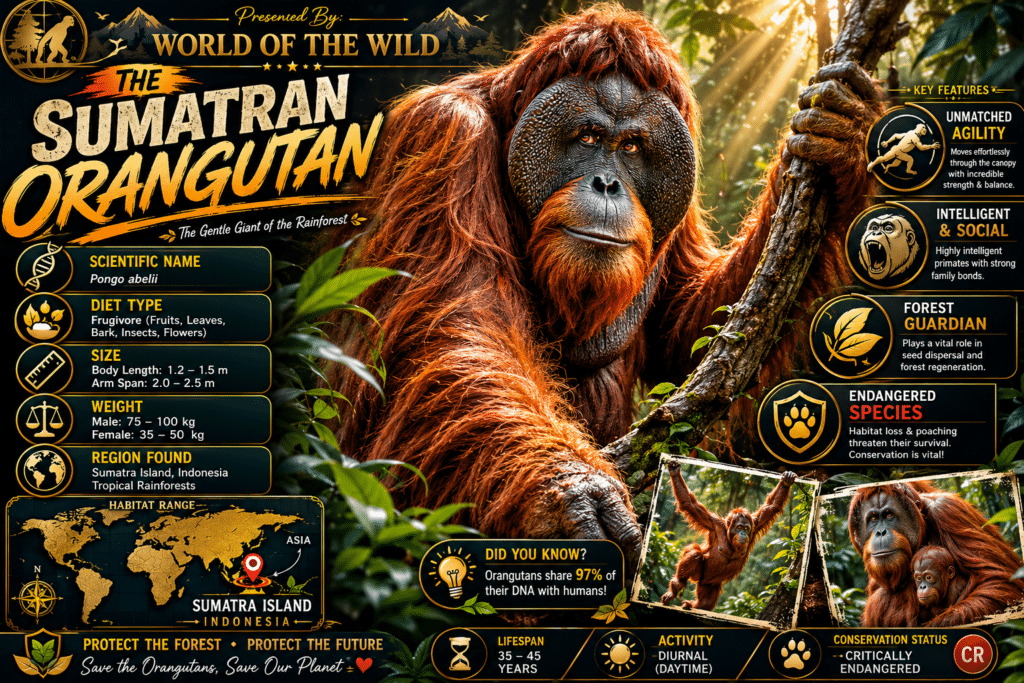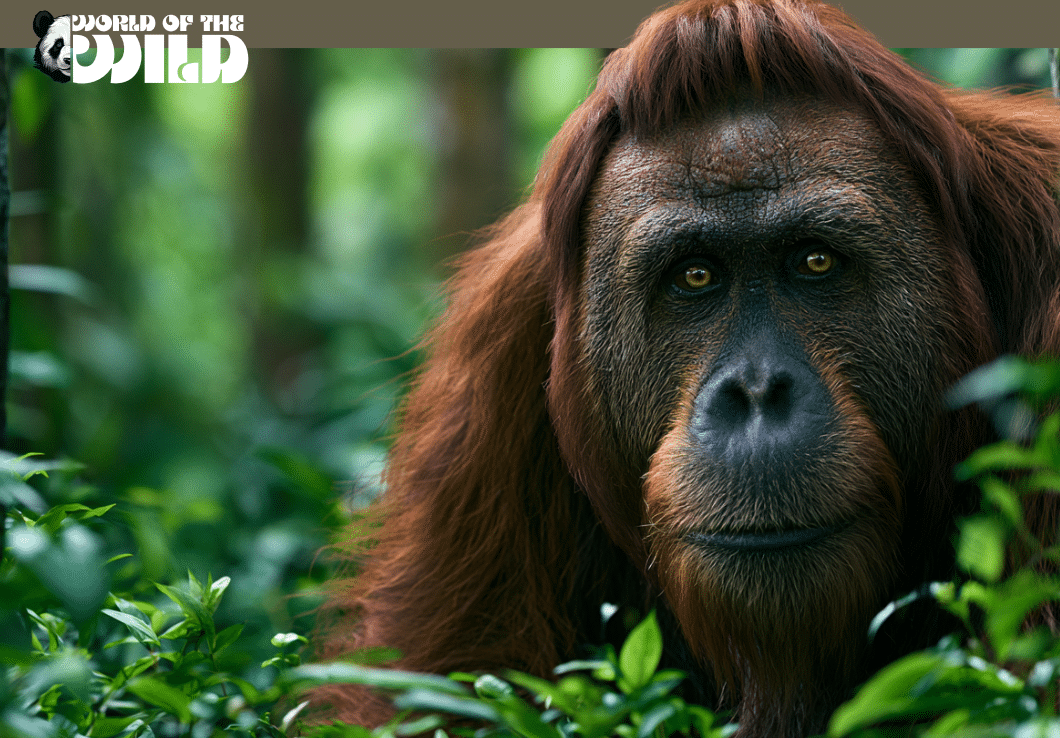

Imagine peering through a canopy of ancient rainforest and locking eyes with a creature that seems to gaze back with unmistakable wisdom. There’s a moment — fleeting but profound — where the boundary between human and animal feels impossibly thin. That is the experience of encountering a Sumatran orangutan in the wild. With their rust-colored coats, soulful amber eyes, and astonishing cognitive abilities, these great apes are among the most captivating animals on Earth. They share approximately 96.9% of their DNA with humans, yet they inhabit a world that is vanishing beneath them — one chainsaw, one palm oil plantation, one poached infant at a time. To understand the Sumatran orangutan is to confront one of the most urgent conservation crises of our time.
Facts
- The word “orangutan” comes from the Malay and Indonesian words orang (person) and hutan (forest), literally meaning “person of the forest.”
- Sumatran orangutans are one of the slowest-reproducing mammals on the planet — females give birth only once every seven to nine years.
- They have been observed crafting and using at least 54 distinct tool types in the wild, including using sticks to extract insects from tree bark and leaves as makeshift gloves or umbrellas.
- Unlike their Bornean cousins, Sumatran orangutans are notably more social, frequently gathering in fruit-rich trees and even forming loose traveling groups.
- Adult male Sumatran orangutans develop dramatic cheek pads called flanges, which amplify their long-call vocalizations — haunting sounds that can travel over a kilometer through dense jungle.
- These orangutans have been documented teaching their young specific foraging skills that vary between populations, representing one of the clearest examples of animal culture in the natural world.
- A Sumatran orangutan’s arms are so long that, when standing, their fingertips nearly reach their ankles — an extraordinary adaptation to an almost entirely arboreal life.
Species
The Sumatran orangutan occupies a well-defined place in the tree of life:
| Rank | Classification |
|---|---|
| Kingdom | Animalia |
| Phylum | Chordata |
| Class | Mammalia |
| Order | Primates |
| Family | Hominidae |
| Genus | Pongo |
| Species | Pongo abelii |
The genus Pongo contains three recognized species of orangutan, each geographically and genetically distinct. The Bornean orangutan (Pongo pygmaeus) is the most numerous of the three, inhabiting the island of Borneo and comprising three subspecies of its own. The Tapanuli orangutan (Pongo tapanuliensis), described by scientists only in 2017, is the most recently identified great ape species in over a century and is restricted to the Batang Toru ecosystem in the southernmost part of Sumatra’s northern range — separated from the Sumatran orangutan by the geological barrier of Lake Toba. With fewer than 800 individuals, the Tapanuli orangutan is the rarest great ape on Earth.
The Sumatran orangutan (Pongo abelii) is confined to the northern end of the island of Sumatra in Indonesia. While it is not divided into formal subspecies, populations across its range show meaningful behavioral and ecological variation, particularly in tool use — a fact that has captivated primatologists for decades.
Appearance
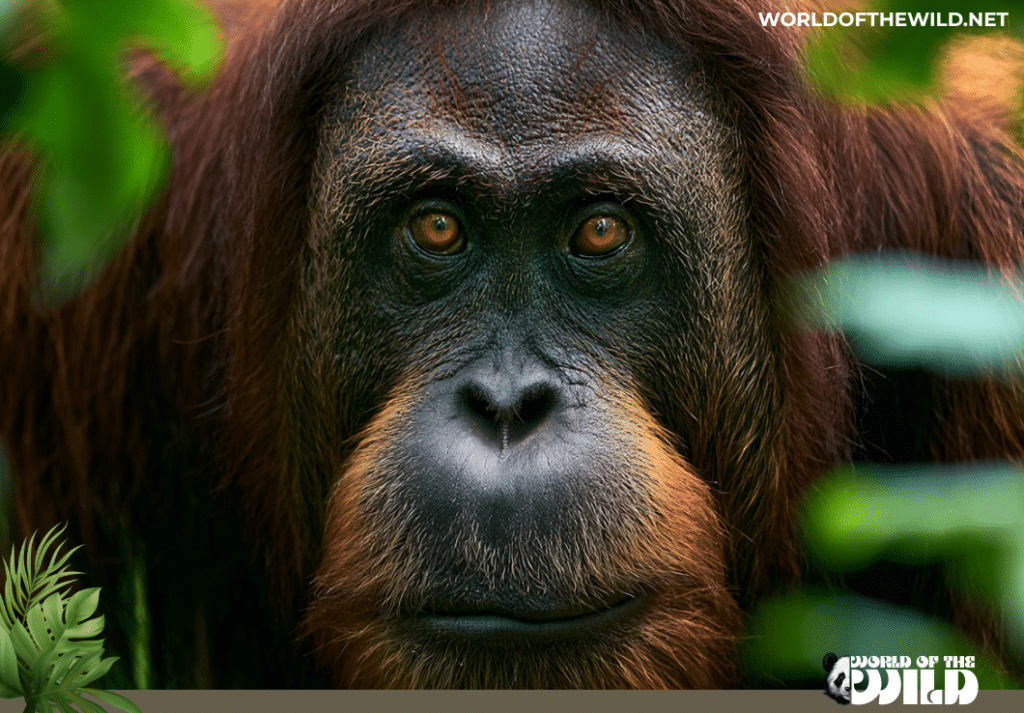
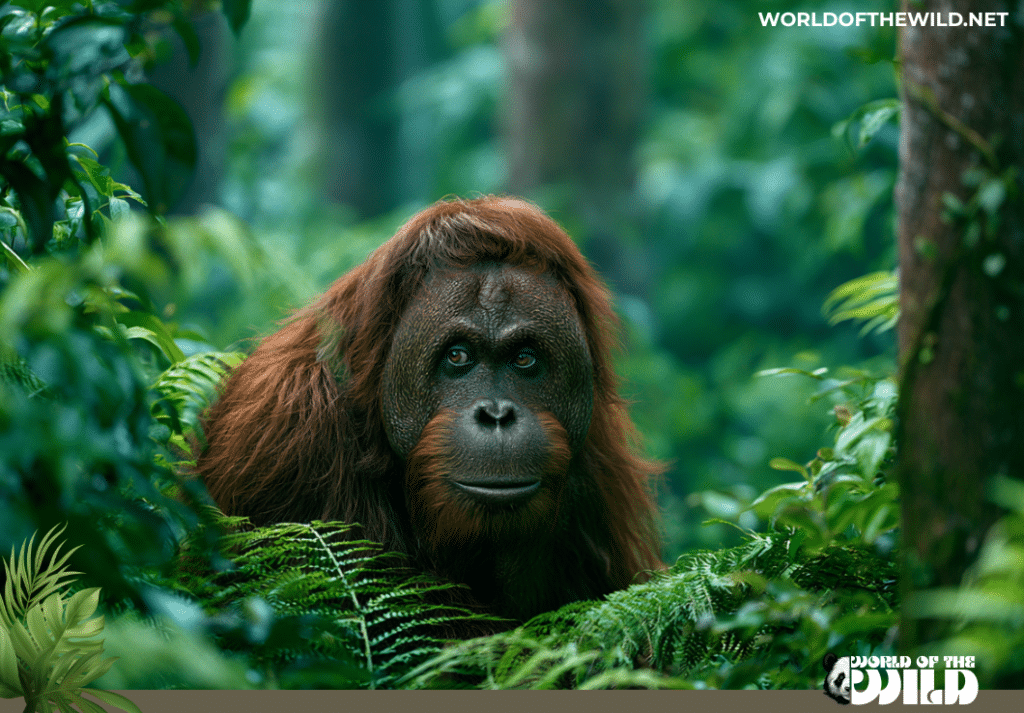
The Sumatran orangutan is an animal of extraordinary physical presence. Adults are draped in long, shaggy fur that ranges from pale orange to deep cinnamon-red, often appearing lighter on the crown and darker on the limbs. Compared to Bornean orangutans, Sumatran individuals tend to have longer, finer hair and noticeably paler faces, giving them a somewhat more delicate appearance.
Sexual dimorphism is dramatic in this species. Flanged adult males — those that have fully matured and developed their secondary sexual characteristics — are truly imposing. They can stand roughly 4.5 to 5 feet tall and weigh between 130 and 200 pounds, with some individuals exceeding this range. Their most striking features are the large, flat cheek flanges (or flanges) that frame their faces like a crown, along with a prominent throat pouch capable of inflating to produce thunderous vocalizations. A flowing beard and mustache of pale hair further distinguish older males.
Females are considerably smaller, typically standing around 3.5 to 4 feet and weighing between 66 and 110 pounds. They lack flanges and throat pouches but share the same expressive face, with deep-set, intelligent eyes that seem to radiate awareness.
Perhaps their most functional physical trait is their arm span, which in males can reach up to 7 feet — longer than their standing height. Their hands and feet are built for grasping, with long, curved fingers and a reduced thumb placement that gives them a hook-like grip perfectly suited for moving through a three-dimensional canopy. Unlike most primates, orangutans spend nearly their entire lives off the ground, and their bodies reflect millions of years of adaptation to that vertical world.
Behavior
Life for a Sumatran orangutan unfolds slowly, deliberately, and almost entirely in the treetops. They are semi-solitary animals, but less rigidly so than their Bornean relatives. In areas of fruit abundance, multiple individuals — females with offspring, adolescents, and occasionally males — will congregate peaceably, socializing through soft vocalizations, mutual grooming, and what can only be described as quiet companionship.
Each morning, an orangutan wakes in a nest it constructed the previous evening by bending and weaving branches together — a fresh architectural feat performed almost every night. These nests are built high in the canopy, sometimes with a secondary “roof” of layered leaves to shed rain, hinting at a level of planning and foresight that few animals demonstrate.
The cognitive life of the Sumatran orangutan is nothing short of remarkable. They have been observed:
- Using sticks as tools to extract seeds from spiny Neesia fruits, a behavior so sophisticated that it appears to be culturally transmitted from mother to offspring.
- Fashioning leaf “gloves” to handle prickly vegetation and leaves folded into cups to drink water.
- Deceiving researchers in captivity, hiding food and displaying deliberate deception — a behavior once thought uniquely human.
- Problem-solving at levels comparable to chimpanzees and, in some tests, young children.
Communication is rich and multifaceted. Mothers and infants maintain near-constant contact through soft whimpers, squeaks, and lip-smacking. Dominant males produce long calls — a rising, roaring vocalization that can last several minutes — to advertise their presence to females and warn rival males. These calls travel through the forest like slow thunder and are one of the most evocative sounds in the natural world.
Play is a significant part of juvenile life. Young orangutans spend years watching, imitating, and learning from their mothers before they become truly independent — a childhood that mirrors the extended developmental period of humans more closely than perhaps any other animal.
Evolution
The orangutan lineage diverged from the common ancestor of the great apes approximately 12 to 16 million years ago, making them the most ancient branch of the living great ape family. Fossil evidence reveals that ancestors of modern orangutans once ranged across a vast sweep of Southeast Asia and southern China. Sivapithecus, a fossil ape from the Miocene epoch, is widely regarded as one of the earliest relatives of the Pongo lineage, displaying facial features strikingly similar to modern orangutans.
The ancestors of today’s orangutans are thought to have colonized the Sundaland region — the ancient landmass that encompassed present-day Sumatra, Borneo, and the Malay Peninsula — during periods when sea levels were low enough to expose land bridges. As sea levels rose following the last glacial maximum roughly 10,000 to 15,000 years ago, populations on Sumatra and Borneo became geographically isolated, eventually diverging into the distinct species we recognize today.
The discovery of the Tapanuli orangutan in 2017 further complicated and enriched this story. Genetic analysis revealed that the Tapanuli population had been isolated from northern Sumatran populations for over 10,000 years, and that it actually represents the lineage most closely related to the common ancestor of all three orangutan species — essentially a living relic of the ancestral orangutan population.
Within Sumatra itself, the massive volcanic eruption of Mount Toba approximately 74,000 years ago — one of the most catastrophic geological events in human prehistory — likely caused significant disruption to orangutan populations, reshaping their distribution and contributing to the genetic differences observed between northern and southern Sumatran populations.
Habitat
The Sumatran orangutan is an island specialist, confined entirely to the northern and northwestern regions of Sumatra, Indonesia — primarily in the provinces of Aceh and North Sumatra. Their range is fragmented into several key forest blocks, with the largest and most critical being the Leuser Ecosystem, a UNESCO World Heritage Site and one of the most biodiverse places on Earth.
These orangutans are forest architects in the truest sense — they depend on lowland and montane tropical rainforests, with a strong preference for peat swamp forests and alluvial floodplain forests at lower elevations. These habitats offer the richest diversity of fruiting trees, which form the cornerstone of their diet. They are also found in hill forests and montane forests up to approximately 1,500 meters in elevation, though their density decreases sharply with altitude.
The ideal Sumatran orangutan habitat is characterized by:
- A closed, multi-layered canopy that allows continuous arboreal travel without descending to the ground.
- High tree species diversity, particularly fig trees (Ficus spp.) and fruiting dipterocarps.
- Seasonal but reliable fruit availability, which dictates orangutan ranging patterns and social aggregation.
- Proximity to water, as riverine forests tend to support particularly high fruit diversity.
The connectivity between forest patches is critical. Unlike many animals, orangutans are extraordinarily reluctant to cross open ground, making habitat fragmentation an existential threat — not just a nuisance.
Diet
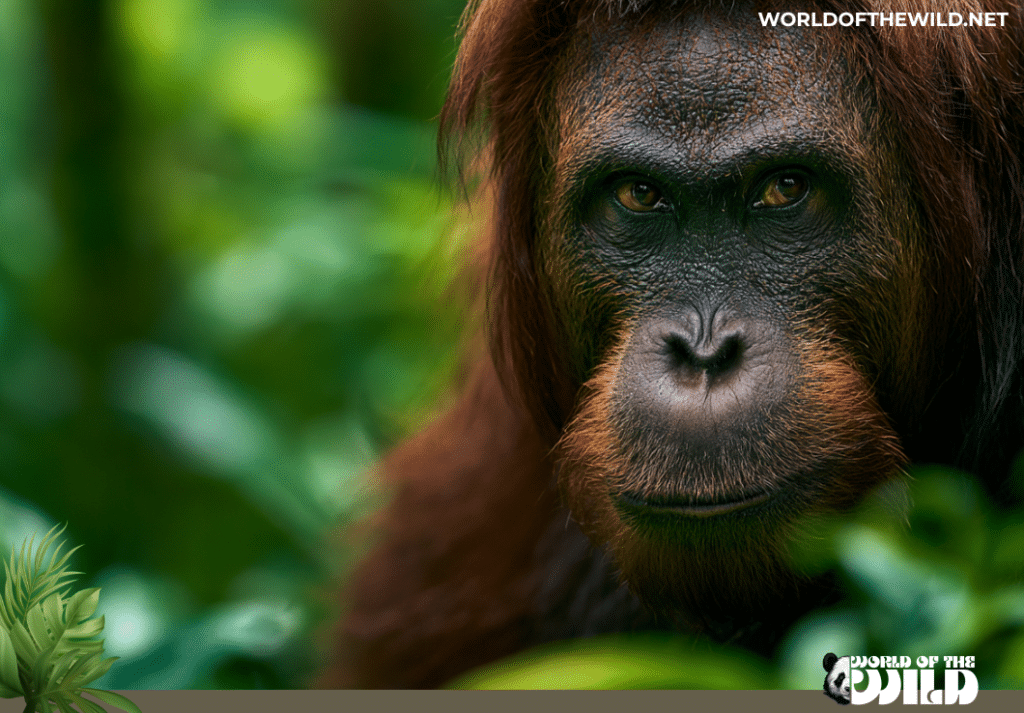
The Sumatran orangutan is primarily a frugivore — a fruit specialist — though its diet encompasses a remarkable range of foods depending on season and availability. Fruit can account for up to 60–90% of their diet during periods of abundance, particularly the large, energy-rich fruits of dipterocarp trees during masting events.
Their most important and beloved food is the durian (Durio spp.) — the notoriously pungent “king of fruits” — which provides an extraordinary caloric payload. They are also strongly attracted to figs, which produce fruit year-round and serve as a critical fallback food during lean seasons.
Beyond fruit, Sumatran orangutans forage for:
- Young leaves and shoots, particularly when fruit is scarce
- Bark, which they strip and chew for both nutrition and medicinal compounds
- Insects and their larvae, extracted from dead wood using tools
- Bird eggs, occasionally raided from nests
- Mineral-rich soil, licked directly from clay deposits — a behavior thought to supplement dietary minerals
Their tool-assisted extraction of seeds from Neesia fruits — which are enclosed in a dense, fibrous husk lined with irritating hairs — is one of the most impressive examples of wild primate technology. Using carefully selected and sometimes modified sticks, they pry apart the husk to access the fat-rich seeds within, a skill that takes years for young orangutans to fully master.
Orangutans are also known to self-medicate. They have been observed chewing the leaves of Dracaena cantleyi — a plant used by local people to treat inflammation — and rubbing the resulting lather into their skin, suggesting an intuitive understanding of plant pharmacology.
Predators and Threats
In their native rainforest, adult Sumatran orangutans face few natural predators. The Sumatran tiger (Panthera tigris sumatrae) is the primary natural threat, capable of ambushing orangutans that descend to the ground. Clouded leopards may occasionally prey on juveniles, and reticulated pythons pose a potential threat to infants. However, the sheer size of adult males and their predominantly arboreal lifestyle renders natural predation a relatively minor pressure on the population.
The devastating threats facing Sumatran orangutans are almost entirely human-caused, and they operate at a scale that dwarfs anything natural predation could produce:
Habitat Loss and Deforestation
This is the single greatest threat. Sumatra has lost over 50% of its forest cover in the past 25 years, driven largely by the expansion of palm oil plantations, pulp and paper industries, and illegal logging. Even nominally protected forests face encroachment. The Leuser Ecosystem — the last place on Earth where orangutans, tigers, rhinos, and elephants coexist — is perpetually under threat from development proposals and political pressures.
Fires
Deliberate burning to clear land for agriculture generates catastrophic wildfires that destroy vast tracts of orangutan habitat. The peat swamp forests they depend on, when drained for agriculture, become tinder-dry and burn for weeks or months, releasing immense carbon plumes and rendering the land permanently unsuitable for forest recovery.
Illegal Wildlife Trade
Infant orangutans are captured for the illegal pet trade — a practice that requires killing the mother, who will fight to the death to protect her offspring. This doubly devastating crime removes a breeding female and a future member of the population simultaneously.
Human-Wildlife Conflict
As forests shrink and orangutans are pushed into agricultural margins, they come into conflict with farmers whose crops they raid. This leads to retaliatory killings, often of animals that survived displacement only to encounter the next wave of human expansion.
Reproduction and Life Cycle
Few aspects of the Sumatran orangutan’s biology are as consequential — or as poignant — as their reproductive rate. These are among the slowest-reproducing mammals on Earth, a trait that makes every individual’s survival critically important.
Mating
Mating dynamics in Sumatran orangutans are complex and somewhat contested. Flanged males produce long calls that attract receptive females over long distances, and these females often actively seek out and engage in consortships — extended periods of traveling and mating with a preferred male. However, unflanged males — adults that have not yet developed flanges, sometimes for years or even decades — also reproduce, occasionally through forced copulations, representing one of the more difficult aspects of orangutan biology to contextualize.
Gestation and Birth
The gestation period is approximately 8.5 to 9 months, nearly identical to humans. Females almost always give birth to a single infant, though twins occur rarely. Newborns are tiny — typically around 3 to 4 pounds — and are wholly dependent on their mothers from birth.
Parental Care
The mother-infant bond in Sumatran orangutans is one of the most intensive in the animal kingdom. Infants are carried constantly for their first two years, nursing on demand for up to six to eight years. The inter-birth interval — the time between successive offspring — averages seven to nine years, the longest of any land mammal. This means a female orangutan may raise only three to five offspring in her entire reproductive lifetime.
During this long developmental period, young orangutans learn everything from their mothers: which fruits are ripe and safe, how to construct nests, how to use tools, how to navigate their forest home. This transferred knowledge — cultural inheritance — is so comprehensive that orphaned orangutans raised without maternal guidance often struggle to survive when rehabilitated and released.
Lifespan
Sumatran orangutans live approximately 45 to 50 years in the wild, with some captive individuals reaching beyond 60 years. Females reach sexual maturity around 10 to 12 years of age but typically do not give birth for the first time until their mid-teens.
Population
The Sumatran orangutan is classified as Critically Endangered on the IUCN Red List — the highest threat category short of extinction in the wild. Current population estimates place the total number of wild Sumatran orangutans at approximately 13,000 to 14,000 individuals, concentrated primarily within the Leuser Ecosystem and a handful of other fragmented forest areas in Aceh and North Sumatra.
The population trajectory is deeply troubling. Over the past 75 years, it is estimated that Sumatran orangutan populations have declined by more than 80%, driven by the deforestation and human pressures described above. Several isolated subpopulations are considered functionally non-viable — too small and too isolated to sustain themselves over the long term without intervention.
There are hopeful pockets of effort. Rehabilitation centers operated by organizations including the Sumatran Orangutan Conservation Programme (SOCP) rescue, rehabilitate, and release orphaned and displaced individuals. Translocation programs have established new populations in areas of suitable habitat. Legal protections — both under Indonesian law and international conventions — formally prohibit the killing, capture, or trade of orangutans.
But these efforts are meaningful only if the forests remain standing. The math is stark: with females producing at most one offspring every seven to nine years, a population cannot sustain significant annual losses. The recovery time for a depleted orangutan population is measured not in years but in generations — in centuries.
Conclusion
The Sumatran orangutan is many things at once: a master engineer of the forest canopy, a tool-using cultural being, a patient and devoted mother, and an ecological cornerstone that disperses seeds across the rainforest, sustaining the very environment that sustains it. To lose the Sumatran orangutan would be to lose something irreplaceable — not merely a species, but a mirror held up to our own humanity, and one of the most complex, intelligent minds the natural world has ever produced.
Their story is not yet over. Forests can be protected. Palm oil can be sourced sustainably. Rehabilitation programs work. Laws, when enforced, make a difference. But time is the resource in shortest supply, and the orangutan’s glacial reproductive rate means that every individual lost today echoes forward for decades.
The next time you reach for a product containing palm oil — in your shampoo, your snacks, your cosmetics — remember the rust-colored figure in the canopy above the Leuser forest, watching the world change around her with ancient, knowing eyes. She is running out of forest. We are running out of time to save it. And what we do next will determine whether future generations encounter the Sumatran orangutan only in photographs, or whether they too can experience that profound, humbling moment of meeting another mind in the trees.
Quick Reference
| Scientific Name | Pongo abelii |
| Diet Type | Primarily frugivore (fruit-specialist omnivore) |
| Size | Males: 54–60 inches (4.5–5 ft); Females: 42–48 inches (3.5–4 ft) |
| Weight | Males: 130–200 lbs; Females: 66–110 lbs |
| Region Found | Northern Sumatra, Indonesia (primarily Aceh & North Sumatra provinces) |