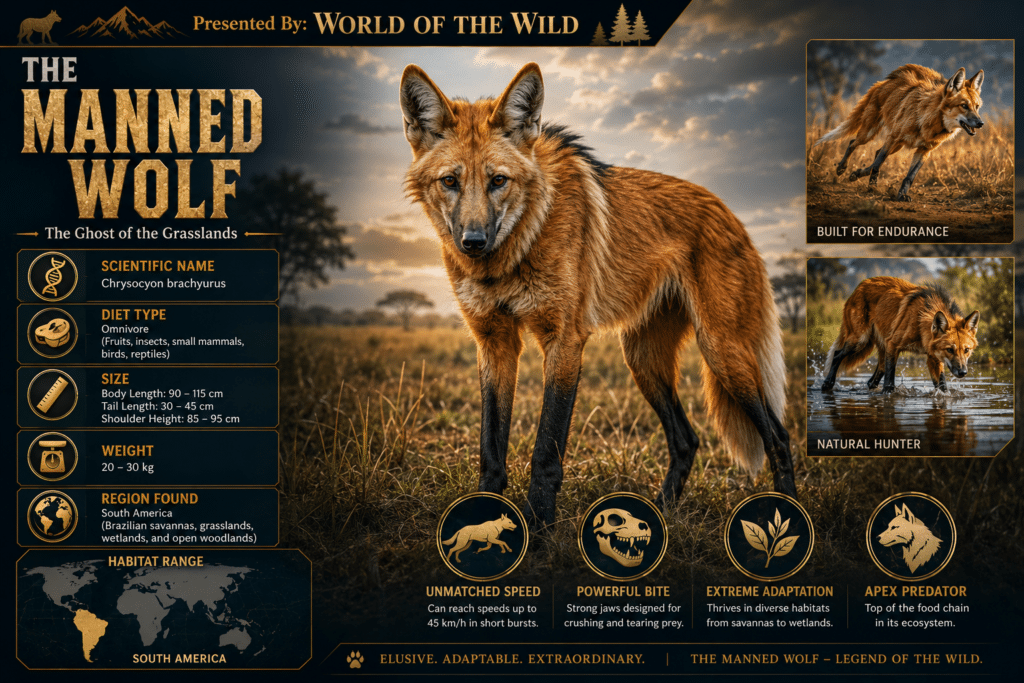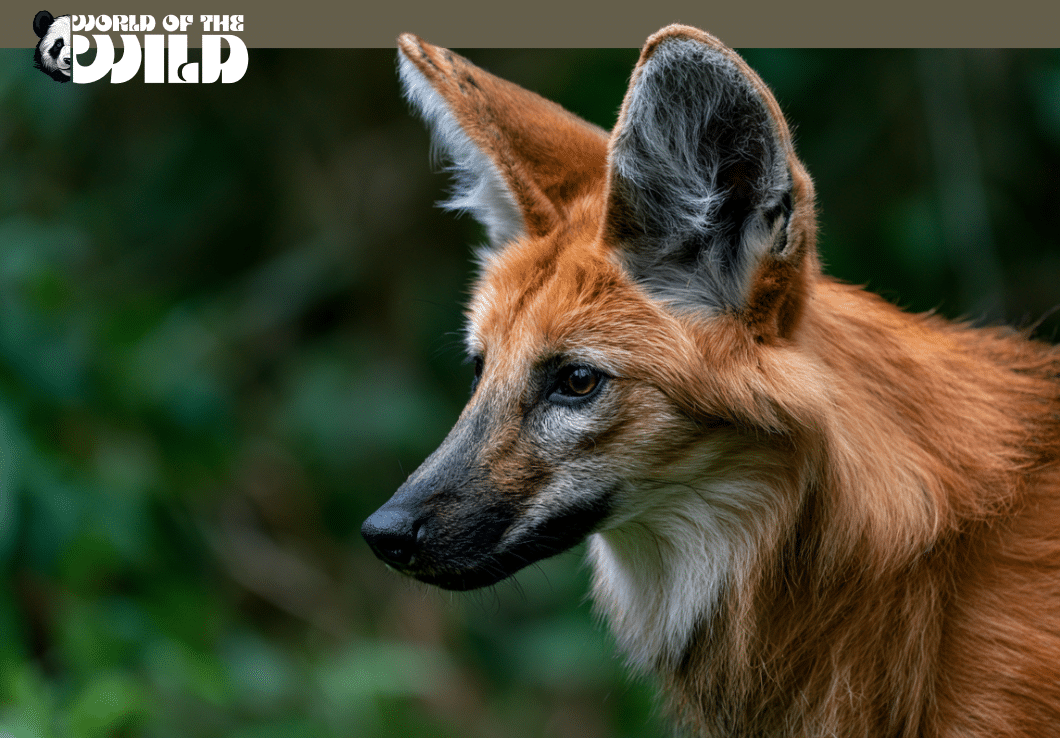

There is an animal prowling the vast savannas of South America that looks like someone took a red fox and stretched it to absurd proportions — long, stilted legs, a fiery rust-colored coat, and enormous radar-dish ears that swivel to catch the faintest rustle in the grass. It moves like a ghost at dusk, padding silently through the cerrado on legs so long they seem almost architectural. It is the Maned Wolf, and it defies nearly every expectation you bring to it.
It isn’t a wolf. It isn’t a fox. It isn’t a dog in any sense you’d recognize from your backyard. It is, in the truest sense, a biological original — the sole surviving member of its genus, a relic of an ancient South American lineage, a creature so singular that scientists have spent decades simply trying to figure out where it belongs on the tree of life. Part predator, part frugivore, part phantom of the grassland twilight, the Maned Wolf is one of the natural world’s most compelling contradictions — and one of its most urgent conservation stories.
Facts
Before we dive deep, here are some quick and surprising facts that capture just how extraordinary this animal is:
- It smells like marijuana. The Maned Wolf’s urine has a distinctly skunky, cannabis-like odor due to a compound called pyrazine. Zoo visitors have reportedly called animal control thinking someone was smoking nearby — inside the zoo.
- It’s the only species in its genus. Chrysocyon brachyurus has no close living relatives, making it an evolutionary dead-end in the most poetic sense — a lone survivor of an ancient canid radiation.
- Its long legs aren’t just for show. Those impossibly tall limbs — giving it a shoulder height of nearly 3 feet — evolved to help it see above the tall grasses of the cerrado, functioning essentially as biological periscopes.
- It eats more fruit than meat. Despite being a canid classified as an omnivore, the Maned Wolf’s diet is more than 50% plant matter, with a wild fruit called the lobeira (wolf’s fruit) making up a substantial portion of its meals.
- It has a cooperative relationship with a plant. The lobeira fruit depends heavily on the Maned Wolf for seed dispersal, and the wolf depends on the fruit for nutrition — a remarkable example of mutualism between mammal and plant.
- It doesn’t howl like a wolf. Its primary vocalization is a deep, far-carrying call described as a “roar-bark” — a sound more reminiscent of a foghorn than anything you’d expect from a dog-like creature.
- Maned Wolf pups are born black. Juveniles come into the world with dark, nearly black fur before developing the iconic rust-red coloration of the adult.
Species
The Maned Wolf occupies a fascinating and somewhat lonely place in the animal kingdom. Its full taxonomic classification is as follows:
- Kingdom: Animalia
- Phylum: Chordata
- Class: Mammalia
- Order: Carnivora
- Family: Canidae
- Genus: Chrysocyon
- Species: Chrysocyon brachyurus
The genus name Chrysocyon derives from the Greek for “golden dog,” a reference to its warm, amber-red coat. Brachyurus means “short-tailed,” which is somewhat ironic given how distinctive and long-limbed the rest of the animal is.
Unlike wolves, foxes, and dogs — which belong to various other genera within Canidae — the Maned Wolf is the sole living representative of Chrysocyon. There are no recognized subspecies. It is, taxonomically speaking, entirely alone.
Its closest living relatives within the family Canidae include the Bush Dog (Speothos venaticus), the Short-eared Dog (Atelocynus microtis), and various South American foxes of the genus Lycalopex. However, none of these are particularly close relatives — the Maned Wolf diverged from other South American canids millions of years ago and has been evolving independently ever since, which explains its highly distinctive morphology and behavior.
Appearance
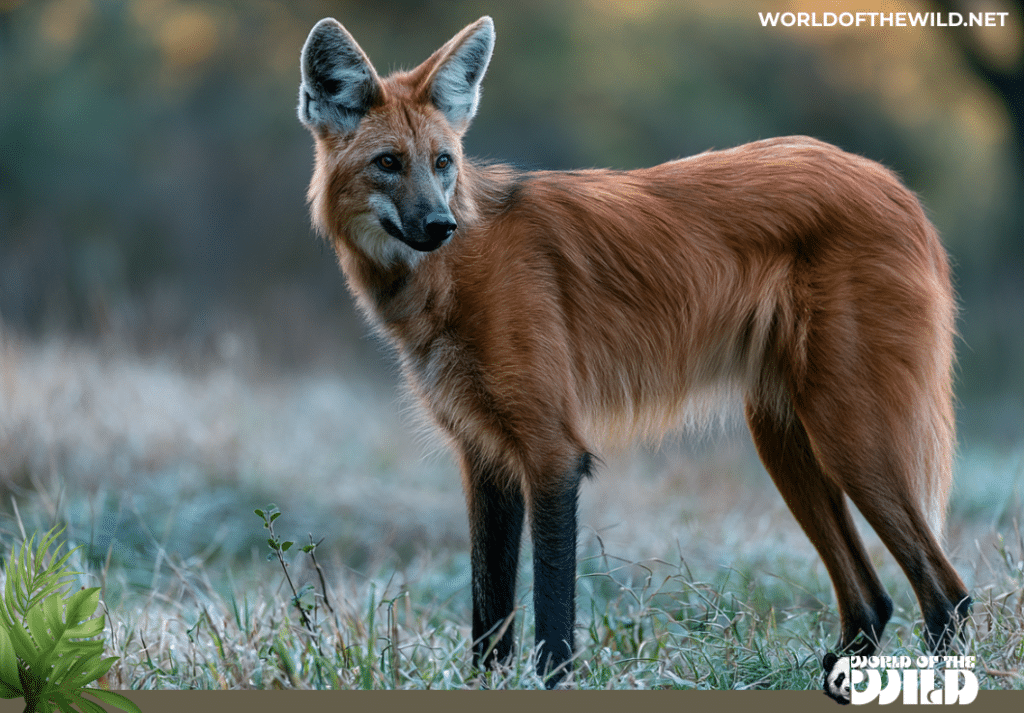
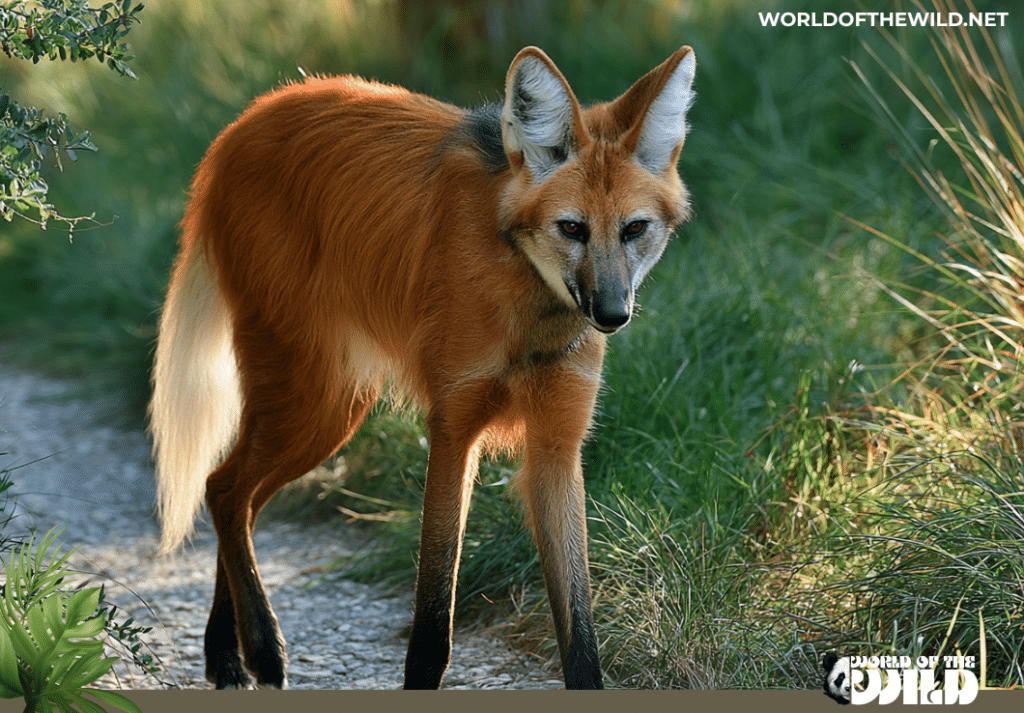
To see a Maned Wolf for the first time is to do a double-take. The overall impression is of a red fox that has been dramatically, almost comically, elongated.
Adult Maned Wolves stand approximately 35 inches (nearly 3 feet) at the shoulder, with a body length of roughly 49 to 57 inches, and a tail adding another 12 to 18 inches. They weigh between 44 and 51 pounds on average, though some individuals may tip the scales slightly higher. Despite their height, they are lean and lightly built — lithe rather than powerful, built for trotting and scanning rather than sprinting and tackling.
The coat is a vivid, almost flame-like reddish-orange on most of the body, darkening toward the legs, which are largely black. A distinctive black mane runs along the back of the neck and between the shoulders — the feature that gives the animal its name. This mane is erectile; when the animal feels threatened, it raises the mane to appear larger and more imposing. The throat and inner ears are often white or cream-colored, providing soft contrast to the vibrant body coloring.
The face is elongated and pointed, reminiscent of a fox’s, with large, upright ears that can measure up to 7 inches in length. The eyes are amber to golden in color, giving the animal a watchful, almost otherworldly gaze in low light. The legs are extraordinarily long relative to body size — a morphological adaptation that is arguably the Maned Wolf’s most visually arresting feature, making it appear to walk on stilts as it moves through tall grass.
Behavior
The Maned Wolf is fundamentally a solitary animal. Unlike true wolves, it does not form packs, does not hunt cooperatively, and largely avoids others of its kind outside of the mating season. Adult pairs may share a territory of 10 to 30 square kilometers, and while they overlap in range, they tend to move through that territory independently, occasionally marking the same locations with urine — a form of indirect, asynchronous communication.
This is a crepuscular and nocturnal creature, most active in the hours around dawn and dusk and through the night. During the day, it typically rests in dense vegetation, venturing out as the light fades. Its enormous ears are constantly in motion, rotating independently to detect the sounds of small animals moving through the grass.
Despite its carnivoran classification and wolf-like name, the Maned Wolf exhibits relatively non-aggressive hunting behavior. It stalks small prey patiently and precisely, often tapping the ground with a forepaw to flush hidden animals. This “foot-stamping” behavior is thought to disturb insects and small rodents hiding in the grass, causing them to move and betray their position.
The Maned Wolf communicates through several vocalizations. The most distinctive is the roar-bark, a deep, resonant call used to communicate with distant partners and establish territorial presence. It also uses whines, growls, and a high-pitched whine called a “choro” in interactions with other individuals. Scent marking — via that pungently distinctive urine — plays a crucial role in communication, establishing territory and reproductive status.
Notably, despite their solitary nature, monogamous pairs do engage in shared parental care, with males bringing food to nursing females and later to pups — a behavior more reminiscent of foxes than of large wolves.
Evolution
The evolutionary history of the Maned Wolf is a story written in isolation. South America was, for tens of millions of years, an island continent — separated from North America and developing its own extraordinary menagerie of unique fauna. When the Great American Biotic Interchange occurred roughly 3 million years ago, as the Isthmus of Panama formed and connected the two continents, North American canids migrated south and diversified explosively across the new landmass.
The Maned Wolf’s ancestors were part of this early South American canid radiation. The fossil record suggests that Chrysocyon-like animals appeared in South America during the Pleistocene epoch, approximately 1–2 million years ago, and that the lineage has remained largely isolated since. Some paleontological evidence points to a slightly larger ancestral form, and it has been hypothesized that the elongated limbs evolved in response to the expansion of open savanna habitats — the cerrado growing drier and more grass-dominated during climatic shifts of the Pleistocene.
The Maned Wolf has no clear close ancestor and no surviving close relatives, placing it in an unenviable evolutionary position: it is a phylogenetic relict, representing an entire branch of the canid family tree that has otherwise gone extinct. Its uniqueness is not just ecological but deeply historical — it carries millions of years of independent evolutionary history in its long-legged frame.
Habitat
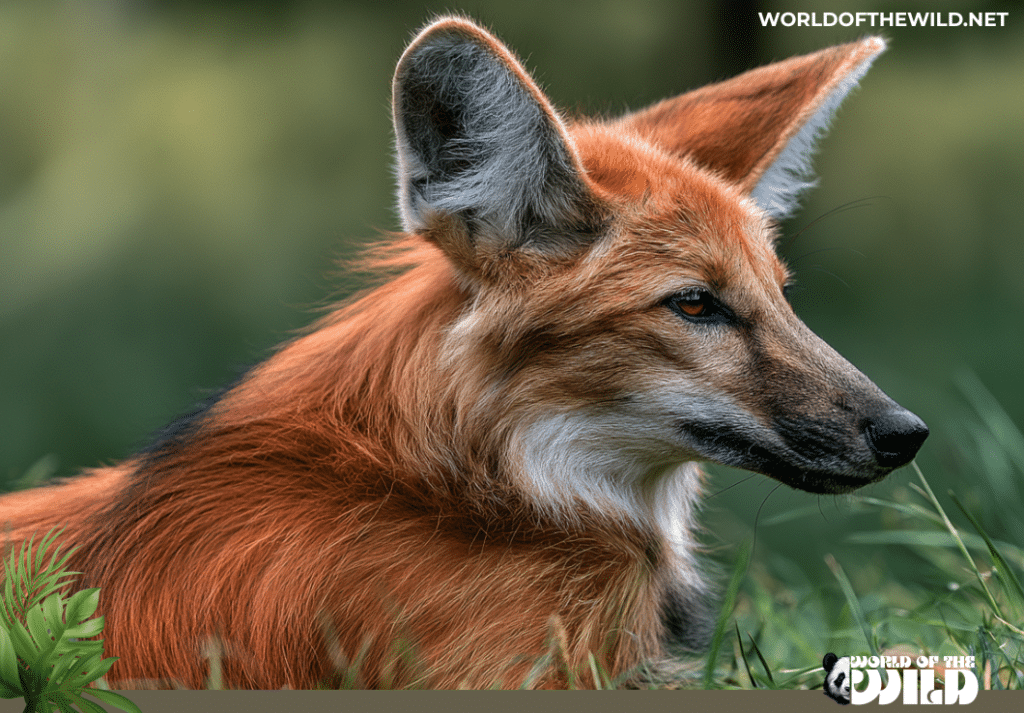
The Maned Wolf is quintessentially a creature of the South American cerrado — the vast tropical savanna and grassland biome that covers much of central Brazil, and extends into portions of Bolivia, Paraguay, Argentina, and Peru. The cerrado is one of the world’s most biodiverse savannas, characterized by its distinctive mix of twisted, fire-adapted trees, open grasslands, gallery forests along rivers, and seasonal wetlands.
Within this landscape, the Maned Wolf favors areas with tall grasses, scattered shrubs, and transitional zones between forest and open grassland — environments where it can use its height to scan for prey and retreat into cover when needed. It is also found in grassland-forest mosaics, marshland edges, and agricultural areas where native vegetation has not been entirely cleared.
Geographically, Brazil holds the largest population by far, with significant numbers in the states of Minas Gerais, Goiás, Mato Grosso, and Mato Grosso do Sul. Smaller populations persist in Bolivia’s Beni region, in the Paraguayan Chaco, in the Argentinian provinces of Formosa and Corrientes, and possibly in isolated pockets of Peru.
The cerrado itself is under extreme pressure — it has been called the world’s most threatened tropical savanna, having lost more than 50% of its original extent to agriculture, particularly soy farming and cattle ranching. This habitat destruction is the single largest threat to Maned Wolf survival.
Diet
The Maned Wolf is a true omnivore, and a remarkably plant-heavy one for an animal in the order Carnivora. Studies of its diet have consistently found that plant matter accounts for more than 50% of its food intake, with the lobeira fruit (Solanum lycocarpum) — literally translated as “wolf’s fruit” — being among the most important single food items.
The lobeira is a large, tomato-like fruit that ripens on low shrubs across the cerrado. The Maned Wolf consumes it in enormous quantities and passes the seeds intact in its feces, making it one of the plant’s most important seed dispersers. The relationship is so intimate and mutually beneficial that it qualifies as a classic mutualistic interaction — the wolf gets nutrition, the plant gets propagation.
Beyond fruit, the Maned Wolf eats a diverse array of animal prey, including rodents (particularly armadillos and marsh rats), rabbits, birds, reptiles, frogs, fish, and large insects. It is not a pursuit predator — it lacks the speed and social coordination for chasing down large prey — but rather an opportunistic stalker of small-to-medium animals.
Hunting is a solitary, stealthy affair. The wolf moves carefully through the grass, relying on its acute hearing and the foot-stamping technique to locate prey before pouncing with a swift, fox-like leap. It has been documented hunting in shallow water for fish and frogs, demonstrating surprising behavioral flexibility.
Predators and Threats
In terms of natural predators, adult Maned Wolves have relatively few serious threats in the wild. Pumas and jaguars are capable of taking them, particularly younger or weakened individuals, but encounters are uncommon given the Maned Wolf’s wariness and largely nocturnal habits. Pups are more vulnerable and may fall prey to a wider range of predators, including large birds of prey and feral domestic dogs.
The far more significant threats are human-caused:
Habitat loss is the dominant crisis. The cerrado has been relentlessly converted for agricultural use, primarily for soy cultivation and cattle grazing, destroying and fragmenting the grassland ecosystems the Maned Wolf depends upon. As habitat fragments become smaller and more isolated, local populations lose genetic diversity and connectivity.
Roadkill is a devastating and underappreciated threat. As roads cut through Maned Wolf territory, these animals — which patrol large home ranges — are frequently struck by vehicles. Roadkill is considered one of the leading direct causes of mortality for the species in Brazil.
Domestic dogs pose a dual threat: they can attack and kill Maned Wolves, and they can transmit diseases such as rabies, distemper, and parvovirus — diseases to which wild canids have little immunity and which can devastate local populations.
Persecution by farmers also contributes to mortality. Though the Maned Wolf rarely takes livestock, it is sometimes killed by ranchers who mistake it for a threat to their animals or poultry.
Reproduction and Life Cycle
Maned Wolves are seasonally monogamous, with breeding typically occurring between April and June, though this can vary by region. The pair bond is maintained over multiple seasons, with partners sharing a territory year-round but largely living independently within it.
Gestation lasts approximately 60 to 65 days, after which the female gives birth to a litter of 2 to 5 pups in a secluded den, often in dense vegetation. Newborn pups weigh roughly 12 to 14 ounces and are born with dark, nearly black fur that gradually transitions to the adult’s reddish coat over the first few months of life.
Parental care is notably biparental: the male plays an active role in raising pups, bringing food — particularly regurgitated fruit and small prey — to the nursing female and later directly to the growing pups. This level of paternal involvement is more characteristic of foxes and jackals than of the large pack-living wolves of North America and Eurasia.
Pups begin accompanying their parents on foraging trips at around 3 to 4 months of age and gradually become independent over the following several months. Sexual maturity is reached at approximately 1 year, though young wolves may not successfully breed until they have established their own territory, which can take longer.
In the wild, Maned Wolves are believed to live approximately 5 to 7 years, though captive individuals have lived into their teens — up to 15 years under optimal conditions, reflecting the reduced risks of predation, disease, and roadkill in captivity.
Population
The Maned Wolf is currently classified as Near Threatened on the IUCN Red List, one step below Vulnerable — a status that reflects genuine concern without yet reaching the threshold of formal endangerment. However, many conservationists argue that the population trends warrant closer to Vulnerable status given the accelerating pace of cerrado habitat loss.
Global population estimates are difficult to pin down precisely due to the animal’s secretive, nocturnal habits and vast range, but current estimates place the wild population at approximately 13,000 to 17,000 individuals, with some assessments suggesting the true number may be lower. The Brazilian population represents the vast majority of the global total.
Population trends are declining. As the cerrado continues to shrink — and it has been estimated to lose hundreds of thousands of acres per year to agricultural expansion — Maned Wolf populations become increasingly fragmented. Isolated subpopulations face inbreeding, reduced genetic diversity, and local extinction pressures. Roadkill mortality continues to rise as infrastructure expands across previously wild landscapes.
Conservation efforts are underway in Brazil and internationally. Protected areas like the Serra da Canastra and Emas National Parks in Brazil provide important refuges, and NGOs and zoological institutions support breeding programs, roadkill prevention initiatives, and community education campaigns. Several Brazilian zoos maintain successful captive breeding populations that contribute to genetic diversity preservation.
Conclusion
The Maned Wolf is, in every sense, irreplaceable. It has no close relatives to carry on its genetic legacy if it disappears. It has no ecological understudy to step into its role as the cerrado’s primary disperser of the lobeira fruit. It is, biologically and ecologically, utterly one-of-a-kind — a living artifact of South America’s long evolutionary isolation, a canid unlike any other that has ever existed.
And yet, it treads an increasingly narrow path between survival and loss. Roads slice through its territory. Soy fields swallow its grasslands. Disease spreads from the dogs that follow human settlement into the frontier. The cerrado — one of the planet’s most biologically rich and least appreciated biomes — burns and shrinks with each passing year.
To save the Maned Wolf is not merely to preserve a striking, long-legged, marijuana-scented canid. It is to preserve an entire evolutionary lineage, an intricate web of ecological relationships, and a piece of South America’s wild heart that, once gone, can never be recovered. That is worth fighting for — and it begins with knowing this extraordinary animal exists at all.
Quick Reference
| Scientific Name | Chrysocyon brachyurus |
| Diet Type | Omnivore (primarily fruit, small mammals, insects, and reptiles) |
| Size (Body Length) | 49–57 inches (~4.1–4.75 feet); Shoulder height ~35 inches (~2.9 feet) |
| Weight | 44–51 pounds |
| Region Found | Central South America — primarily Brazil, with populations in Bolivia, Paraguay, Argentina, and Peru |