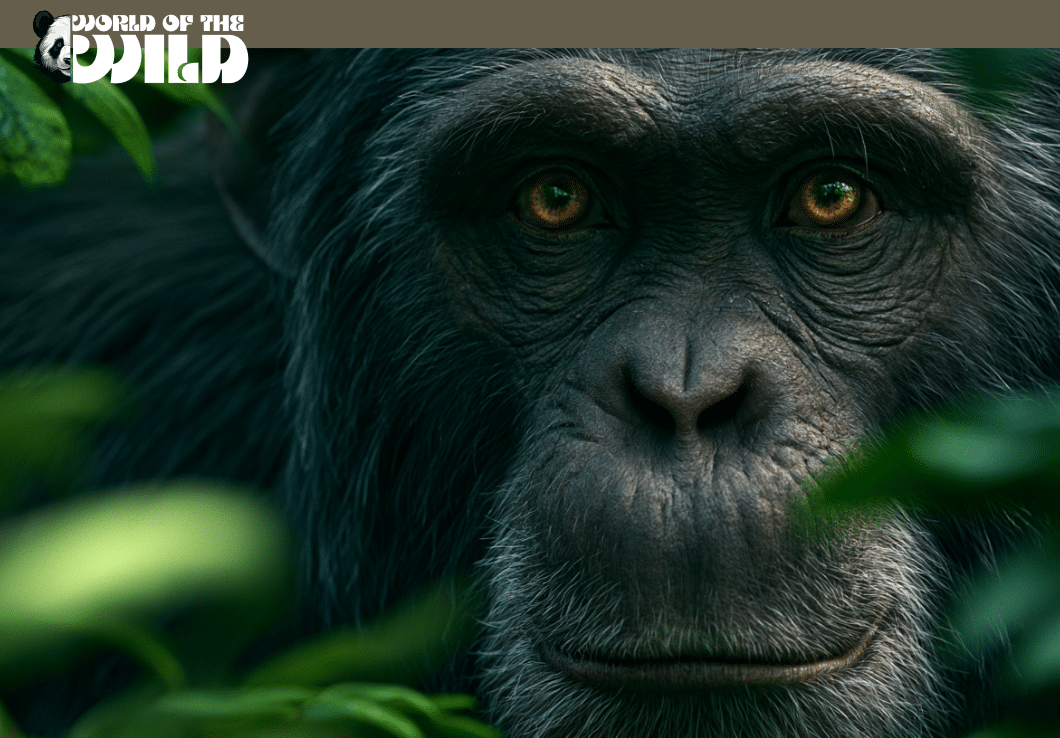

Imagine looking into a pair of eyes and seeing something unmistakably familiar staring back — curiosity, mischief, grief, and joy all flickering across a face that feels eerily close to your own. That is the experience of encountering a chimpanzee, and it is one that has captivated scientists, explorers, and nature lovers for centuries.
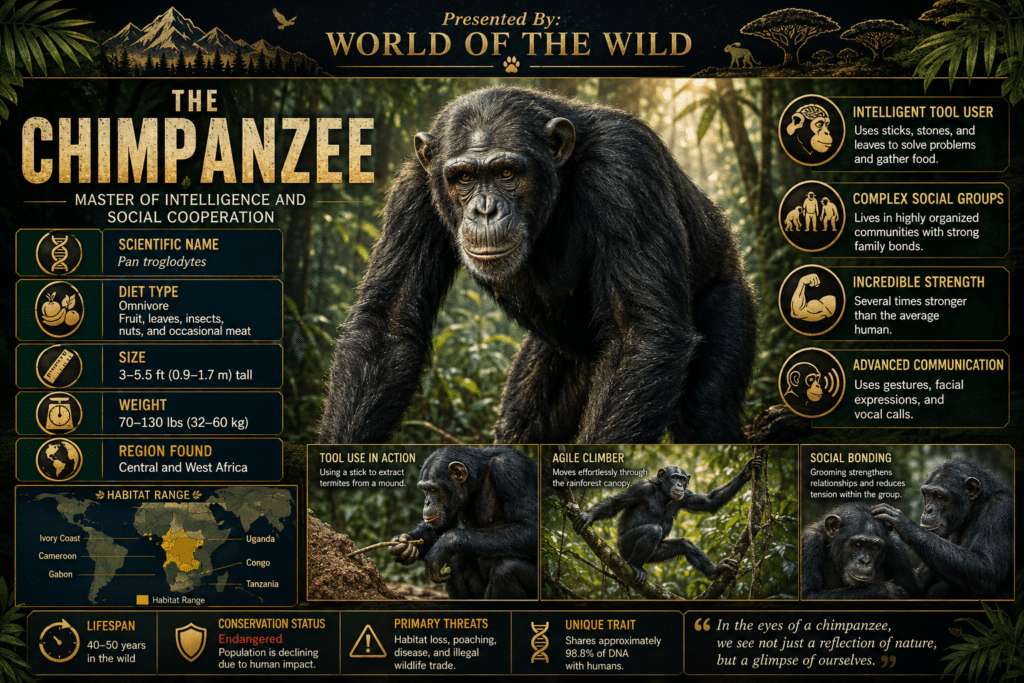
Chimpanzees are not just another remarkable animal. They are, genetically speaking, our nearest living relatives on Earth, sharing approximately 98.7% of our DNA. They use tools, wage wars, mourn their dead, teach their young, and even display rudimentary forms of culture that vary from one community to the next. In studying chimpanzees, we are, in many ways, studying ourselves — examining the raw, unfiltered blueprint from which human civilization emerged. Yet despite this profound connection, chimpanzees are in crisis, their wild populations shrinking under the relentless pressure of habitat loss, disease, and exploitation. Understanding them is not merely an academic exercise. It is an urgent moral imperative.
Facts
- Chimpanzees share approximately 98.7% of their DNA with humans, making them more closely related to us than they are to gorillas.
- They are one of the only non-human animals known to enter a trance-like state when watching a waterfall — a behavior some researchers interpret as a primitive form of awe or ritual.
- Chimpanzees have been documented crafting and using up to 20 different types of tools in the wild, including sharpened sticks used as spears to hunt bush babies.
- Each chimpanzee has a unique fingerprint and a unique facial pattern, much like human individuals.
- They can learn and use American Sign Language (ASL), and famous subjects like Washoe and Nim Chimpsky demonstrated the ability to construct simple sentences.
- Chimpanzees practice medicinal self-care — they have been observed swallowing rough leaves whole (without chewing) to expel intestinal parasites, and rubbing themselves with certain plants that have known antiparasitic properties.
- A chimpanzee’s short-term memory has been shown to outperform that of adult humans in certain numerical recall tasks, as famously demonstrated by Ayumu, a chimp at the Primate Research Institute in Kyoto, Japan.
Species
Full Taxonomic Classification:
| Rank | Classification |
|---|---|
| Kingdom | Animalia |
| Phylum | Chordata |
| Class | Mammalia |
| Order | Primates |
| Family | Hominidae |
| Genus | Pan |
| Species | Pan troglodytes |
The genus Pan contains two living species: the common chimpanzee (Pan troglodytes) and the bonobo (Pan paniscus), sometimes called the pygmy chimpanzee. While bonobos are a distinct species, they are the chimpanzee’s closest relative and share many behavioral and physical traits, though bonobos tend to be more slender, more matriarchal, and notably more peaceful in their social structure.
The common chimpanzee is further divided into four recognized subspecies:
- Central Chimpanzee (Pan troglodytes troglodytes) — Found in Cameroon, the Republic of Congo, Gabon, and the Central African Republic. This is the most numerous subspecies.
- Eastern Chimpanzee (Pan troglodytes schweinfurthii) — Ranges from Uganda and Tanzania through the Democratic Republic of Congo into Rwanda and Burundi. This is the subspecies most famously studied by Jane Goodall at Gombe Stream.
- Western Chimpanzee (Pan troglodytes verus) — Inhabits West Africa from Senegal to Ghana. This subspecies is critically endangered.
- Nigeria-Cameroon Chimpanzee (Pan troglodytes ellioti) — The rarest of all subspecies, found only in a narrow region along the Nigeria-Cameroon border.
Appearance
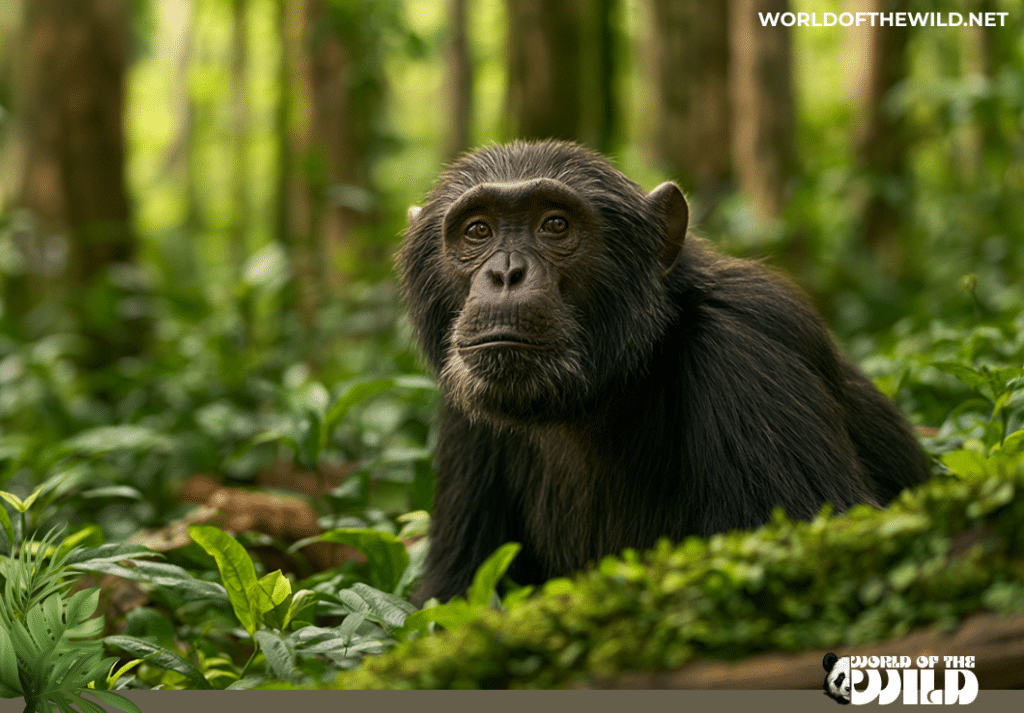
Chimpanzees are powerfully built primates with a body plan that is simultaneously familiar and alien to the human eye. Adults typically stand between 3 and 5.5 feet tall when upright, though they most commonly move on all fours in a gait called knuckle-walking, in which they support their weight on the knuckles of their hands rather than the palms.
Males are notably larger than females. Adult males weigh between 88 and 130 pounds, while females typically range from 60 to 110 pounds. Despite this size, chimpanzees are extraordinarily strong — pound for pound, they are estimated to be roughly 1.5 times stronger than an adult human male, owing to the greater proportion of fast-twitch muscle fibers in their bodies.
Their bodies are covered in coarse black hair, which can develop a grey or brown tinge on the back as the animal ages. The face, ears, palms of the hands, and soles of the feet are bare and typically pale pinkish to dark brown in color, darkening with age and sun exposure. Young chimpanzees are born with a distinctive white tail tuft, which fades as they mature — a feature that helps adults identify juveniles within the group.
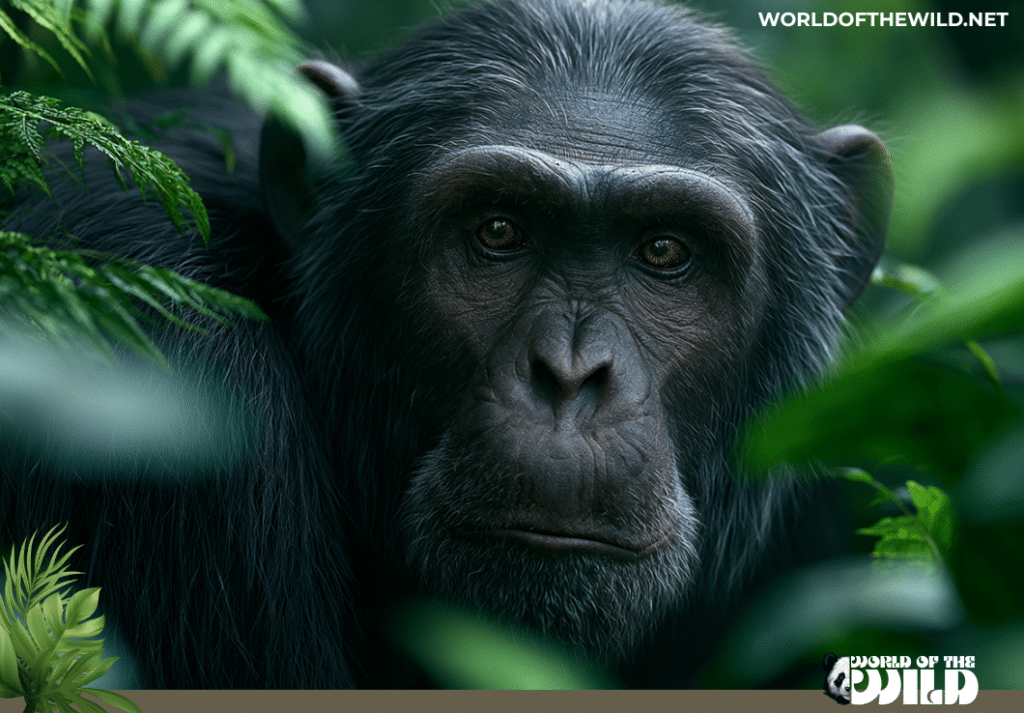
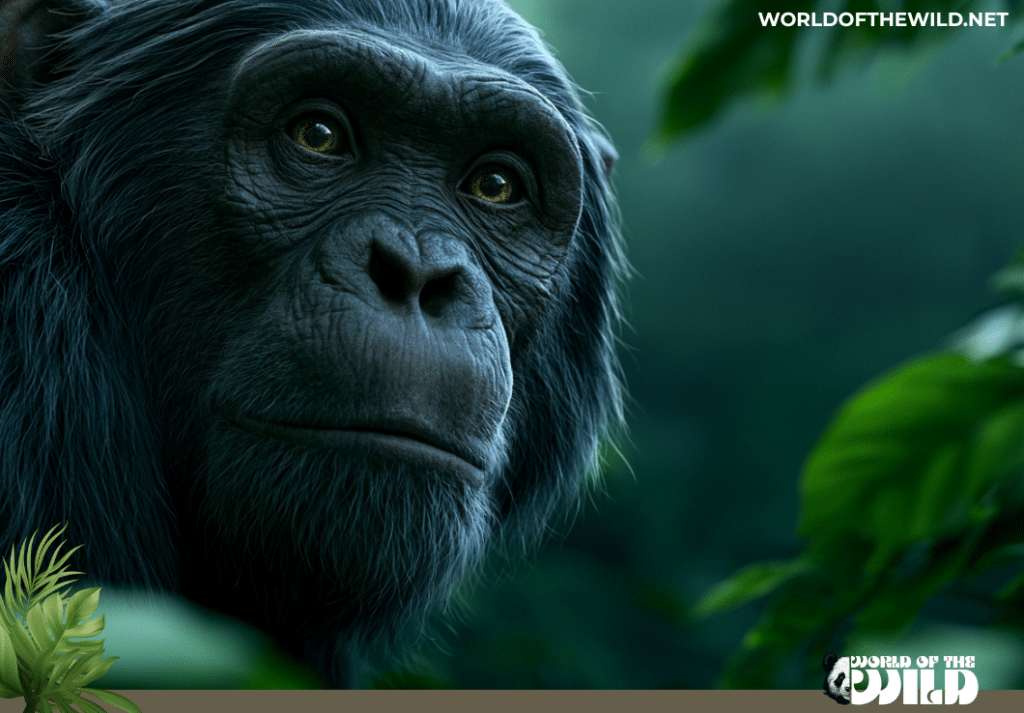
The face is among the most expressive in the animal kingdom. Chimpanzees have large, mobile lips, prominent brow ridges, and forward-facing eyes that provide excellent binocular vision. Their ears are large and somewhat rounded, and their arms are proportionally longer than their legs — a hallmark of an animal equally at home in the trees as on the ground.
Behavior
Chimpanzees are highly social animals that live in communities, or “troops,” typically ranging from 15 to 150 individuals, though they spend most of their time in smaller, fluid subgroups — a social system known as fission-fusion dynamics. These subgroups constantly split and merge based on food availability, social bonds, and circumstance.
Within each community, chimpanzees maintain a strict dominance hierarchy. The alpha male holds the top position not always through brute strength alone, but often through political maneuvering — forming alliances, trading favors, and consolidating support. Researcher Frans de Waal’s groundbreaking work at the Arnhem Zoo in the Netherlands revealed that chimpanzee politics bear a striking resemblance to human power struggles, complete with backstabbing, coalition-building, and strategic displays of power.
Communication is rich and multimodal. Chimpanzees use a wide range of vocalizations — including the iconic pant-hoot, a loud, escalating call that can carry over a mile through forest — as well as facial expressions, gestures, and touch. Researchers have catalogued dozens of distinct gestures with consistent meanings, some of which overlap with gestures used by humans.
Tool use is perhaps their most celebrated cognitive feat. Chimpanzees use rocks to crack open nuts, sticks to fish termites from mounds, leaves as sponges to soak up drinking water from hollow logs, and even sharpened branches as spears to probe into tree cavities for hiding bush babies. Crucially, these techniques are learned socially — young chimps spend years watching their mothers and elders before mastering complex skills. This means that different communities have different tool-use traditions, a hallmark of culture.
Chimpanzees also have a darker side. They engage in organized, lethal inter-group violence — raiding parties that seek out and kill members of neighboring communities. This behavior, first documented by Jane Goodall at Gombe in what became known as the “Gombe Chimpanzee War” (1974–1978), shocked the scientific world and reshaped our understanding of the origins of human warfare.
Evolution
The story of the chimpanzee is inseparable from the story of human evolution. Both humans and chimpanzees descended from a common ancestor that lived approximately 5 to 7 million years ago during the late Miocene epoch in Africa. The precise identity of this ancestor remains debated, but fossil candidates such as Sahelanthropus tchadensis and Orrorin tugenensis offer tantalizing clues about what this transitional creature may have looked like.
After the split, the lineage leading to chimpanzees and bonobos — collectively the genus Pan — evolved along a distinct path in the dense forests of equatorial Africa. The split between common chimpanzees and bonobos occurred more recently, approximately 1 to 2 million years ago, likely as a result of the Congo River forming a geographic barrier that isolated two populations.
The fossil record for chimpanzees is frustratingly sparse, largely because forest environments are poor at preserving bones. The oldest confirmed chimpanzee fossils are teeth found in Kenya’s Rift Valley, dating to approximately 545,000 years ago — a humbling reminder of how much evolutionary history remains buried and undiscovered.
What is clear from genetic and anatomical evidence is that chimpanzees represent one of the most conserved of the great ape lineages — meaning that in many ways, they have changed relatively little from the common ancestor, while the human line underwent rapid and dramatic anatomical transformations including bipedalism, brain expansion, and the reduction of body hair.
Habitat
Chimpanzees are found exclusively on the African continent, distributed across a broad equatorial belt stretching from Senegal in the west to Tanzania and Uganda in the east. Their range spans approximately 21 countries, though their distribution within this range is highly fragmented due to deforestation and human encroachment.
They are primarily forest-dwelling animals, most at home in:
- Tropical and subtropical moist broadleaf forests — their preferred habitat, where food is abundant and canopy cover provides both shelter and travel routes.
- Woodland savannas — some populations, particularly in West Africa, have adapted to life in drier, more open woodland environments with seasonal food availability.
- Montane forests — certain populations have been found at elevations exceeding 9,000 feet, demonstrating remarkable adaptability.
Chimpanzees are semi-arboreal, spending significant time both in the trees and on the ground. They sleep in nests that they construct fresh each night in the tree canopy — platforms of bent and woven branches that keep them safe from nocturnal predators. A healthy chimpanzee habitat requires large, continuous tracts of forest with abundant fruit trees, water sources, and sufficient territory for community ranges, which can span from 5 to 30 square miles depending on food availability.
Diet
Chimpanzees are omnivores with a diet of remarkable breadth and flexibility. Their nutrition is dominated by fruit — particularly ripe, sugary fruits like figs, which can constitute up to 50% of their caloric intake during peak seasons. However, they supplement this foundation with an impressive variety of other foods:
- Leaves, stems, flowers, and bark — important sources of protein and fiber, especially when fruit is scarce.
- Seeds and nuts — cracked open with stone or wooden hammers and anvils.
- Insects — including termites, ants, and larvae, which provide valuable protein and fat.
- Honey — extracted from beehives using specially crafted stick tools, often at great personal risk from stings.
- Meat — chimpanzees are active and cooperative hunters, preying primarily on red colobus monkeys, but also on other primates, small antelopes, and bush pigs. Hunts are coordinated group affairs, with individuals playing distinct roles — blockers, chasers, and captors — suggesting a level of tactical cooperation once thought unique to humans.
Meat consumption, though relatively rare (accounting for perhaps 3–5% of annual caloric intake), is socially significant. The alpha male controls the distribution of meat, using it as a form of social currency to reward allies, attract mates, and reinforce political bonds.
Predators and Threats
In the wild, chimpanzees face relatively few natural predators as adults, owing to their size, intelligence, and group living. However, they must contend with:
- Leopards — the primary natural predator of chimpanzees, capable of ambush attacks in dense forest. Adult chimps have been observed working cooperatively to mob and drive off leopards.
- Lions — in savanna woodland habitats, lions pose a threat, particularly to juveniles and isolated individuals.
- Large snakes — pythons and other large constrictors occasionally prey on young or incapacitated individuals.
- Other chimpanzees — infanticide, intergroup violence, and cannibalism, though disturbing, occur within the species.
Far more consequential, however, are the human-caused threats that have pushed chimpanzees to the brink:
- Habitat loss and fragmentation — Agricultural expansion, logging, mining, and infrastructure development have destroyed and fragmented vast swaths of African forest. This is the single greatest threat to chimpanzee survival, eliminating both living space and food sources.
- Bushmeat hunting — Chimpanzees are killed for their meat across much of their range. Juveniles are often captured alive and sold as exotic pets after their mothers are killed — a trade that removes multiple individuals from wild populations for every animal that reaches a buyer.
- Disease — Chimpanzees are highly susceptible to human respiratory diseases, including Ebola virus disease, respiratory syncytial virus (RSV), and even the common cold. As human populations push deeper into forest habitats, disease transmission becomes an ever-growing threat.
- Climate change — Shifting rainfall patterns and increasing temperatures are altering the phenology of fruit trees, disrupting the food supply that chimpanzee communities depend upon.
Reproduction and Life Cycle
Chimpanzees have one of the slowest reproductive rates of any land mammal — a biological reality that makes population recovery from decline extremely difficult.
Females reach sexual maturity at around 10 to 13 years of age and signal fertility through dramatic genital swelling — a bright pink perineal swelling that reaches its peak during the fertile window of their approximately 36-day menstrual cycle. Mating is generally promiscuous, with multiple males mating with a fertile female, though alpha males attempt to monopolize reproductive access. Occasionally, a male and female will form a “consortship,” traveling away from the group together for exclusive mating.
The gestation period is approximately 230–240 days (about 8 months), after which a single infant is born — twins are extremely rare. Newborns weigh roughly 4 pounds and are entirely dependent on their mothers. For the first few months of life, infants cling to their mother’s belly; later, they ride on her back.
Maternal investment is extraordinary. Mothers nurse their young for 4 to 5 years and maintain close bonds with their offspring for many years beyond weaning. Due to this extended dependency, females typically give birth only once every 5 to 6 years — one of the longest inter-birth intervals of any mammal.
Young chimpanzees spend years in a prolonged juvenile period, learning survival skills — tool use, social navigation, foraging strategies — through observation and play. Males typically begin to assert themselves in the dominance hierarchy in their teens, while females may emigrate to join neighboring communities at adolescence.
In the wild, chimpanzees live for approximately 40 to 50 years. In captivity, with veterinary care and reliable nutrition, individuals have been known to survive into their 50s and 60s.
Population
The common chimpanzee (Pan troglodytes) is currently listed as Endangered on the IUCN Red List of Threatened Species — a classification that reflects both the severity of the threats they face and the steep trajectory of their decline.
Global population estimates are difficult to calculate with precision given the remote and fragmented nature of their habitat, but current estimates place the total wild population at approximately 170,000 to 300,000 individuals. This represents a dramatic decline from historical numbers — at the turn of the 20th century, chimpanzee populations were estimated to exceed one million.
Population trends are negative across nearly all subspecies. The Western chimpanzee (Pan troglodytes verus) is in particularly dire straits — classified separately as Critically Endangered, with a population that may have declined by more than 80% over the past three generations. The Nigeria-Cameroon subspecies (Pan troglodytes ellioti) is also critically imperiled, with perhaps only 6,000 to 9,000 individuals remaining.
Bright spots exist — protected areas such as Gombe Stream National Park, Bwindi Impenetrable Forest, and Taï National Park serve as important refugia, and community-based conservation programs are showing promise in buffer zones around key habitats. But without significant and sustained intervention, the trajectory for wild chimpanzees remains deeply concerning.
Conclusion
The chimpanzee forces us to confront a profound and uncomfortable truth: the line between human and animal is far thinner than we have long chosen to believe. In their tool use, their politics, their grief, their joy, and their capacity for both cruelty and extraordinary kindness, chimpanzees hold up a mirror to our own species — and the reflection is unmistakable.
Yet we are failing them. In less than a century, human activity has reduced chimpanzee populations by as much as 80% in some regions, shrinking their forest homes to isolated fragments and placing entire subspecies on the knife’s edge of extinction. A world without wild chimpanzees would not merely be a biological tragedy — it would represent the severing of one of the last living threads connecting us to our own evolutionary past.
The good news is that it is not too late. Supporting organizations working in habitat protection, anti-poaching enforcement, community-based conservation, and responsible ecotourism can make a measurable difference. Being a conscious consumer — avoiding products linked to deforestation, such as certain palm oils and unsustainably sourced timber — removes economic pressure from the forests chimpanzees call home. And amplifying the voices of scientists and conservationists fighting for their survival ensures that decision-makers cannot look away.
Chimpanzees did not choose to share 98.7% of their DNA with the species now responsible for their decline. But we can choose what we do with that knowledge.
Quick Reference
| Scientific Name | Pan troglodytes |
| Diet Type | Omnivore |
| Size (Height) | 36 – 66 inches (3 – 5.5 feet) |
| Weight | 60 – 130 pounds |
| Region Found | Equatorial Africa (Senegal east to Tanzania and Uganda; 21 countries) |