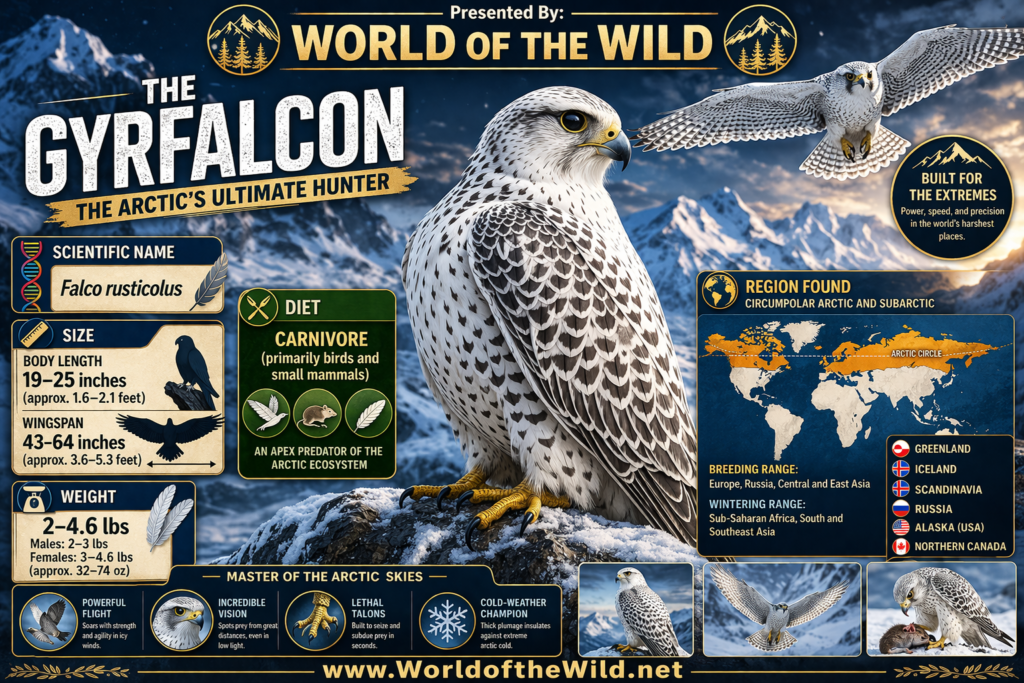

There is a moment, witnessed by only the most fortunate observers, when the Arctic sky seems to crack open and something ancient and formidable descends from the grey. The Gyrfalcon arrives not with fanfare, but with the quiet, devastating authority of a creature that has ruled the world’s most unforgiving landscapes for millennia. It is the largest falcon on Earth — a bird so commanding in its presence that medieval kings and emperors coveted it above all other hunting companions, and so perfectly engineered by evolution that it can chase down prey at speeds exceeding 150 miles per hour across the open tundra.
But the Gyrfalcon is far more than a symbol of royal prestige or a feat of aerodynamic engineering. It is a living testament to what life looks like when it is pushed to its absolute limits — thriving where most creatures would perish, raising chicks on the edge of glaciers, and navigating some of the most brutal weather conditions on the planet with breathtaking grace. To understand the Gyrfalcon is to understand something profound about resilience, power, and the strange beauty that emerges when nature has no room for compromise.
Facts
- Imperial currency of the medieval world: During the Middle Ages, Gyrfalcons were so prized that a single bird could be exchanged for an entire ship’s cargo, a ransom for a nobleman, or even used as diplomatic gifts between kings and sultans. No other falcon carried such extraordinary monetary and symbolic value.
- They don’t build their own nests: Gyrfalcons are nest thieves by habit — they almost exclusively take over old cliff ledges or nests previously constructed by ravens or rough-legged hawks, making minimal modifications before settling in.
- Their feet are nature’s shock absorbers: The Gyrfalcon’s talons are uniquely adapted to high-speed aerial strikes. The force of impact when catching prey mid-flight would cripple lesser birds, but their musculoskeletal structure is reinforced to absorb that extraordinary collision force.
- They can go weeks without eating — or gorge on 10% of their body weight in one sitting: Like many apex predators, Gyrfalcons have remarkable metabolic flexibility, capable of surviving lean periods and then consuming enormous meals when prey is plentiful.
- The color of their plumage has nothing to do with sex: Unlike many bird species where males and females display dramatically different colors, Gyrfalcon plumage morphs — white, grey, and dark — appear in both sexes, and the variation is purely regional and genetic rather than gender-based.
- They are the falconry world’s ultimate status symbol — still: To this day, trapping wild Gyrfalcons for falconry (where legally permitted) is a regulated, elite practice. Captive-bred birds fetch prices in the tens of thousands of dollars in the Gulf States, where falconry remains a deeply embedded cultural tradition.
- Their name may come from “gier,” the Old High German word for vulture — an ironic etymology for a bird that is, in every measurable way, the antithesis of a scavenger.
Species
The Gyrfalcon occupies a clear and commanding position in the tree of life:
- Kingdom: Animalia
- Phylum: Chordata
- Class: Aves
- Order: Falconiformes
- Family: Falconidae
- Genus: Falco
- Species: Falco rusticolus
Within the genus Falco, the Gyrfalcon is the undisputed giant, sitting comfortably at the top of the size hierarchy among all falcons. Historically, taxonomists debated whether distinct subspecies existed across the Gyrfalcon’s vast range — dividing birds from Greenland, Iceland, North America, and Siberia into separate groupings. Modern genetic analysis, however, has largely collapsed these distinctions, and most contemporary ornithologists treat Falco rusticolus as a single, monotypic species with significant geographic variation in plumage.
Its closest relatives within the Falco genus are the Peregrine Falcon (Falco peregrinus), the Saker Falcon (Falco cherrug), and the Lanner Falcon (Falco biarmicus) — a grouping sometimes referred to as the “large falcons.” Among these, the Saker Falcon is considered the Gyrfalcon’s nearest evolutionary cousin, sharing similar hunting strategies, prey preferences, and a partially overlapping range across Central Asia. The two species are so genetically close that hybrids — sometimes called “Saker-Gyrs” — are deliberately produced in the falconry world for their combined size and agility.
Appearance
The Gyrfalcon is a bird that stops you in your tracks. Standing between 19 and 25 inches tall with a wingspan stretching from 43 to nearly 64 inches, females are substantially larger than males — a pattern called reverse sexual dimorphism that is common across birds of prey. Females can weigh up to 4.6 pounds, while males typically come in between 2 and 3 pounds. This size difference is not merely cosmetic; it directly influences the division of labor between sexes during the breeding season.
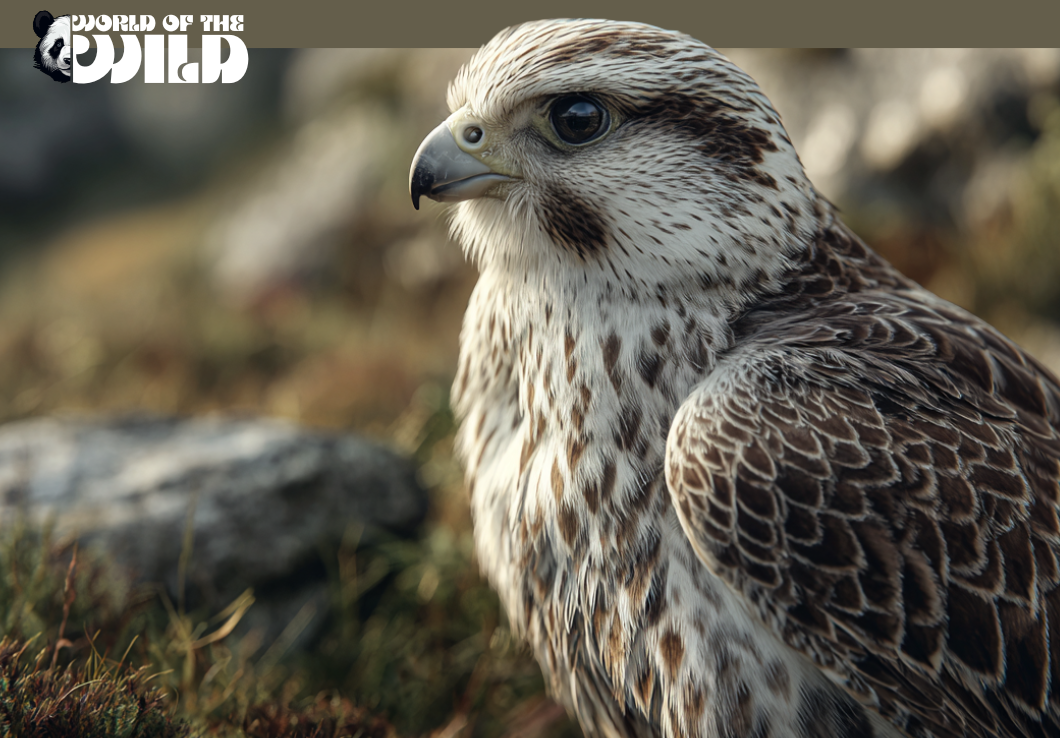
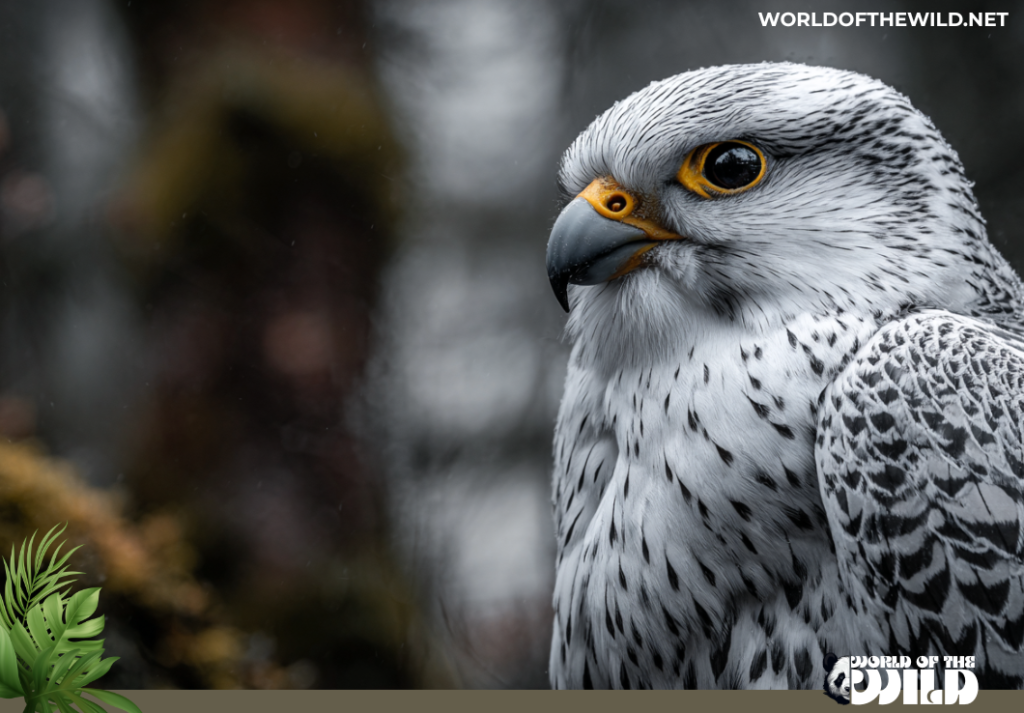
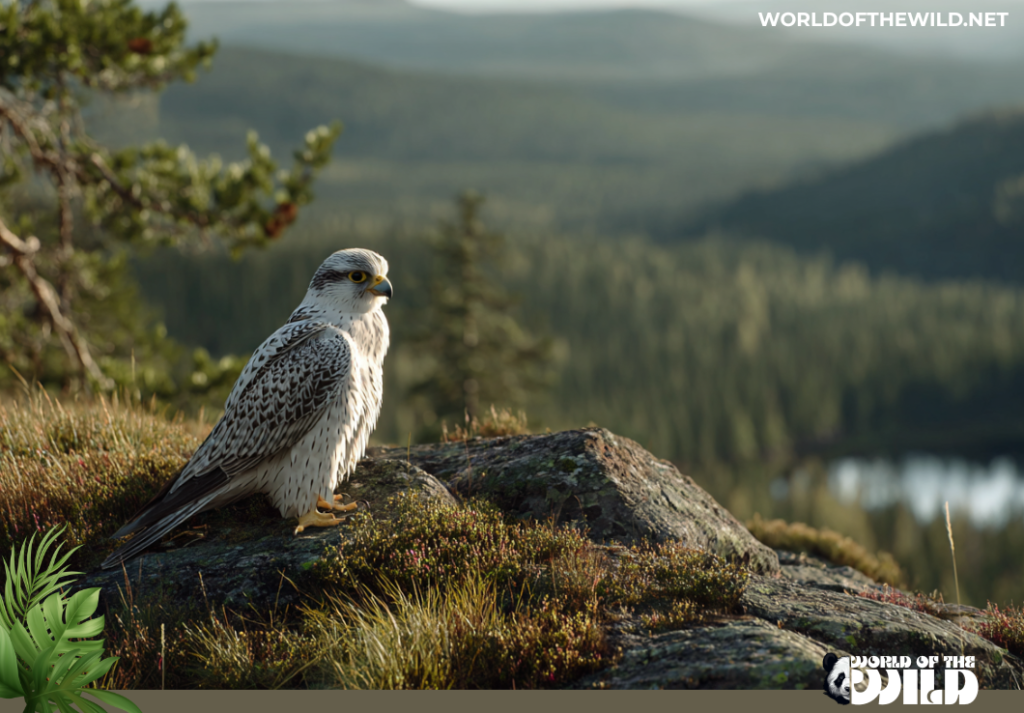
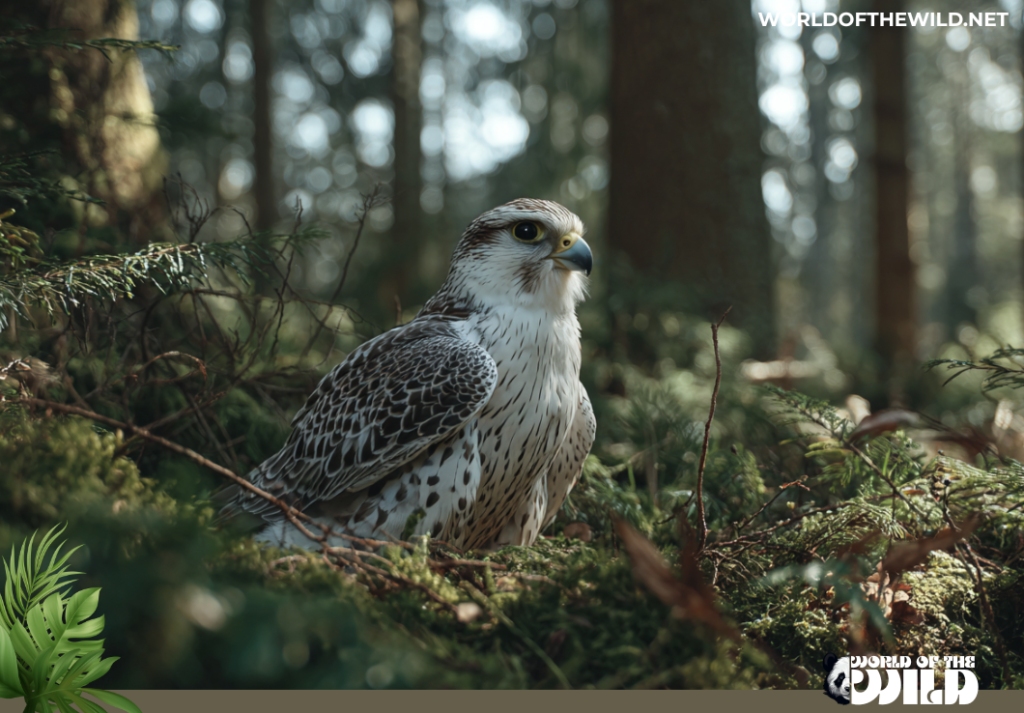
What makes the Gyrfalcon immediately visually striking is its extraordinary range of plumage color morphs. Birds exist along a spectrum from brilliant, almost pure white — the legendary white Gyrfalcons of Greenland that so captivated medieval falconers — to a deep, slate charcoal that borders on black. Between these extremes lies a rich intermediate grey morph, which is the most commonly encountered form across much of the species’ range. All morphs share characteristic facial markings: a subtle moustachial stripe (far less pronounced than a Peregrine’s bold “helmet”), large, dark, intelligent eyes ringed with yellow-orange orbital skin, and a powerful hooked beak that is steel-blue-grey and tipped in black.
The wings are broad and pointed but noticeably longer and more tapered at the base than a Peregrine’s — an adaptation for sustained, powerful flight over open tundra rather than rapid vertical stooping. The tail is longer proportionally as well, lending the bird a slightly heavier, more muscular silhouette that experienced birders instantly recognize. The feet and cere — the fleshy patch at the base of the bill — are a vivid yellow, bright against the muted tones of arctic rock and snow.
Juvenile birds display more heavily streaked underparts and a bluish-grey cere that transitions to yellow as they mature, reaching full adult plumage by their second year.
Behavior
The Gyrfalcon is, above all else, a creature of focus. It is not a social bird in any meaningful sense — adults outside the breeding season are predominantly solitary, defending personal territories and hunting ranges that can span hundreds of square miles of tundra and coastline. Communication between individuals is most concentrated during the breeding season, when a repertoire of rasping kak-kak-kak alarm calls and softer chittering vocalizations are exchanged between nesting pairs.
On the hunt, the Gyrfalcon abandons the Peregrine Falcon’s famous high-altitude stoop in favor of something arguably more impressive: a low, relentless pursuit across open ground. It launches from a perch or from soaring flight, locks onto its target — usually a ptarmigan or seabird — and then simply outruns it in level flight, using both raw speed and terrifying stamina to run down prey that attempts to escape. This “tail-chase” hunting style is a hallmark of the species and demands extraordinary aerobic capacity.
Intelligence is evident in their behavioral flexibility. Gyrfalcons have been observed learning the movement patterns of prey colonies, timing attacks to coincide with moments of maximum vulnerability. They cache excess food — storing kills under snow or in rock crevices — demonstrating planning behavior and a capacity to anticipate future needs. Some individuals develop highly specialized hunting tactics uniquely their own, suggesting a degree of individual learning that goes beyond instinct.
During winter, Gyrfalcons in northern populations may partially migrate southward following prey, while others remain year-round on their arctic territories, seemingly indifferent to conditions that would be lethal to most vertebrates. They are physiologically equipped for this: dense underlayer feathering, heavily feathered legs extending nearly to the talons, and a high metabolic rate that generates sustained body heat.
Evolution
The Gyrfalcon’s evolutionary story is deeply intertwined with the geological and climatic drama of the Pleistocene — the epoch of glaciers, shifting continents, and the repeated reshaping of the Northern Hemisphere’s habitats over the past 2.6 million years.
Falcons as a group represent one of the most recent major radiations among birds. Genetic and fossil evidence indicates that the Falco lineage diverged from other raptors relatively recently in geological terms — perhaps 8 to 10 million years ago — and that the large falcons, including the Gyrfalcon and Saker Falcon, diverged from a common ancestor within the last few million years. This means the Gyrfalcon, while ancient by human standards, is a relatively young species in the grand sweep of avian evolution.
The cycles of glaciation that repeatedly advanced and retreated across the Northern Hemisphere likely played a decisive role in shaping the Gyrfalcon’s distribution and its plumage variation. As ice sheets expanded and contracted, populations were isolated in refugia — pockets of suitable habitat surrounded by glacial barriers — and then reconnected as climates warmed. This repeated isolation and reconnection is the probable engine behind the remarkable plumage diversity we see today: white morphs predominating in the permanently ice-covered zones of Greenland, darker morphs more common in the forested tundra of Russia and Canada, with grey intermediates occupying the transitional zones.
Interestingly, molecular studies have suggested that the white plumage morph may be ancestral — representing the original arctic-adapted form — with darker morphs arising as secondary adaptations to more vegetated, ice-free environments. Whether this is true remains an active area of research, but it suggests that the Gyrfalcon’s color is not merely cosmetic but carries genuine adaptive significance tied to camouflage and thermoregulation in different microhabitats.
Habitat
To understand where the Gyrfalcon lives is to mentally transport yourself to the edge of the habitable world. This bird is a true arctic and subarctic specialist, breeding across a vast circumpolar belt that includes the high tundra and coastal cliffs of Greenland, Iceland, northern Scandinavia, Russia, Alaska, and northern Canada. No other falcon breeds as far north, and no other large raptor is as thoroughly committed to the treeless, wind-scoured landscapes of the high arctic.
The species shows a strong affinity for dramatic topography — nesting almost exclusively on cliff faces, rocky outcroppings, and gorge walls that offer commanding views of the surrounding landscape. These nest sites, often called eyries, are frequently situated near water: coastal fjords, river valleys cutting through tundra, or the shores of arctic lakes. The proximity to water is not accidental — it mirrors the distribution of the Gyrfalcon’s primary prey, which congregates around similar features.
During the non-breeding season and in years of prey scarcity, Gyrfalcons may disperse southward, occasionally appearing at lower latitudes across the northern United States, central Europe, and central Asia. These irruptive movements are typically triggered by crashes in ptarmigan populations — the cyclical boom-and-bust dynamic that governs much of arctic ecology. In some winters, Gyrfalcons turn up in unexpected locations, delighting birders far outside their usual range, before returning north as conditions improve.
The habitat they occupy is extreme by any measure: temperatures plunging below -40°F, perpetual daylight in summer and perpetual darkness in winter, gale-force winds sweeping unobstructed across treeless plains. The Gyrfalcon has not merely survived these conditions — it has made them its competitive advantage, evolving into an organism that thrives precisely where competition from other large predators is lowest.
Diet
The Gyrfalcon is an obligate carnivore and a highly specialized predator, with its diet shaped almost entirely by what is available in its arctic environment. Across most of its range, ptarmigan — both willow ptarmigan and rock ptarmigan — constitute the cornerstone of its diet, sometimes making up 80% or more of prey taken during the breeding season. This dependency is so complete that Gyrfalcon breeding success is directly and dramatically linked to ptarmigan population cycles, which fluctuate on roughly 10-year intervals. In good ptarmigan years, Gyrfalcon pairs raise large, healthy broods. In crash years, many pairs fail to breed at all.
Beyond ptarmigan, the Gyrfalcon’s menu reflects its opportunistic intelligence. Seabirds — including fulmars, auks, and kittiwakes — are hunted along coastal cliffs, where the Gyrfalcon’s powerful, sustained flight allows it to outmaneuver birds that are themselves exceptional flyers. Shorebirds, ducks, and geese are taken when available, and in lean times, the Gyrfalcon will pursue small mammals including lemmings, voles, ground squirrels, and occasionally young Arctic hares.
Hunting strategy is tailored to terrain and prey. Over open tundra, the Gyrfalcon launches a direct tail-chase, relying on its speed and stamina advantage. In more varied terrain near cliffs or water, it may use cover to approach prey before a sudden burst of acceleration. It occasionally pirates kills from other raptors, including Rough-legged Hawks and even Peregrine Falcons, demonstrating a pragmatic willingness to scavenge easy opportunities when they arise.
Predators and Threats
For an apex predator of its size and power, the Gyrfalcon has remarkably few natural enemies at any stage of its adult life. Healthy adult birds face virtually no predation risk — no terrestrial predator in the Arctic can reliably catch one, and aerial competition from other large raptors is limited. Eggs and chicks, however, are vulnerable to Arctic foxes, ravens, and other opportunistic predators that may raid nests when adult falcons are temporarily absent. Golden Eagles are perhaps the most significant avian threat to both eggs and juvenile birds.
The far more consequential threats to the Gyrfalcon are those originating with human activity, and they are accelerating.
Climate change is perhaps the most existential long-term challenge. The Arctic is warming at two to four times the global average rate, and the cascading effects on Gyrfalcon ecology are already measurable. Shrub vegetation is advancing northward onto open tundra, altering the habitat structure that ptarmigan — and by extension Gyrfalcons — depend upon. Snow and ice dynamics are shifting in ways that affect prey availability and nesting conditions. Perhaps most alarmingly, warmer temperatures have brought peregrine falcons into Gyrfalcon breeding territories in increasing numbers, introducing competitive pressure the Gyrfalcon never historically experienced.
Contaminants represent a persistent concern. As a top predator, the Gyrfalcon bioaccumulates pollutants — including organochlorines, mercury, and persistent organic pollutants — that concentrate up the food chain. Historical exposure to DDT decimated populations of many raptors globally, and while DDT is now banned in most countries, its legacy persists in the tissues of long-lived organisms and in ongoing contamination from related compounds.
Illegal trapping and smuggling for the falconry market — particularly in the Gulf States, where live Gyrfalcons command staggering prices — remains a documented threat, despite international legal protections under CITES (the Convention on International Trade in Endangered Species).
Disturbance at nest sites from low-flying aircraft, military operations, and ecotourism can cause nest abandonment during the critical early breeding period, representing a localized but real source of productivity loss.
Reproduction and Life Cycle
The Gyrfalcon’s reproductive year begins earlier than almost any other bird of prey — a calculated gambit that ensures chicks are ready to hunt when the brief Arctic summer delivers its surge of prey. In March and April, while the tundra is still locked under snow, pairs begin returning to traditional nest sites that may have been used by successive generations of Gyrfalcons for decades, even centuries. The same cliff ledge, the same rocky outcropping — loyalty to proven nest sites is remarkably strong.
Courtship involves spectacular aerial displays: high-speed chases, synchronized soaring, and the male bringing food gifts to the female — a behavior called courtship feeding that serves both as a nutritional contribution and as a demonstration of the male’s hunting prowess. Pairs typically mate for life, reinforcing their bond each season.
The female lays a clutch of 2 to 5 eggs — most commonly 3 to 4 — at intervals of approximately two days. Incubation lasts around 35 days and is shared between both parents, though the female carries the greater portion of brooding duties while the male provides most of the food. Chicks hatch asynchronously, meaning the first egg hatches before the last, creating a size hierarchy among siblings that can be consequential in lean years when food is scarce.
The chicks — covered in white down at hatching — develop rapidly under the long Arctic summer days. By 7 weeks, they begin to fledge, taking their first tentative flights from the nest ledge. But fledging is far from independence: juvenile Gyrfalcons remain dependent on their parents for food and hunting instruction for a further 5 to 6 weeks post-fledging, a period during which they hone the pursuit skills they will need for survival. Full sexual maturity is reached at approximately 2 years of age.
In the wild, Gyrfalcons typically live 12 to 15 years, though individuals in captivity have survived past 20 years. Mortality is highest among first-year birds learning to hunt independently during their first Arctic winter — an unforgiving proving ground for a species that tolerates no inefficiency.
Population
The Gyrfalcon is currently listed as a species of Least Concern on the IUCN Red List — a designation that reflects a population stable enough, and distributed widely enough, that it does not yet meet the threshold for threatened status. Global population estimates vary depending on methodology, but most reliable assessments place the total breeding population at somewhere between 20,000 and 50,000 individuals, with the global total including non-breeding birds estimated at roughly 60,000 to 100,000.
Russia holds the largest share of the breeding population, given the vast extent of suitable arctic and subarctic habitat across Siberia. Canada, Alaska, Greenland, and Iceland together account for a substantial additional portion of the global total.
“Least Concern” should not, however, be mistaken for “thriving without concern.” Population monitoring in the Arctic is logistically difficult, and confidence intervals on estimates are wide. More importantly, the directional trends associated with climate change — habitat degradation, prey base disruption, increased competition from encroaching species — are structural changes that could alter the Gyrfalcon’s status significantly within decades. Several regional populations, particularly in Scandinavia, have shown worrying declines that the global “Least Concern” designation somewhat obscures.
The combination of a relatively small global population, high dependence on a single cyclically fluctuating prey species, specialized habitat requirements, and an accelerating pace of arctic climate disruption means that the Gyrfalcon occupies a more precarious position than its current conservation status might suggest.
Conclusion
The Gyrfalcon is not simply a large, impressive bird. It is an evolutionary argument — a living proof that sufficiently driven adaptation can produce an organism capable of dominating environments so extreme they barely sustain life at all. Every physical feature, every behavioral tendency, every aspect of its reproductive timing represents a solution to a problem that the Arctic posed and the Gyrfalcon answered with breathtaking precision.
For centuries, humanity recognized the Gyrfalcon’s supremacy and celebrated it — ironically, by capturing and commodifying it. Today, the threats it faces are less romantic and more systemic: a planet warming faster in the Arctic than anywhere else, a prey base disrupted by cascading ecological change, and a habitat slowly being reshaped by forces set in motion half a world away.
The Gyrfalcon does not need our admiration — it has survived without it for millions of years. What it needs, and what we have the rare and urgent capacity to provide, is a stable climate, a protected landscape, and the restraint to let the sovereign of the arctic sky continue to reign over a kingdom worth ruling.
Quick Reference
| Scientific Name | Falco rusticolus |
| Diet Type | Carnivore (primarily birds and small mammals) |
| Size | 19–25 inches (approximately 1.6–2.1 feet); wingspan 43–64 inches (approximately 3.6–5.3 feet) |
| Weight | 2–4.6 lbs (males: 2–3 lbs; females: 3–4.6 lbs) |
| Region Found | Circumpolar Arctic and Subarctic — Greenland, Iceland, Scandinavia, Russia, Alaska, northern Canada |