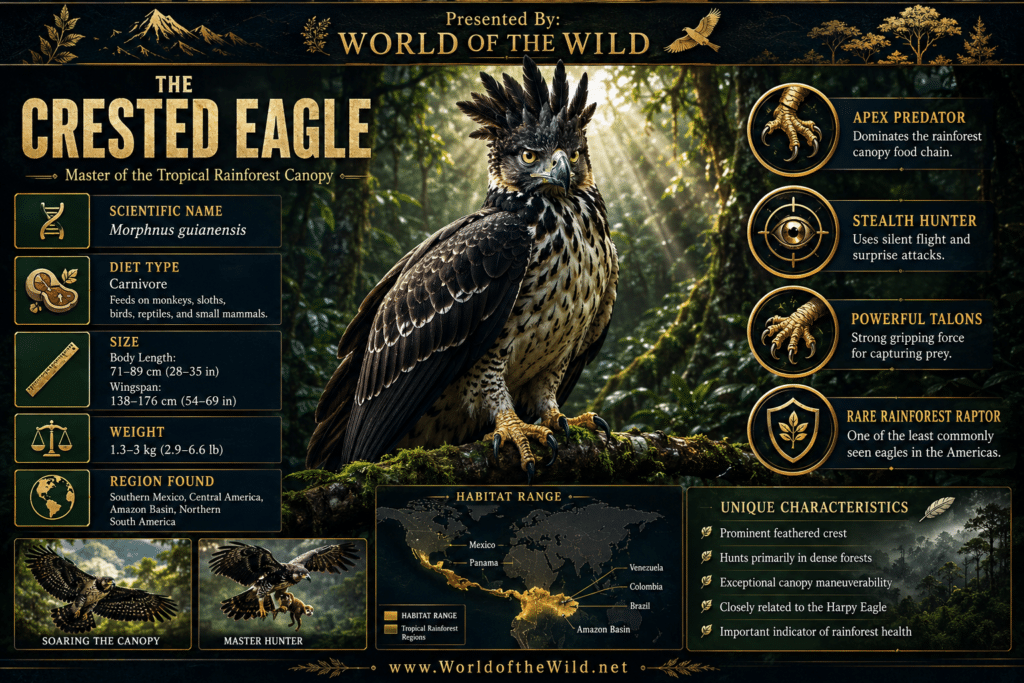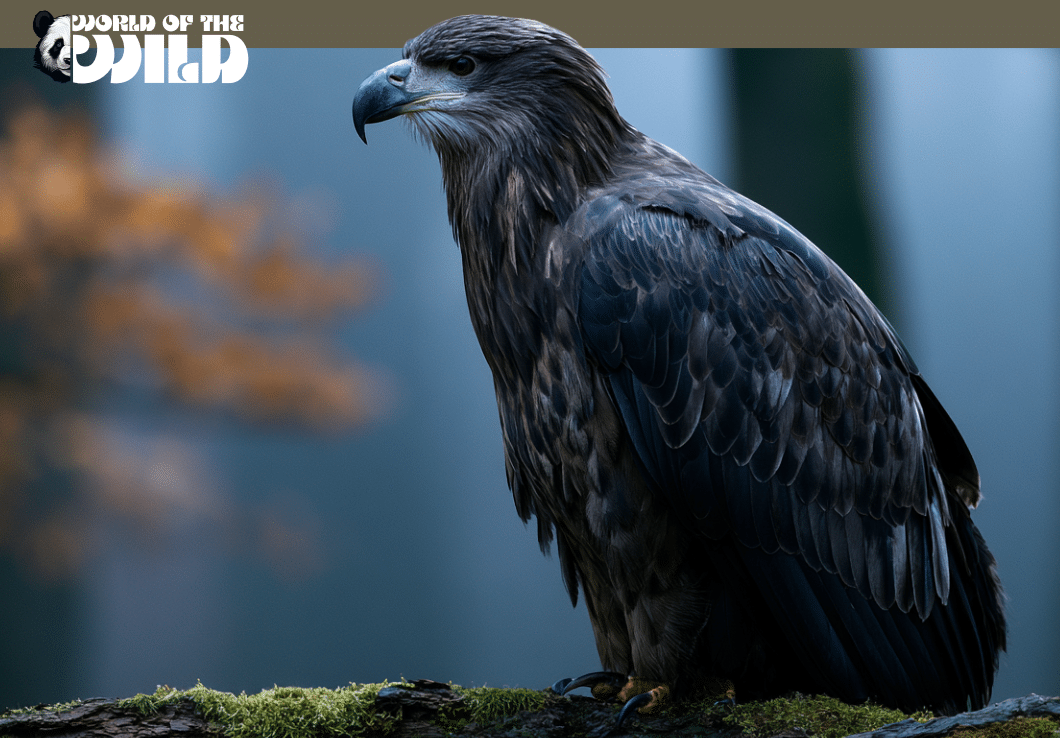

Deep within the dense, emerald labyrinth of Central and South American rainforests, a phantom moves through the upper canopy with breathtaking precision. The Crested Eagle (Morphnus guianensis) is one of the most enigmatic and visually arresting raptors on Earth — a bird so rarely encountered that many wildlife biologists spend entire careers in the tropics without ever laying eyes on one. Larger than most eagles yet sleeker than its famous cousin the Harpy Eagle, the Crested Eagle occupies a regal niche at the top of its ecosystem, embodying both the raw power and the fragile vulnerability of the Neotropical wilderness. To learn about this bird is to peer into the soul of one of the planet’s last great wild frontiers.
Facts
- The Crested Eagle is one of the largest raptors in the Western Hemisphere, yet it remains so elusive that scientists have been able to study only a handful of nests in the wild.
- Unlike most large eagles, the Crested Eagle has a single, long, upright crest feather — a dramatic plume that rises like a black flame from its crown and gives it an almost mythological appearance.
- Its enormous yellow eyes provide exceptional binocular vision, allowing it to track fast-moving prey through the dense tangle of rainforest vegetation.
- The Crested Eagle is sometimes called a “cryptic apex predator” because despite being at the top of its food chain, it is extraordinarily difficult to detect, using silence and stillness rather than conspicuous displays to hunt.
- This eagle has proportionally shorter wings relative to its body size compared to open-country raptors — an evolutionary adaptation that allows it to maneuver through dense jungle without clipping the vegetation.
- A single breeding pair of Crested Eagles may require a territory of over 100 square kilometers, making them highly sensitive to habitat fragmentation.
- Indigenous communities across Amazonia have long incorporated the Crested Eagle into folklore and spiritual traditions, viewing it as a symbol of power, vision, and the untamed spirit of the forest.
Species
The Crested Eagle belongs to the following taxonomic hierarchy:
| Rank | Classification |
|---|---|
| Kingdom | Animalia |
| Phylum | Chordata |
| Class | Aves |
| Order | Accipitriformes |
| Family | Accipitridae |
| Genus | Morphnus |
| Species | Morphnus guianensis |
The genus Morphnus is monotypic, meaning the Crested Eagle is the sole species within it — a distinction that underscores just how evolutionarily unique this bird truly is. Historically, ornithologists debated whether distinct subspecies existed, and two forms were once proposed: a pale morph and a dark morph. However, current scientific consensus treats these as color morphs of a single species rather than true subspecies.
The Crested Eagle’s closest living relative is the legendary Harpy Eagle (Harpia harpyja), and together they belong to a tribe of large, forest-dwelling “buteonine” eagles that evolved to dominate tropical canopy ecosystems. A third close relative, the Philippine Eagle (Pithecophaga jefferyi), represents a fascinating case of convergent evolution on the other side of the globe — an enormous forest eagle that evolved independently but occupies a strikingly similar ecological niche in the Philippine archipelago.
Appearance
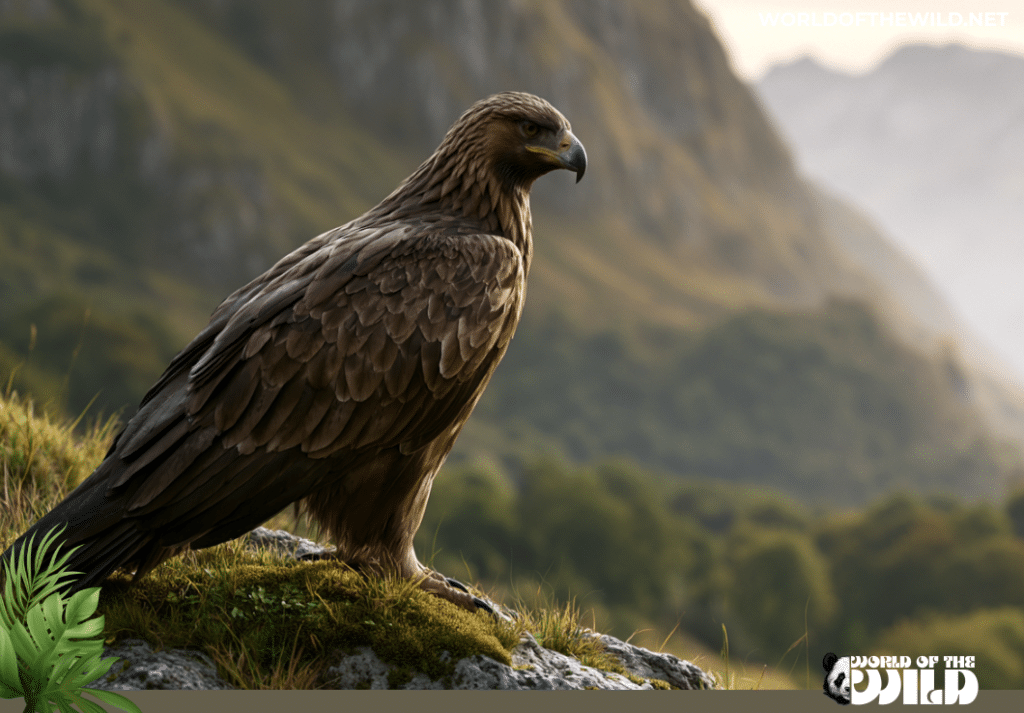
The Crested Eagle is a bird that commands immediate attention. Adults typically measure between 28 and 36 inches (roughly 2.3 to 3 feet) in total body length, with females — as is typical in raptors — noticeably larger than males, a phenomenon known as reverse sexual dimorphism. The wingspan stretches an impressive 43 to 59 inches, and body weight ranges from approximately 2 to 3.5 pounds, though large females may exceed this.
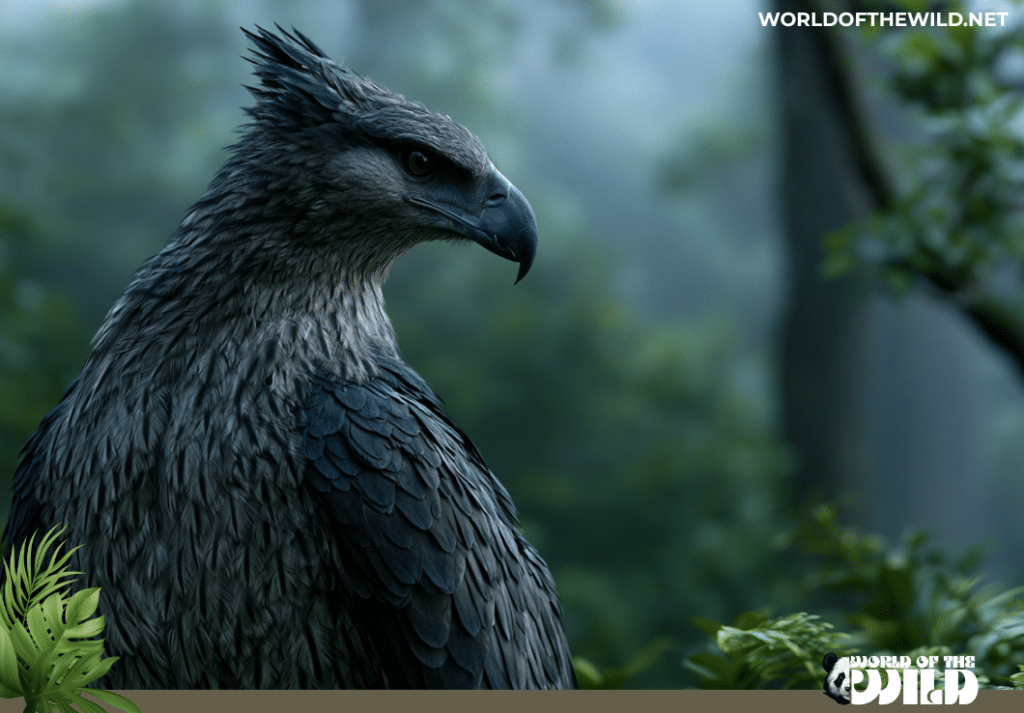
The bird’s most iconic feature is its singular, elongated black crest, which can be raised into a striking upright plume when the eagle is alert or agitated. The head is pale gray or whitish, adorned with a fine dark mask around the face. The upperparts — the back, wings, and tail — are a rich dark brown to black, while the underparts are a clean creamy white, delicately barred with fine brown streaking across the chest and flanks.
The facial disc is broad and slightly rounded, not unlike that of an owl, which helps funnel sound toward the ears — a useful adaptation in the acoustically complex rainforest. The beak is powerful and deeply hooked, designed to tear flesh efficiently. The talons are massive, yellow at the base and darkening to jet black at the tips, capable of exerting extraordinary grip pressure. The dark morph individuals, though rarer, display considerably deeper brown-black coloration across the underparts, making them appear even more dramatic in appearance.
Juveniles are strikingly different — predominantly white below with a white head and a softer, less defined crest — and take several years to acquire full adult plumage.
Behavior
The Crested Eagle is a consummate loner. Outside of the breeding season, individuals are almost entirely solitary, patrolling vast home ranges through the forest interior with quiet, methodical efficiency. Communication between individuals is relatively limited but not absent — the bird produces a series of haunting, high-pitched whistling calls, often described as melancholy or eerie by those lucky enough to hear them in the field. These vocalizations are thought to serve territorial functions and facilitate pair bonding during the breeding season.
As a hunter, the Crested Eagle is a perch-and-pounce predator of extraordinary patience. It will sit motionless on a branch deep within the forest understory or mid-canopy for extended periods, scanning the ground below with its piercing yellow eyes. When prey is detected, it launches itself in a swift, decisive power dive — using those short, broad wings to accelerate through tight vegetation with remarkable agility. It relies far more on stealth and surprise than on aerial pursuit.
Intelligence in raptors is difficult to quantify, but behavioral ecologists who have observed Crested Eagles note their apparent ability to “read” the forest — positioning themselves near animal trails, fruiting trees (where prey species congregate), or water sources to maximize hunting success. This suggests a level of cognitive spatial mapping that goes well beyond simple instinct.
Evolution
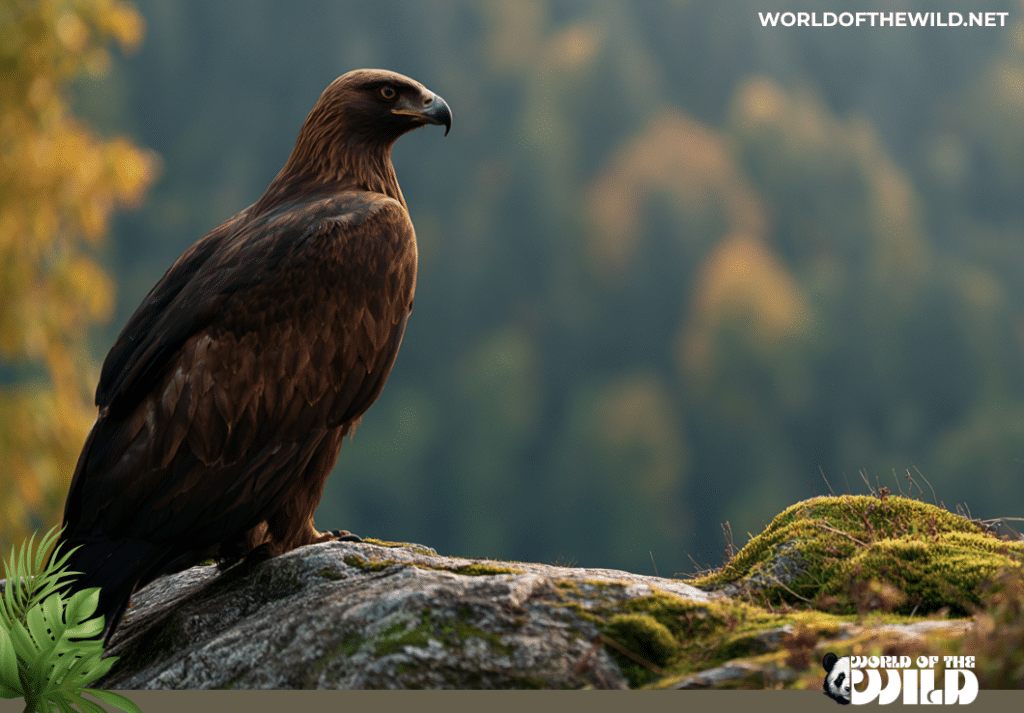
The family Accipitridae — which includes hawks, eagles, kites, and Old World vultures — emerged during the Eocene epoch, roughly 50 million years ago, and diversified explosively as forests spread across the post-dinosaur world. The large, forest-adapted eagles like Morphnus represent some of the most derived members of this lineage, having evolved specialized morphologies for navigating complex, three-dimensional forest environments.
Molecular phylogenetic studies place the Crested Eagle within a clade of “giant forest eagles” alongside the Harpy Eagle and the Philippine Eagle. This group likely shared a common ancestor sometime during the late Oligocene or early Miocene, between 25 and 15 million years ago, when the Neotropical forests of South America were already vast and well-established. As South America remained isolated as an island continent during much of this period, its avian predator guild evolved along its own unique trajectory, producing the spectacular diversity of raptors that characterizes the region today.
No direct fossil record of Morphnus is currently known, which is not uncommon for tropical forest birds whose bones decompose rapidly in warm, humid soils. However, the broader fossil record of Accipitridae from South America — including extinct giant teratorns and other formidable aerial predators — paints a picture of a continent that has long been defined by avian power at the apex of its food webs.
Habitat
The Crested Eagle is a bird of primary tropical rainforest — the old-growth, undisturbed jungle that has never been logged or significantly degraded. Its range stretches from southern Guatemala and Belize in the north, through the entire length of Central America, and across the vast Amazon Basin of South America, including parts of Colombia, Venezuela, the Guianas, Brazil, Ecuador, Peru, Bolivia, and Paraguay.
Within this broad range, the Crested Eagle shows a strong preference for lowland and foothill forests, typically below elevations of 1,000 meters (about 3,300 feet), though occasional sightings have been recorded at higher altitudes. It favors the interior of large, continuous forest blocks, avoiding forest edges, secondary growth, and fragmented patches. This habitat specificity is one of the reasons the species is so rarely encountered — it simply does not venture into the disturbed, accessible areas where most wildlife observations are made.
The rainforest habitat it depends upon is characterized by towering emergent trees, a closed multi-layered canopy, high humidity, and extraordinary biodiversity at every trophic level. These forests are not just the eagle’s home — they are its entire universe, providing nesting sites, perch trees, and a rich prey base of mammals, reptiles, and birds.
Diet
The Crested Eagle is an apex carnivore with a dietary profile that reflects the astonishing biodiversity of its rainforest home. Its primary prey consists of medium-sized vertebrates, including tree-dwelling mammals such as opossums, small monkeys, and arboreal rodents. It also takes a significant number of reptiles — large lizards and snakes, including sizeable constrictors — demonstrating a fearlessness and physical capability that few predators can match.
Birds are also taken opportunistically, particularly larger species encountered at the mid-canopy or forest floor. Frogs and other amphibians likely round out the diet when larger prey is scarce.
Hunting, as described above, is primarily a sit-and-wait strategy. The eagle drops from its perch onto unsuspecting prey below with explosive speed, driving its talons into the animal with lethal force. The sheer grip strength of those talons — capable of penetrating thick hide and crushing bone — ensures that most prey has little chance of escape once contact is made. Prey is typically consumed on a convenient branch near the capture site, with the eagle methodically tearing it apart using its powerful hooked beak.
Predators and Threats
As an apex predator, the adult Crested Eagle has virtually no natural predators. Juveniles and eggs, however, may occasionally fall prey to large arboreal mammals such as tayras or certain snake species capable of raiding nests. Competition with the more powerful Harpy Eagle in areas where their ranges overlap may also limit access to optimal territories.
By far the greatest threats facing the Crested Eagle are human-caused:
Deforestation is the most acute and devastating threat. The Neotropical forests this eagle depends upon are being cleared at alarming rates for cattle ranching, soy agriculture, palm oil production, and logging. Because the Crested Eagle requires large, intact forest tracts and does not tolerate edge habitat, even selective logging can render a territory uninhabitable.
Habitat fragmentation compounds the problem. Even when forests are not entirely cleared, roads, settlements, and agricultural land divide them into patches too small to support a breeding pair’s enormous territorial requirements.
Hunting and persecution also pose significant threats. The eagle is occasionally shot by subsistence hunters, either directly for food or out of misguided fear, and by farmers who incorrectly believe it poses a threat to poultry.
Climate change is an emerging and deeply concerning threat, as shifting rainfall patterns and increasing temperatures alter the structure and species composition of Neotropical forests in ways that are difficult to predict but unlikely to benefit a highly specialized apex predator.
Reproduction and Life Cycle
The Crested Eagle breeds slowly and invests enormously in each reproductive attempt — a strategy known as K-selection that is typical of large, long-lived animals at the top of their food chains.
Breeding pairs are thought to be monogamous and maintain long-term pair bonds, reuniting at their established territory each breeding season. Courtship involves spectacular aerial displays above the canopy — soaring, diving, and calling in unison — before the pair settles to the serious business of nest construction or refurbishment. Nests, known as eyries, are massive stick platforms built high in the canopy of emergent trees, sometimes exceeding a meter in diameter and growing larger with each successive year of use.
The female lays a single egg, which is incubated for approximately 40 to 45 days. Both parents share incubation duties, though the female takes the larger share. Once the eaglet hatches, it is brooded intensively for the first several weeks and remains entirely dependent on its parents for food and protection.
The juvenile period is remarkably long. The eaglet typically fledges at around 3 to 4 months of age but continues to receive parental care and supplemental feeding for many months afterward as it develops the hunting skills needed for independence. Because of this extended investment, a successful breeding pair likely raises only one chick every 2 to 3 years, meaning that population recovery from any decline is an extraordinarily slow process.
The Crested Eagle is believed to be capable of living for 25 to 30 years in the wild, consistent with other large eagles of similar size and ecological position.
Population
The Crested Eagle is currently classified as Least Concern on the IUCN Red List, though this designation is widely considered to understate the genuine pressures the species faces. The “Least Concern” status largely reflects the bird’s still-considerable geographic range across Central and South America rather than evidence of a healthy or stable population.
In reality, the total global population is estimated to be quite small — likely somewhere in the range of 1,000 to 10,000 individuals, though the data underpinning this estimate are poor due to the species’ extreme elusiveness. Population trends are believed to be declining across virtually the entire range, driven primarily by the ongoing loss and degradation of old-growth rainforest.
Several regional assessments have placed the Crested Eagle at higher risk categories within specific countries — for example, it is considered endangered in much of Central America, where deforestation rates are particularly severe and forest cover has been reduced to a fraction of its historical extent. The Brazilian Amazon, which holds the largest remaining tracts of suitable habitat, remains the eagle’s last great stronghold, but even there, deforestation pressures are intensifying year by year.
Conclusion
The Crested Eagle is more than a magnificent bird — it is a barometer of rainforest health, a living signal of whether the Neotropical wilderness is truly intact. Where Crested Eagles persist, the forest is vast, ancient, and whole. Where they disappear, something irreplaceable has been lost — not just a species, but an entire ecological relationship that took millions of years to forge.
This is a bird that most of us will never see in the wild, and yet its existence matters profoundly. Protecting the Crested Eagle means protecting the old-growth rainforests of Central and South America — some of the most biodiverse ecosystems on the planet — which in turn means protecting the climate systems, water cycles, and countless other species that depend upon them.
The next time a headline reports on Amazon deforestation or the expansion of cattle ranches into remote jungle, think of the Crested Eagle — silent, watchful, and utterly dependent on a world that humans are dismantling at breathtaking speed. Supporting organizations that protect Neotropical forests, advocating for sustainable land use policies, and choosing products certified as deforestation-free are all tangible ways to ensure that this sovereign of the rainforest canopy continues to reign for generations to come.
Quick Reference
| Scientific Name | Morphnus guianensis |
| Diet Type | Carnivore (apex predator) |
| Size | 28–36 inches (approx. 2.3–3 feet) in body length; wingspan 43–59 inches |
| Weight | Approximately 2–3.5 pounds |
| Region Found | Southern Guatemala and Belize south through Central America; Amazon Basin of South America (Colombia, Venezuela, the Guianas, Brazil, Ecuador, Peru, Bolivia, Paraguay) |