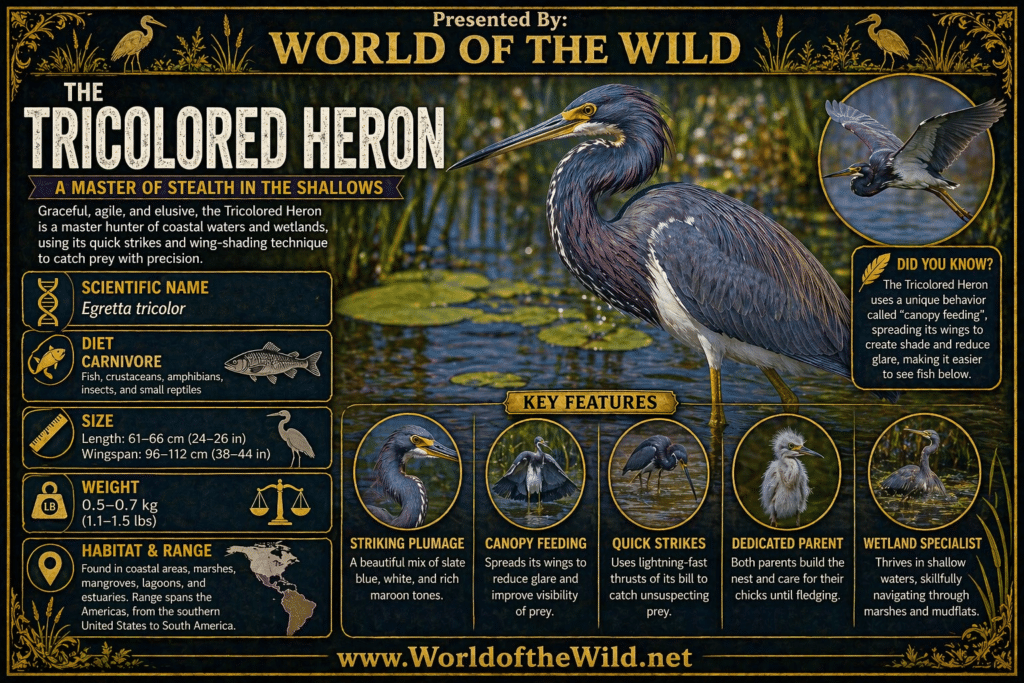

Along the marshy edges of coastal wetlands, where mangrove roots tangle with brackish water and the air hums with the sound of wading birds, one species commands attention not just for its elegance, but for its sheer audacity. The Tricolored Heron — a slender, vividly marked wading bird of the Americas — is a master of the hunt, a marvel of evolutionary refinement, and one of the most visually arresting creatures you’re likely to encounter in North American wetlands. Unlike the stoic, statuesque Great Blue Heron that most people picture when they think of herons, the Tricolored is a bird of movement, energy, and theatrical flair. It sprints, spins, dashes, and lunges through the shallows with a kind of frantic grace that makes watching it feel like witnessing a living performance. Whether you’re a seasoned birder or someone who simply stumbled upon one along a Florida causeway, the Tricolored Heron has a way of making you stop, stare, and marvel.
Facts
- The Tricolored Heron is one of the few heron species known for its active, running hunting style — it frequently chases prey through shallow water at speed rather than standing still and waiting.
- During breeding season, the normally yellow loral skin (the area between the eye and bill) turns a vivid cobalt blue, one of the most dramatic breeding-season color changes of any North American wading bird.
- It was formerly known as the Louisiana Heron, a name that persisted in field guides well into the 20th century before being officially changed to reflect its three-toned plumage.
- The Tricolored Heron sometimes uses its own wings as a canopy, spreading them over the water to create shade that reduces glare and lures fish into the shadow — a behavior called “canopy feeding.”
- Unlike many herons that nest in single-species colonies, the Tricolored Heron is a highly social nester and is commonly found in mixed-species rookeries alongside Snowy Egrets, Great Egrets, and Little Blue Herons.
- Its long, dagger-like bill can strike with such precision and speed that it can spear or grab multiple small fish in a single hunting session without repositioning.
- The species has been documented traveling up to 150 miles inland during post-breeding dispersal, appearing in locations far from typical coastal habitat.
Species
The Tricolored Heron belongs to the following taxonomic classification:
- Kingdom: Animalia
- Phylum: Chordata
- Class: Aves
- Order: Pelecaniformes
- Family: Ardeidae
- Genus: Egretta
- Species: Egretta tricolor
The genus Egretta is a diverse group that includes many of the world’s smaller to medium-sized herons and egrets, and the Tricolored Heron sits comfortably within this lineage alongside familiar species like the Snowy Egret (Egretta thula) and the Little Blue Heron (Egretta caerulea) — both of which share overlapping ranges and nesting colonies with the Tricolored.
Two subspecies are generally recognized. The nominate subspecies, Egretta tricolor tricolor, is the widespread form found across most of North America, Central America, and the Caribbean. The second subspecies, Egretta tricolor ruficollis, is found in parts of South America — particularly in Colombia, Venezuela, and the broader northern coast of the continent — and differs subtly in size and the intensity of certain plumage tones. While debate exists among ornithologists about the validity of these subspecific distinctions, the two forms are broadly accepted in modern taxonomy.
The Tricolored Heron has no full species-level split that has gained widespread acceptance, and it remains a single species in all major authoritative checklists, including those maintained by the American Ornithological Society and the International Ornithological Congress.
Appearance
The Tricolored Heron is a medium-sized wading bird with a distinctly slender, elongated build that sets it apart from the bulkier herons it often shares habitat with. Adults typically stand between 22 and 30 inches tall, with a wingspan ranging from 36 to 40 inches. Despite their tall, commanding presence, they are relatively lightweight birds, generally weighing between 10 and 16 ounces — a reflection of their hollow bones and lean frame built for speed and agility rather than power.
The bird’s common name is an honest one: the plumage is truly tricolored. The upperparts — back, wings, and much of the neck — are a rich slate blue-gray. The foreneck and chest display a mix of chestnut-brown or reddish-purple streaking, which deepens in intensity during the breeding season. The most striking contrast, however, is the brilliant white of the belly and a narrow white stripe running down the center of the foreneck, which stands out dramatically against the darker tones of the rest of the body.
During breeding season, adults develop long, wispy plumes — called aigrettes — on the back and lower neck, as well as elongated plumes on the head and nape. The bill is long, sharply pointed, and typically yellowish-orange at the base, darkening toward a darker tip, though it flushes more vivid orange during peak breeding condition. The legs are typically yellow to greenish-yellow, also brightening during courtship. As mentioned, the loral skin between the eye and the bill becomes an electric cobalt or royal blue during breeding — one of the most fleeting and spectacular transformations in North American birdlife.
Juvenile birds look strikingly different from adults, displaying a warm chestnut-rufous coloring on the neck and wing coverts, with white underparts, making them temporarily resemble a different species altogether. They gradually acquire adult plumage over their first two years of life.

Behavior
The Tricolored Heron is, above all else, an active bird. Where other herons rely on patience — standing motionless for minutes at a time before striking — the Tricolored is almost restless by comparison, frequently seen trotting, dashing, spinning, and lunging through shallow water with surprising speed and coordination. This energetic hunting style is a defining behavioral trait and makes the species one of the most entertaining wading birds to observe in the field.
Socially, the Tricolored Heron occupies an interesting middle ground. Outside of the breeding season, individuals tend to be somewhat territorial at feeding sites, occasionally engaging in aggressive displays — stretching the neck, raising plumes, and vocalizing — to drive competitors away from productive patches of water. Yet during the breeding season, the same bird transforms into a colonial nester, tolerating the close presence of hundreds or even thousands of other birds in large rookeries.
Vocally, the species is not particularly melodious. Its calls include a variety of croaks, squawks, and low guttural sounds used in territorial disputes, pair bonding, and parent-chick communication. The alarm call is a sharp, raspy croak that sends nearby birds scrambling.
One of the most fascinating behavioral adaptations is canopy feeding, in which the bird partially or fully spreads its wings while standing in water, creating a shaded area beneath itself. This is thought to reduce surface glare, making it easier to spot fish below — and possibly to attract fish seeking shade. This behavior, shared with a handful of other heron species, speaks to a level of problem-solving and adaptive behavior that continues to interest ornithologists.
The Tricolored Heron is largely a diurnal forager, most active in the early morning and late afternoon hours, though it will hunt opportunistically throughout the day when tidal conditions favor it.
Evolution
The family Ardeidae — the herons, egrets, and bitterns — has a fossil record stretching back approximately 60 million years, with early ardeids present in the Eocene epoch. These ancestors were wading birds well-suited to the shallow aquatic environments that existed across the ancient landmasses, and over millions of years they diversified into the roughly 70 species we recognize today.
The genus Egretta itself is thought to have originated in the Old World, with ancestral populations eventually colonizing the Americas through dispersal events across what are now oceanic barriers. The Egretta lineage in the Americas subsequently radiated into multiple distinct species, including the Snowy Egret, the Little Blue Heron, the Reddish Egret, and the Tricolored Heron — all of which show adaptations tailored to specific niches within wetland and coastal ecosystems.
The Tricolored Heron’s evolutionary specialization toward active, pursuit-based hunting in shallow water likely developed in response to competition with other wading birds. By evolving a more energetic foraging style and exploiting different microhabitats within the same general wetland ecosystem, the Tricolored Heron was able to reduce direct competition with slower, more patient hunters like the Great Blue Heron and Great Egret — a textbook example of character displacement and niche partitioning among closely related species.
Molecular phylogenetic studies have continued to refine our understanding of relationships within Ardeidae, and the Tricolored Heron’s position within Egretta is well-supported by both morphological and genetic data.

Habitat
The Tricolored Heron is fundamentally a coastal and wetland species, with a strong preference for shallow, productive aquatic environments where small fish are abundant and accessible. Its range spans a broad swath of the Americas, from the Atlantic and Gulf coasts of the eastern United States — particularly concentrated in Florida, Louisiana, Texas, and the Carolinas — south through Central America, the Caribbean islands, and into northern and eastern South America, reaching as far as Brazil, Peru, and Ecuador.
Within this range, the Tricolored Heron shows a marked preference for salt marshes, mangrove swamps, tidal flats, brackish lagoons, estuaries, and the shallow edges of coastal bays. Mangrove systems are particularly important, as they serve both as foraging grounds and as nesting habitat, providing the dense, stable vegetation that colonial rookeries require. Freshwater habitats — including swamps, lake margins, river backwaters, and wet prairies — are also used, particularly during post-breeding dispersal when birds may wander far from the coast.
The species is not tolerant of deep water and strongly favors water depths of less than 12 inches, where it can wade freely and pursue prey with maximum efficiency. Water clarity, prey density, and tidal fluctuation all influence the micro-scale habitat choices the bird makes on a day-to-day basis.
Climate plays a significant role in its distribution — the Tricolored Heron is largely a year-round resident throughout most of its range, though northern populations in the United States may make short migratory movements southward in winter, retreating from areas that become too cold or where prey becomes scarce.
Diet
The Tricolored Heron is a carnivore, and fish form the cornerstone of its diet. Small fish — particularly species like killifish, minnows, mosquitofish, and various small estuarine species — make up the majority of its prey intake. However, the diet is opportunistic and diverse, extending to include crayfish, frogs, tadpoles, aquatic insects, small lizards, and occasionally small crustaceans when fish are less available.
Hunting is accomplished primarily through active pursuit in shallow water. The bird may be seen sprinting through the shallows with wings partially open for balance, changing direction rapidly, jabbing at prey with its sharp bill. It also employs a classic heron technique of stand-and-wait, remaining motionless with its neck coiled like a spring, before delivering a lightning-fast strike. The canopy-feeding technique described earlier represents yet another tool in its hunting repertoire.
The Tricolored Heron typically hunts alone at specific feeding territories, and it can be quite aggressive in defending productive patches of shallow water from competitors — including members of its own species. Foraging is most effective during falling or low tides, when fish are concentrated in shrinking pools and channels, and the bird has been observed timing its foraging activity to correspond with these tidal rhythms.
Predators and Threats
In the wild, adult Tricolored Herons face relatively few natural predators, owing to their vigilance, speed, and typically colonial nesting behavior, which provides collective early warning against threats. However, eggs, nestlings, and juveniles are vulnerable to a range of predators. Raccoons, opossums, rat snakes, and American crows are known to raid nests in accessible colonies, while raptors such as Red-tailed Hawks, Peregrine Falcons, and Bald Eagles may prey on juvenile or weakened individuals. Larger predators like alligators and large wading snakes can pose threats in certain parts of its range.
The more pressing threats to the species are human-caused. Habitat loss is the dominant concern — the destruction, degradation, and fragmentation of coastal wetlands, mangrove forests, and estuarine habitat has reduced and continues to threaten the quality of the environments the Tricolored Heron depends on. Coastal development, the filling of wetlands for agriculture and urban expansion, and the alteration of tidal hydrology have all taken a toll.
Water quality degradation — through agricultural runoff, sewage discharge, and the accumulation of pollutants like heavy metals and pesticides — affects prey availability and can bioaccumulate in the bird’s tissues over time. Disturbance at nesting colonies is another significant issue; human encroachment near rookeries can cause mass nest abandonment, exposing eggs and chicks to heat, predation, and starvation.
Climate change poses an increasingly serious long-term threat through sea level rise — which threatens to inundate low-lying coastal nesting and foraging habitat — as well as through shifts in precipitation, storm intensity, and the timing of fish spawning events that the heron depends on.
Historically, the species suffered catastrophically during the late 19th and early 20th century plume trade, when herons and egrets were slaughtered by the millions to supply decorative feathers for the fashion industry. The public outrage this generated helped spark the modern conservation movement and led to the founding of the Audubon Society and landmark legislation like the Migratory Bird Treaty Act of 1918, which still provides federal protection to the species today.

Reproduction and Life Cycle
Breeding season for Tricolored Herons typically begins in late winter to early spring in the northern parts of the range — often February through April in Florida and the Gulf Coast — and may extend later in more southerly or tropical populations. The species is a colonial nester, gathering in mixed-species rookeries that can contain hundreds to thousands of nesting pairs in close proximity.
Courtship is a theatrical affair. Males arrive at the colony first and select a nest site — often in a mangrove, shrub, or low tree near water — which they then vigorously defend while performing elaborate display behaviors to attract females. These displays include stretching the neck upward, raising and fanning the ornamental breeding plumes, snapping the bill, and producing a series of calls. Once a female accepts a mate’s advances, pair bonding is reinforced through mutual preening, bill rubbing, and continued display.
The nest itself is a flat platform of sticks and twigs, relatively flimsy by the standards of larger herons, usually positioned 3 to 15 feet above the water in dense vegetation. Both sexes contribute to nest building, though the male typically collects materials while the female does the bulk of the construction.
The female lays a clutch of 3 to 4 pale blue-green eggs, which are incubated by both parents for approximately 21 to 25 days. Chicks hatch asynchronously — meaning the first-hatched chick gains a developmental head start over later siblings — and are born semi-altricial, helpless and requiring constant brooding in the early days but developing rapidly. Both parents share feeding duties, regurgitating partially digested fish directly into the nest for the chicks.
Young herons begin to venture out onto nearby branches at around 3 to 4 weeks of age and take their first flights at approximately 35 days. Full independence is typically achieved within 2 to 3 months of hatching. Sexual maturity is reached at 1 to 2 years of age. In the wild, Tricolored Herons typically live for 7 to 17 years, with some banded individuals documented reaching the higher end of that range.
Population
The Tricolored Heron is currently listed as Least Concern on the IUCN Red List, reflecting the fact that the species remains relatively widespread and numerous across its broad range. Global population estimates place the total number of individuals at approximately 190,000 to 310,000 birds, with the largest concentrations found in Florida, Louisiana, and the coastal southeastern United States, as well as in parts of the Caribbean and northern South America.
However, the picture is not uniformly positive. Long-term monitoring data from North America suggests that Tricolored Heron populations have experienced measurable declines in portions of their range over recent decades, driven primarily by wetland habitat loss and degradation. In some historically important nesting areas, colony sizes have shrunk significantly or disappeared entirely. The North American Breeding Bird Survey and Christmas Bird Count data both reflect these regional downward trends, even as the overall global status remains stable.
The species benefits from protection under the Migratory Bird Treaty Act in the United States and from the protection and management of key roosting and nesting sites within national wildlife refuges, state parks, and protected coastal areas. Conservation efforts focused on wetland restoration, water quality improvement, and the protection of colonial nesting sites from disturbance are considered the most impactful interventions for sustaining and recovering regional populations.
Conclusion
The Tricolored Heron is far more than just another long-legged bird at the water’s edge. It is a creature of remarkable behavioral sophistication, evolutionary elegance, and ecological importance — a top-order predator that helps regulate fish and invertebrate populations in the coastal wetland ecosystems it calls home. From its cobalt-blue breeding display to its spinning, dashing pursuit of prey in the shallows, every aspect of this bird’s biology tells the story of millions of years of refinement and adaptation.
Yet the Tricolored Heron also stands as a reminder of how fragile these coastal ecosystems truly are. The wetlands, mangroves, and estuaries that sustain this species are among the most threatened ecosystems on Earth — squeezed by development, polluted by runoff, and increasingly battered by the intensifying effects of climate change. What happens to those habitats will determine what happens to this bird, and to the countless other species that share those spaces.
The good news is that we have seen before what is possible when humans choose to act. The recovery of heron and egret populations following the carnage of the plume trade stands as one of conservation’s great success stories — proof that decisive action, strong legal protections, and public awareness can reverse even severe decline. The Tricolored Heron survived that chapter. Whether it thrives through this one depends on the choices we make about the places it needs to live. The next time you see one sprinting through the shallows, consider that you’re looking at a survivor — and that keeping it that way is entirely within our power.
Quick Reference
| Field | Details |
|---|---|
| Scientific Name | Egretta tricolor |
| Diet Type | Carnivore (primarily piscivore) |
| Size | 22–30 inches tall; wingspan 36–40 inches (roughly 2–2.5 feet tall) |
| Weight | 0.6–1 pound (approximately 10–16 ounces) |
| Region Found | Eastern and Gulf coasts of the United States, Caribbean, Central America, and northern South America |