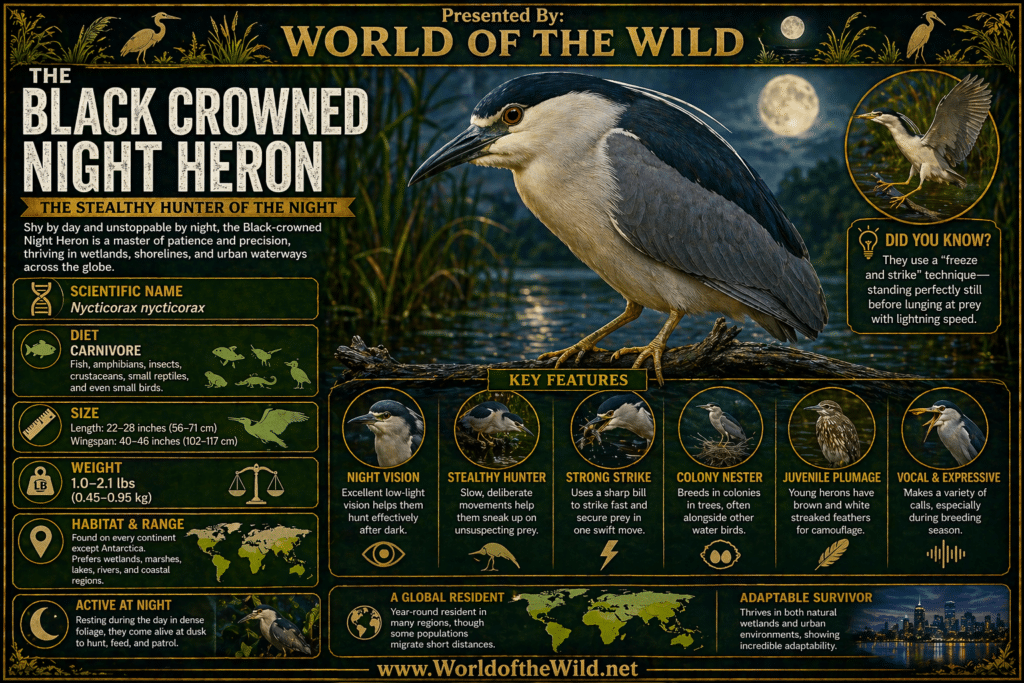

As dusk settles over a quiet marsh, most birds are tucking their heads beneath their wings and drifting off to sleep. But in the fading light, a stocky, hunch-shouldered silhouette stirs to life — wings spreading wide, dark eyes scanning the water below with eerie, red-glowing intensity. This is the Black-Crowned Night Heron (Nycticorax nycticorax) and the Black Capped Night Heron, two of the most widespread, enigmatic, and underappreciated waterbirds on Earth.
While the elegant Great Blue Heron commands attention with its towering stature and daytime grace, the Black-Crowned Night Heron operates in the shadows — literally. It has mastered the art of nocturnal and crepuscular hunting, carving out an ecological niche that few other wading birds dare to occupy. Found on every continent except Antarctica and Australia, this compact heron has quietly conquered the world, thriving in environments ranging from tropical wetlands to urban park ponds. It is a bird of contradictions: patient yet explosive, plain-looking yet secretly stunning up close, common yet deeply mysterious in its habits.
If you’ve ever heard a raspy, barking “quok!” call echoing over a swamp at night and wondered what creature made it — now you know. The Black-Crowned Night Heron has been watching you from the shadows all along.
Facts
- Its name means “night raven” in Latin. The genus name Nycticorax translates directly to “night raven” — a nod to both its nocturnal lifestyle and its hoarse, crow-like call.
- Its eyes are built for darkness. The Black-Crowned Night Heron possesses exceptionally large red eyes with an unusually high density of rod photoreceptors, granting it superior low-light vision compared to most other herons.
- It is a projectile vomiter when threatened. Like many herons, it will regurgitate the contents of its stomach onto perceived predators or overly curious humans — an effective, if unpleasant, defense mechanism.
- It uses “bait” to lure fish. Some individuals have been observed dropping feathers, insects, or small pieces of bread onto the water’s surface to attract curious fish — a remarkable display of tool-adjacent behavior once thought exclusive to higher-order animals.
- It can eat almost anything that fits in its beak. While fish dominate its diet, Black-Crowned Night Herons have been documented eating everything from small mammals and lizards to garbage scraps and even the chicks of other bird species.
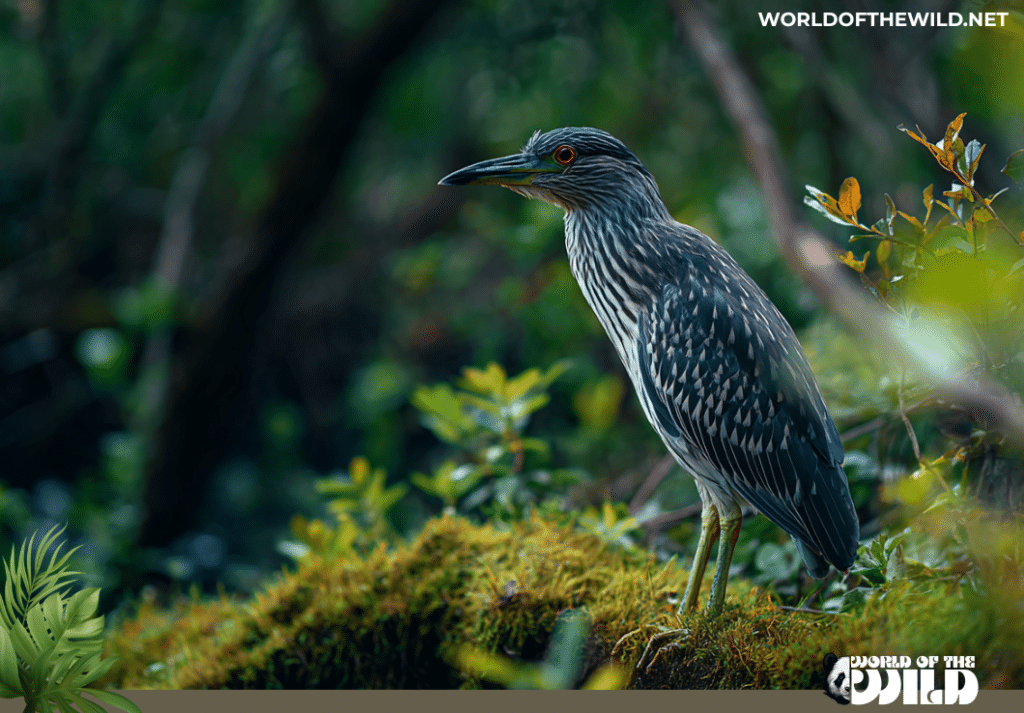
- Chicks have a completely different appearance from adults. Juvenile Black-Crowned Night Herons are streaky brown and white, so different from their parents that early naturalists once classified them as an entirely separate species, calling them the “Quawk” or “Squawk Heron.”
- It is one of the most cosmopolitan birds in the world. With a global range spanning six continents and populations on nearly every major landmass, it holds the distinction of being among the most geographically successful herons alive today.
Species
The Black-Crowned Night Heron occupies the following taxonomic classification:
| Rank | Classification |
|---|---|
| Kingdom | Animalia |
| Phylum | Chordata |
| Class | Aves |
| Order | Pelecaniformes |
| Family | Ardeidae |
| Genus | Nycticorax |
| Species | Nycticorax nycticorax |
Four subspecies are currently recognized, each defined by subtle differences in size and plumage tone:
- N. n. nycticorax — The nominate subspecies, found across Europe, Asia, and Africa. This is the most widely distributed form.
- N. n. hoactli — The North and South American subspecies, slightly larger than the nominate form with marginally different proportions.
- N. n. obscurus — Native to southern South America, particularly Chile and Argentina, this subspecies is darker overall.
- N. n. falklandicus — Restricted to the Falkland Islands, this is the rarest and most isolated subspecies.
The closest living relative of the Black-Crowned Night Heron is the Yellow-Crowned Night Heron (Nyctanassa violacea), native to the Americas. Though superficially similar in body shape and nocturnal habits, the Yellow-Crowned is a distinct genus and feeds primarily on crustaceans rather than fish. Another close relative, the Nankeen Night Heron (Nycticorax caledonicus) — also called the Rufous Night Heron — fills a similar ecological role across Australia and the Pacific, and is sometimes considered a sister species.
Appearance
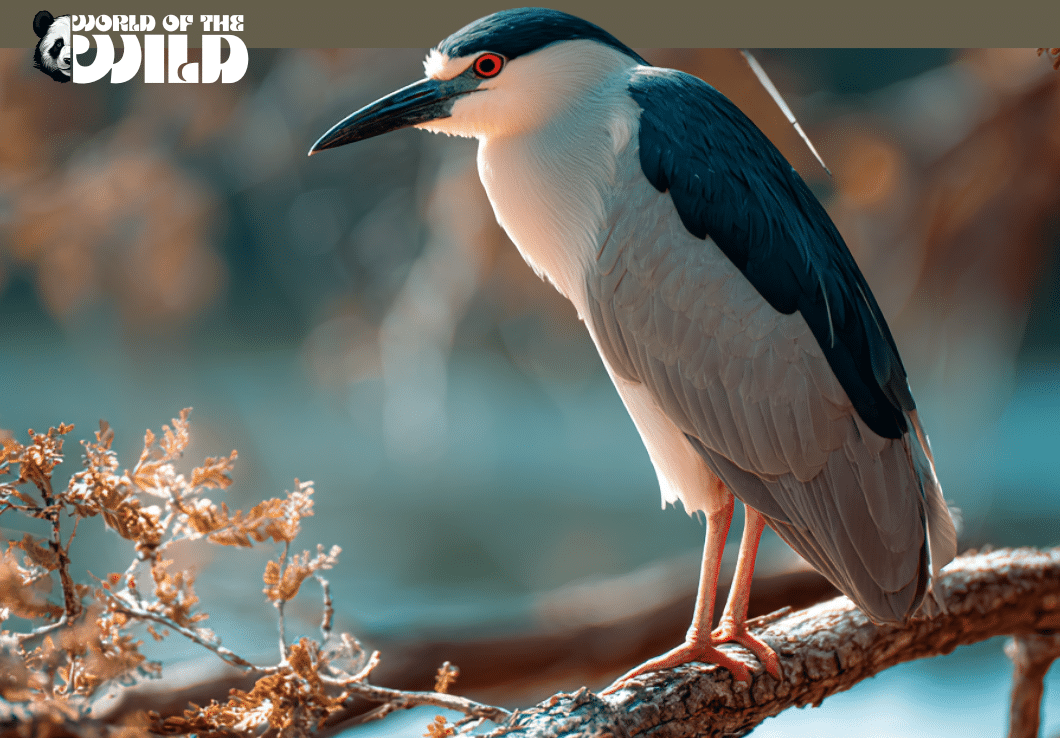
The Black-Crowned Night Heron is a compact, powerfully built wading bird that looks as though nature compressed a full-sized heron into a smaller, sturdier frame. Adults stand roughly 23 to 28 inches tall with a wingspan spanning 44 to 45 inches — impressive for a bird that weighs only 1.5 to 2.2 pounds on average.
The adult plumage is striking in its bold simplicity. The crown and back are a rich, glossy black with a subtle iridescent sheen of blue-green in good light. The wings and tail are soft gray, and the underparts — the neck, breast, and belly — are a clean, pale white to light gray. The face is adorned with a bold black cap that extends down to the base of the heavy, dagger-like black bill, giving the bird a masked, almost villainous expression. The legs are short and stout, typically yellow but flushing to a vivid pink or red during the breeding season as hormones surge.
The most arresting feature, however, is the eyes — enormous, round, and a deep, burning scarlet red, perfectly adapted for hunting in near-darkness. During breeding season, adults also develop two to three long, elegant white occipital plumes that cascade down the back of the head like streamers — a decoration visible from a considerable distance and central to courtship displays.
Juveniles, as mentioned, are a completely different visual story: streaked brown and buff above, heavily spotted and striped below, and equipped with yellow-orange eyes that gradually redden with age. The transformation to full adult plumage takes approximately three years.
Behavior
The Black-Crowned Night Heron is, above all else, a creature defined by patience and timing. Unlike its diurnal heron cousins that stalk fish through the brightness of the afternoon, this species is most active at dusk, through the night, and into the early morning hours — though in areas with little human disturbance, it will hunt opportunistically at any time of day.
During daylight hours, Black-Crowned Night Herons roost communally in dense vegetation — willows, mangroves, bamboo thickets, and dense stands of marsh reeds are favored. These roosts can contain dozens to hundreds of birds sitting motionless, hunched in that characteristic stooped posture, waiting for darkness. Their stillness is legendary; a roosting bird can be perched a few feet from an observer and be nearly invisible.
When hunting, they employ the classic heron strategy of stand-and-wait foraging — standing absolutely still at the water’s edge or on a partially submerged branch, then striking with explosive speed when prey comes within range. The strike is a rapid, coiling lunge of the neck that uses the S-shaped cervical vertebrae as a biological spring. Some individuals have also been observed slowly wading or even swimming slightly to reposition between strikes.
Socially, they are colonial nesters but relatively solitary hunters, each bird defending a personal feeding territory along the water’s edge after dark. Communication is largely vocal — the iconic “quok” or “wok” alarm call is frequently heard during nighttime flights between roosts and feeding grounds. Breeding birds employ a range of grunts, bill-snapping, and display postures to communicate at the colony.
A fascinating behavioral quirk is their adaptability to urban environments. Black-Crowned Night Herons have colonized city parks, sewage treatment ponds, fish hatcheries, and zoo ponds with remarkable ease, demonstrating a degree of behavioral flexibility that speaks to their intelligence and opportunism.
Evolution
The family Ardeidae — the herons, egrets, and bitterns — is an ancient lineage with roots stretching back approximately 60 million years to the Paleocene epoch, not long after the mass extinction event that ended the age of the non-avian dinosaurs. The earliest definitive ardeids appear in the fossil record during the Eocene, and the group diversified rapidly alongside the expansion of freshwater wetland ecosystems.
The genus Nycticorax itself has a reasonably well-documented fossil record. Fossil material attributed to the genus has been recovered from Miocene deposits in Europe — suggesting that night herons as a distinct group have been occupying wetland niches for at least 10 to 15 million years. The separation of Old World and New World night heron populations, and the subsequent divergence of the four recognized subspecies, appears to have been driven largely by geographic isolation during Pleistocene glaciation events, when fluctuating sea levels and ice sheets periodically fragmented wetland habitats and restricted gene flow between populations.
The nocturnal specialization of the Nycticorax lineage is particularly intriguing from an evolutionary standpoint. It represents a clear case of niche partitioning — by shifting activity to nighttime hours, these birds effectively sidestepped competition with the larger, more dominant diurnal herons that monopolize daytime fishing territories. The enlarged eyes, modified photoreceptor ratios, and behavioral adaptations for low-light hunting all evolved as a cohesive suite of traits serving this nocturnally-specialized ecological strategy.
Habitat
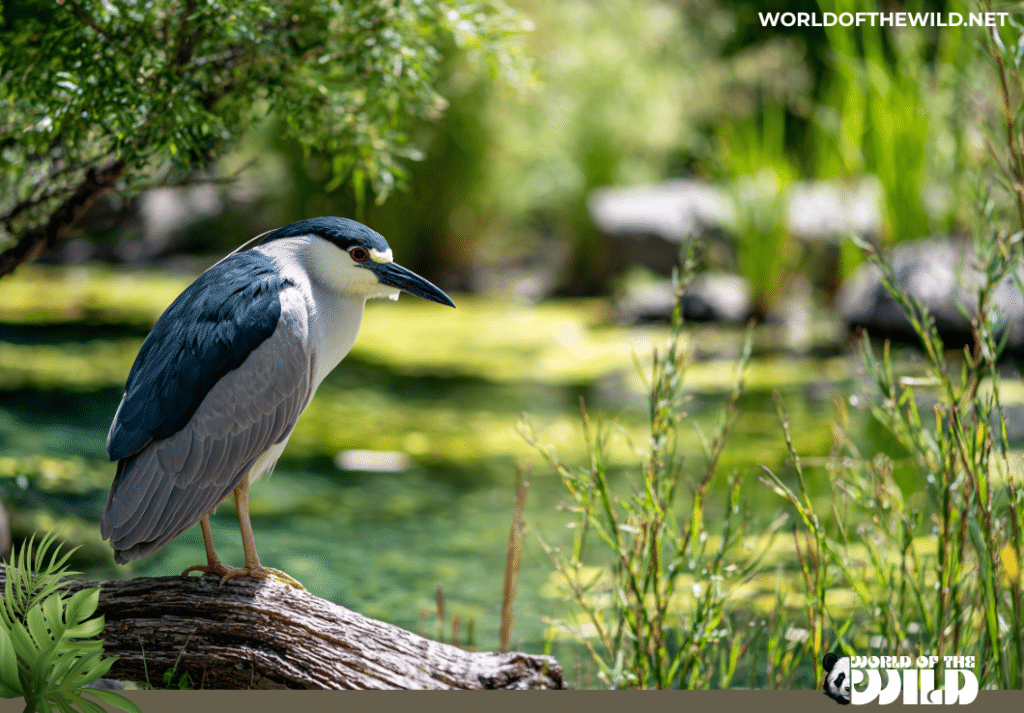
Few birds on Earth can claim as diverse a habitat portfolio as the Black-Crowned Night Heron. Across its enormous global range, it has been documented in virtually every type of wetland environment imaginable.
Primary habitats include freshwater marshes, swamps, stream and river margins, lake shores, estuaries, mangrove forests, tidal flats, rice paddies, and flooded agricultural fields. In coastal areas, salt marshes and sheltered bays are commonly used. In urban settings, the species readily exploits park ponds, ornamental water features, sewage lagoons, and aquaculture facilities.
The species is found on every permanently inhabited continent, ranging from sea level up to altitudes exceeding 4,500 meters in parts of Asia, including the high wetlands of Tibet and the Andes in South America. In North America, breeding populations concentrate along the Atlantic and Pacific coasts, the Gulf of Mexico, the Great Lakes region, and throughout the interior wetlands of the United States and southern Canada. In Europe, the species is a summer breeder in the Mediterranean basin and parts of Central Europe, wintering in sub-Saharan Africa. In Asia, it occupies wetlands from Japan and Korea through South and Southeast Asia.
The key habitat requirement is not a specific ecosystem type, but rather the presence of shallow water for foraging and dense woody or herbaceous vegetation for roosting and nesting — a combination found across an extraordinarily wide range of landscapes.
Diet
The Black-Crowned Night Heron is an opportunistic carnivore with one of the most eclectic diets in the heron family. While it strongly prefers fish as its primary food source — targeting small species such as minnows, perch, killifish, carp, and eels — it is far from a finicky eater.
A comprehensive list of documented prey items includes:
- Fish (primary prey)
- Frogs and tadpoles
- Crayfish and other crustaceans
- Aquatic and terrestrial insects
- Earthworms
- Leeches
- Small rodents (mice, voles)
- Small reptiles (lizards, small snakes)
- Bird eggs and nestlings (including those of other heron species in mixed colonies)
- Carrion
- Human food waste in urban environments
The hunting method is primarily sit-and-wait ambush predation, with the bird standing motionless for extended periods before delivering a lightning-fast strike. However, individuals adapt their technique to circumstances — slow stalking is used in open water, while aerial plunge-diving has occasionally been recorded. The fish-luring behavior described in the Facts section represents one of the more sophisticated foraging strategies observed in the species, placing it among a small elite of birds documented using rudimentary tool-like behavior to acquire food.
Predators and Threats
Natural Predators
Adult Black-Crowned Night Herons are large enough to be relatively safe from most predators, though large raptors such as Great Horned Owls, Red-tailed Hawks, and various eagle species will take adults when the opportunity arises. Eggs, chicks, and juveniles face a wider range of threats from raccoons, opossums, American minks, foxes, and large snakes that invade nesting colonies. Interestingly, the colonial nesting strategy itself serves as a partial defense — the collective alarm calls and mobbing behavior of dozens or hundreds of birds at a nesting colony can deter even determined predators.
Human-Caused Threats
The picture grows more complex and concerning when human impacts are considered:
- Habitat loss and wetland degradation remain the single greatest long-term threat to the species globally. Drainage of wetlands for agriculture and urban development eliminates both foraging habitat and nesting sites.
- Water pollution, particularly from agricultural runoff carrying pesticides, herbicides, and excess nutrients, degrades prey availability and can cause direct toxic harm through bioaccumulation of contaminants such as mercury and organochlorine pesticides up the food chain.
- Disturbance of nesting colonies — by recreational activities, development, or well-intentioned but poorly managed wildlife watching — can cause colony abandonment, particularly during the sensitive early nesting period.
- Persecution by fish farmers and aquaculture operators, who view the heron as a pest species, has historically led to direct shooting and nest destruction at some locations.
- Climate change is increasingly implicated in shifting prey distributions, altering wetland hydrology, and causing mismatches between the timing of breeding and peak prey availability.

Reproduction and Life Cycle
Breeding in the Black-Crowned Night Heron is a colonial, seasonally timed affair that transforms otherwise solitary-seeming birds into densely packed, raucous communities. Colonies — called heronries or rookeries — can range from a handful of pairs to several thousand, often shared with other heron and egret species in mixed-species nesting aggregations.
Courtship begins with conspicuous display behavior by males, who take up station at potential nest sites and advertise their fitness through a repertoire of postures: stretching the neck upward, raising the white occipital plumes, bill-snapping, and emitting low advertising calls. Once a pair bond forms, the male gathers nesting material while the female constructs the nest — a loosely assembled platform of sticks, twigs, and reeds placed in a tree, shrub, or dense marsh vegetation, typically 10 to 40 feet above water or ground.
Egg-laying occurs once the nest is established, with females typically producing 3 to 5 pale blue-green eggs in a single clutch. Both parents share incubation duties over approximately 24 to 26 days. Chicks hatch asynchronously — a few days apart — and are initially helpless, covered in sparse gray-white down. Both parents feed the chicks by regurgitating semi-digested food directly into the nestlings’ mouths or onto the nest floor.
Chicks develop rapidly. They begin moving around the colony on foot at around 3 weeks, and fledge — taking their first sustained flights — at approximately 6 to 7 weeks of age. Full independence typically follows within a few weeks of fledging.
Sexual maturity is reached at 2 to 3 years of age, coinciding roughly with the acquisition of full adult plumage. In the wild, Black-Crowned Night Herons commonly live 10 to 15 years, with the oldest reliably recorded individual reaching more than 21 years of age. Captive birds have lived even longer under ideal conditions.
Population
The Black-Crowned Night Heron is currently listed as Least Concern on the IUCN Red List of Threatened Species — the lowest conservation concern category — reflecting its enormous global range and large total population.
Global population estimates are difficult to pin down precisely given the species’ vast distribution, but the total breeding population is broadly estimated at somewhere between 2 and 4 million individuals worldwide, though some estimates run higher when wintering and non-breeding birds are included. In North America alone, the breeding population is estimated at roughly 500,000 to 700,000 birds.
However, the Least Concern designation should not be read as an all-clear signal. Population trends are declining across much of the species’ range, particularly in Europe and North America, where long-term monitoring programs have documented significant reductions in breeding colony size and overall abundance over the past several decades. North American Breeding Bird Survey data, for instance, show a measurable downward trend in many regions since the 1970s — though populations rebounded considerably after the banning of DDT and related organochlorine pesticides, which had devastated reproduction in the mid-20th century.
The species’ global abundance and adaptability provide a significant buffer against extinction. Nevertheless, continued wetland loss, water quality degradation, and the compounding effects of climate change make complacency a luxury that wildlife managers cannot afford.
Conclusion
The Black-Crowned Night Heron is a master of the in-between — active at the margins of day and night, inhabiting the borderlands between water and land, comfortable in wilderness and city alike. It is a bird that rewards patience: easy to overlook in the daylight hours when it sits motionless and hunched in the shadows of a willow tree, but utterly captivating once you understand the life it leads in the darkness.
Its story is also a cautionary tale with a hopeful chapter. The collapse of Black-Crowned Night Heron populations during the DDT era — when the pesticide thinned eggshells and caused catastrophic breeding failures across North America and Europe — and the subsequent recovery following the chemical’s ban stand as one of conservation’s most important object lessons: environmental damage is real, measurable, and reversible when humans choose to act.
Today, the pressures facing this species are less dramatic but no less insidious — a slow accumulation of wetland losses, water pollution, and climatic disruption that, unchecked, will quietly erode what remains. The Black-Crowned Night Heron does not need our pity; it has survived for millions of years without us. What it needs is simply for us to stop making the world uninhabitable — one drained marsh, one poisoned watershed, one lost roosting tree at a time.
The next time you hear that hoarse, prehistoric “quok!” echoing over the water at dusk, take a moment. A creature that has watched over the world’s wetlands for ten million years just announced itself. The least we can do is listen.
Quick Reference
| Field | Details |
|---|---|
| Scientific Name | Nycticorax nycticorax |
| Diet Type | Carnivore (primarily piscivore; opportunistic omnivore) |
| Size | 23–28 inches tall; wingspan 44–45 inches (~2 feet tall; ~3.7 feet wingspan) |
| Weight | 1.5–2.2 pounds |
| Region Found | Worldwide (North America, South America, Europe, Africa, Asia); absent from Australia and Antarctica |