
World of the Wild — Endangered Species Series
The Ghost of the Batang Toru
Dawn comes slowly to the Batang Toru ecosystem. In the highlands of North Sumatra, the morning reveals itself not through birdsong alone, but through a low, resonant groan that rolls across the forest canopy like distant thunder. It is the long call of a male Tapanuli Orangutan — a sound that travels nearly a kilometer through the dense, humid air, a declaration of territory and existence that has echoed through these hills for perhaps hundreds of thousands of years. You hear it before you see anything. You feel it before you understand it.
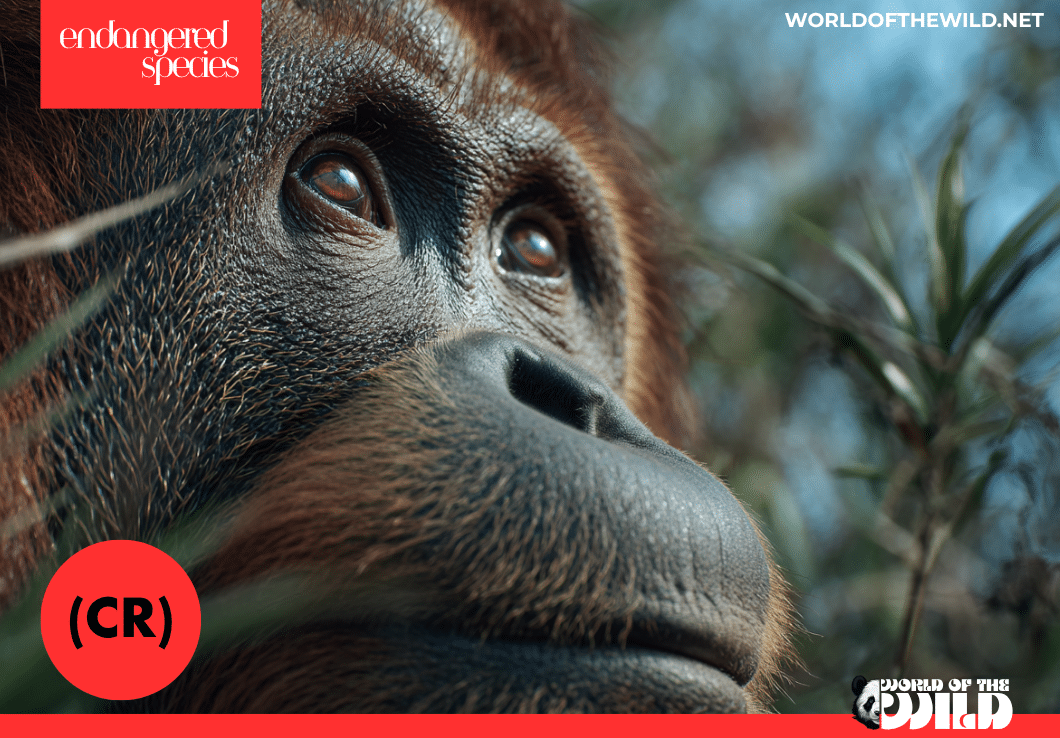
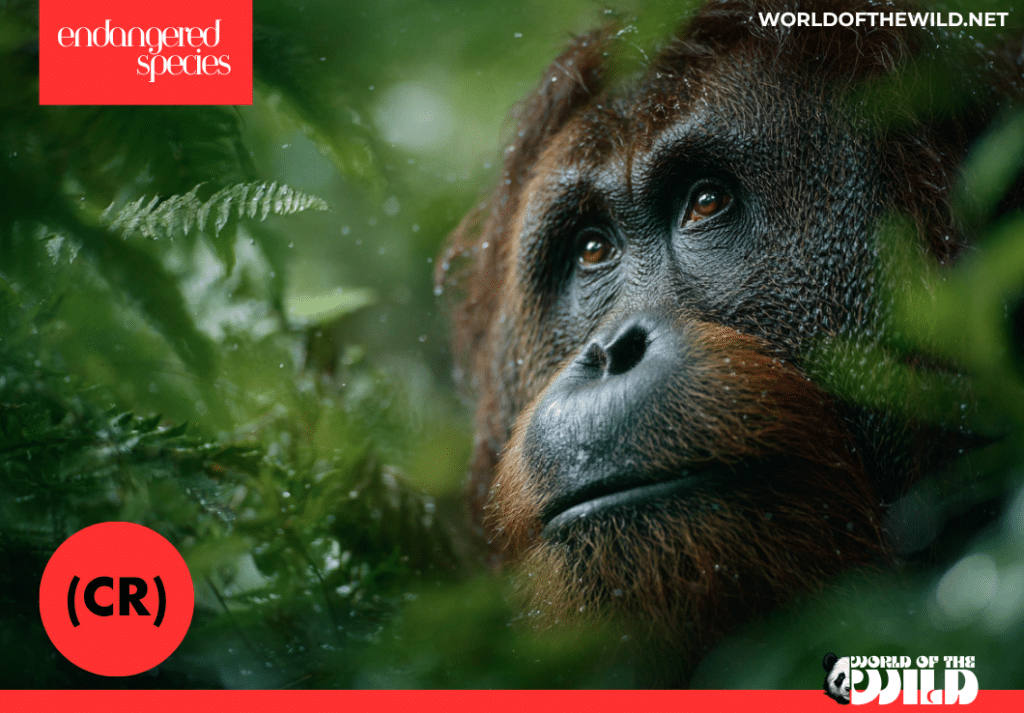
The male is somewhere above you in the emergent trees. He is enormous, perhaps 90 kilograms, draped in long, frizzier, darker reddish-brown hair unlike any other great ape on Earth. His cheek pads, or flanges, are flatter and less pronounced than those of his Sumatran cousin, giving his face an ancient, almost archaic quality. He smells of wet earth and old wood, of decades lived in canopy and rain.
He moves with deliberate, unhurried intelligence. One massive hand closes around a branch the thickness of a human thigh with the calm authority of an animal that has never been seriously challenged in these trees. He feeds on Lithocarpus acorns — a dietary preference shared with no other orangutan species — pausing to strip bark and probe the wood for insects, his lower canine teeth leaving furrows in the timber. Below him, the Batang Toru River catches the first light. The water is clear over grey stone, cold from the mountains, and it carves through a forest that has stood for millions of years.
He is one of the last of his kind. Across this entire watershed — the only place on Earth where his species exists — there are fewer people who have seen a Tapanuli Orangutan than there are members of most small-town high school graduating classes. He does not know this. He does not know that roads are being pushed through the forest below. He does not know about the hydroelectric dam whose reservoir has severed the southern corridor connecting his sub-population to others. He does not know that a team of researchers tracks his movement via camera trap and acoustic monitor from a field station several ridges away. He climbs higher into the canopy, where the morning mist is still thick, and the forest still belongs entirely to him. For now.

Status of Survival
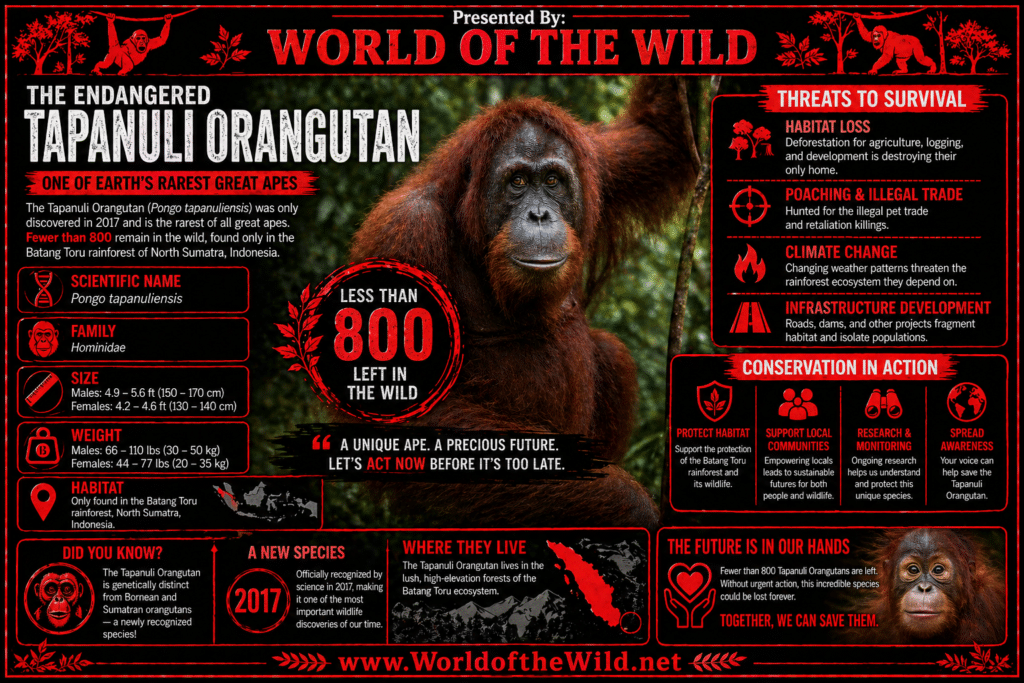
The Tapanuli Orangutan (Pongo tapanuliensis) was formally described as a new species to science in November 2017, in a landmark paper published in the journal Current Biology. It was the first new great ape species identified in nearly a century. The announcement made headlines across the world. And then, almost immediately, a darker headline followed: this newly described species was already Critically Endangered.
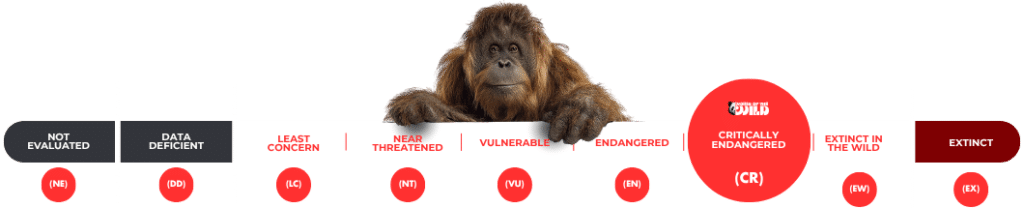
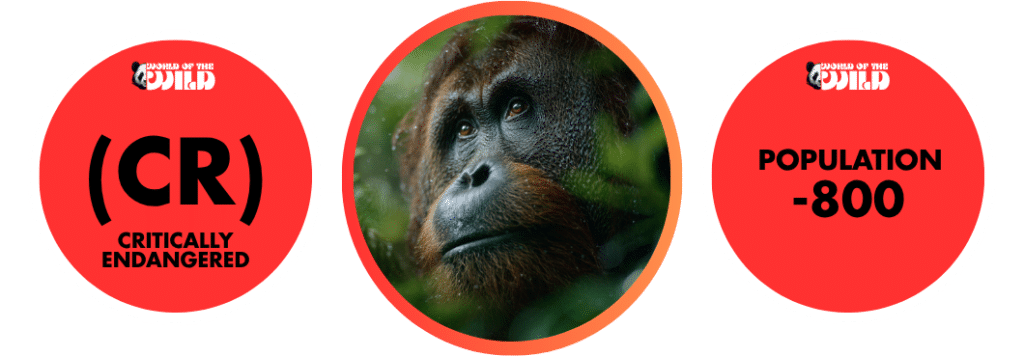
The IUCN Red List — the gold standard of global conservation assessments — places Pongo tapanuliensis at Critically Endangered (CR), the highest category before “Extinct in the Wild.” Current population estimates, based on field surveys, habitat modelling, and camera-trap density analyses conducted by the Sumatran Orangutan Conservation Programme and partner organizations, place the total wild population at fewer than 800 individuals, with most recent assessments suggesting the number may be as low as 700.
To understand why that number represents a true emergency rather than simply a low census figure, you have to understand what population viability actually means in biological terms. Conservation geneticists generally estimate that a species needs at least 500 to 1,000 individuals to maintain sufficient genetic diversity and avoid the compounding harms of inbreeding depression — the gradual accumulation of harmful genetic mutations that occurs when closely related animals breed repeatedly over generations. The Tapanuli Orangutan is at, or below, this absolute floor. And the floor is not a comfortable place to stand.
The situation is made more acute by the species’ reproductive biology. Orangutans have the slowest reproductive rate of any mammal on Earth. Females give birth to a single offspring every seven to nine years, and do not reach sexual maturity until around 12 to 15 years of age. This means that population recovery, even under ideal conditions, is measured in generations rather than years. A species that loses 50 individuals to a disease outbreak cannot replace them in a decade. It may not be able to replace them at all.
Adding another layer of complexity, the fewer than 800 remaining Tapanuli Orangutans are not a single, contiguous breeding population. They are divided across three geographically isolated habitat patches within the Batang Toru Landscape, with limited and increasingly compromised connectivity between them. This means the effective breeding population — the number of individuals actually capable of exchanging genes with one another under current conditions — is considerably smaller than the raw count suggests. Isolated subpopulations face their own independent extinction risks, and a catastrophe in one patch cannot be buffered by individuals from another.
There is also a deeper loss encoded in these numbers. DNA analysis has confirmed that the Tapanuli Orangutan represents a lineage that diverged from all other orangutans approximately 3.38 million years ago — predating the split between the Sumatran and Bornean orangutan lineages. Losing this species would mean losing an irreplaceable evolutionary branch of the great ape family tree, a lineage with no backup copy anywhere on Earth.
The Map of the Vanishing
Drive south from Medan, the capital of North Sumatra Province, for five hours through palm oil plantations and rubber smallholdings, and you arrive at the edge of the Batang Toru Landscape. This upland ecosystem, covering roughly 1,000 square kilometres across the Tapanuli Regencies, is the entire world for Pongo tapanuliensis. Not in the way that Africa is the world for elephants, or the Pacific is the world for humpback whales. Literally: this one watershed, this one ridgeline system, is every habitat this species has ever occupied since before our ancestors painted cave walls in Europe.
The Tapanuli Orangutan occupies mid-to-high elevation forest, typically between 300 and 1,300 metres above sea level. This preference for highland terrain — steeper, less accessible, historically less attractive to agricultural conversion — is likely the primary reason the species survived long enough to be discovered by science. The lowland forests of Sumatra, where other orangutan populations once thrived, were largely cleared for agriculture across the 20th century. The mountains bought the Tapanuli Orangutan time. But that same topography now acts as a double-edged sword: the ridges that protected the forest also fragment it into isolated valleys, and the river systems that define the landscape are precisely where hydroelectric developers see economic opportunity.
Within its forest, the Tapanuli Orangutan functions as a keystone seed disperser. It consumes the large, fatty fruits of dozens of tree species and deposits intact seeds across vast distances as it travels its enormous home range. Many of the trees that define the Batang Toru canopy — including ecologically significant species and the forest’s structural giants — depend on this dispersal relationship for regeneration. Remove the orangutan from this system, and you do not simply lose a charismatic animal. You interrupt a cycle of forest renewal that has sustained this landscape for millions of years. Canopy gaps fill with invasive species. Genetic exchange between tree populations declines. Over decades, the forest slowly changes character — becoming less complex, less biodiverse, less capable of withstanding drought and fire. The Tapanuli Orangutan is not merely a symbol of this ecosystem’s health. It is one of the mechanisms by which the ecosystem maintains itself. Its disappearance would be felt long after the last individual was gone, written into the changed composition of the forest itself.
The Descent — How We Got Here
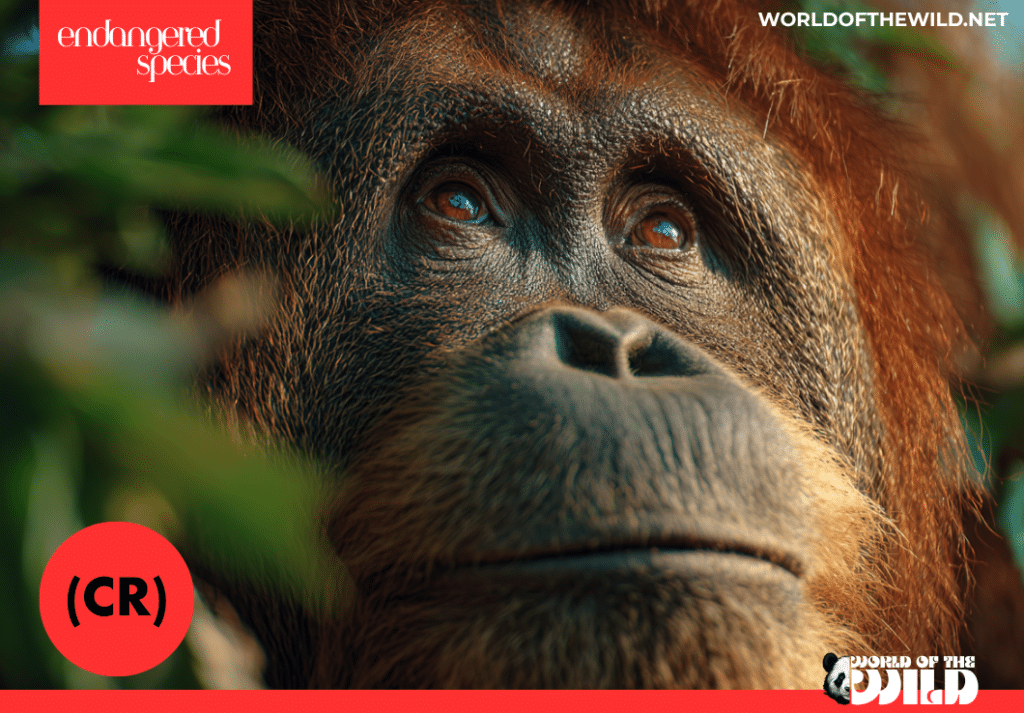
The Tapanuli Orangutan’s precarious position is not the result of a single catastrophe. It is the accumulated weight of multiple, overlapping pressures that have compressed a species into an ever-shrinking corner of a continent, each threat compounding the damage of the others in ways that make the total far greater than the sum of its parts.
The most foundational driver is habitat loss and fragmentation. The conversion of lowland and foothill forest to oil palm and rubber cultivation has been a sustained, large-scale process across Sumatra since the 1990s, progressively destroying and isolating habitat patches and pushing surviving orangutan populations into higher, smaller, and more disconnected forest fragments. This process did not begin with any single policy decision or corporate expansion — it was the cumulative effect of economic incentives, weak land-tenure protections, and inadequate enforcement of conservation law across decades and multiple administrations.
Into this already degraded landscape came a threat so direct and so well-documented that it provoked an international scientific outcry: the Batang Toru Hydroelectric Dam. The 510-megawatt PLTA Batang Toru project, with construction accelerating from 2018 onward, placed major infrastructure directly into the heart of the species’ most critical habitat. The dam’s reservoir submerged river corridor habitat that had served as a movement pathway between the southern and central subpopulations. Scientists and NGOs — including a formal letter signed by more than 100 primatologists from institutions around the world — warned Indonesian authorities that the project would directly destroy or degrade habitat used by at least 8 percent of the total species population. In a species with fewer than 800 individuals, 8 percent is not a rounding error. It is a potentially unrecoverable loss. The protests were ultimately unsuccessful in halting construction.
The road network that accompanied dam construction introduced a second-order threat that is in some ways harder to see and harder to reverse. Every new road through intact forest is a vector — for settlers, for informal loggers, for hunters, and for the agricultural frontier that follows human access wherever it leads. Satellite analysis of the Batang Toru Landscape conducted between 2016 and 2024 documented measurable increases in deforestation pressure along newly built access routes, with forest patch sizes decreasing and the degree of isolation between subpopulations increasing. For a species that already exists in three fragmented groups with limited connectivity, increasing isolation is not merely a conservation concern. It is a biological sentence, written slowly over decades.
Direct killing remains a persistent problem. As orangutans are displaced from their forest and pushed into the margins of agricultural land, crop-raiding conflicts occur, sometimes resulting in retaliatory killing by farmers protecting their livelihoods. Infant orangutans, made vulnerable when their mothers are killed, are occasionally taken into the illegal wildlife trade as pets — each infant representing not only an individual lost, but a reproductive future erased. The legal framework protecting orangutans under Indonesian law designates them as Schedule I protected species, but enforcement in remote highland areas remains chronically under-resourced.
Climate change, while not yet the dominant immediate driver, is beginning to reshape the threat landscape in ways that will matter more with each passing decade. Altered rainfall patterns across Sumatra are changing the timing and abundance of fruit crops — the mast fruiting events that orangutans depend on for the caloric surpluses necessary to support female reproductive cycling. In El Niño years, when drought suppresses fruit production across wide areas, already-stressed populations face additional nutritional pressure that can suppress birth rates in a species where every birth is an eight-year commitment. As climate volatility increases, the frequency of these bad years is projected to rise.
The Front Lines of Conservation
Against this convergence of threats, a determined community of scientists, local advocates, and international organizations is fighting — with camera traps, legal filings, community engagement programs, and in some cases their sustained physical presence in contested forest over years and decades.
The Sumatran Orangutan Conservation Programme, a partnership between the Swiss-based PanEco Foundation and the Indonesian Yayasan Ekosistem Lestari, leads the most comprehensive on-the-ground effort for the Tapanuli Orangutan. Their work in the Batang Toru Landscape encompasses systematic population monitoring using camera trap grids deployed across the habitat, acoustic monitoring of long-call vocalizations to estimate density and track individual males without requiring direct observation, habitat connectivity analysis, and sustained engagement with local communities, regional government, and national policy bodies. The SOCP’s field presence in North Sumatra is long-established and irreplaceable — they are not a distant organization issuing reports from abroad, but a team embedded in the landscape and the local relationships that conservation ultimately depends upon.
The Frankfurt Zoological Society has been a critical funding and technical partner, financing landscape-scale conservation operations and lending institutional weight to advocacy efforts. Their involvement has been particularly important in sustaining the scientific monitoring infrastructure that generates the data needed to make the case for protection in policy forums where numbers carry more persuasive weight than moral arguments alone.
On the technology side, conservation practice for this species is pushing toward the frontier of what field science can currently achieve. Drone-based monitoring now supplements satellite imagery, providing higher-resolution, near-real-time detection of deforestation events and illegal activity within the landscape. Acoustic AI systems — machine learning models trained on recordings of Tapanuli Orangutan long calls — are being piloted to detect and geolocate calling males across wide areas without the observer time and logistical cost of traditional field surveys. These tools allow a small, modestly resourced team to effectively monitor a landscape that would require hundreds of field staff using conventional methods.
One area under active scientific discussion, though not yet implemented for this species, is the concept of genetic rescue — the deliberate translocation of individuals between isolated subpopulations to introduce new genetic material and counter the effects of inbreeding. Given the species’ extreme fragmentation and dangerously small effective population size, this intervention may eventually become not just advisable but necessary for the species’ survival. The logistics and ethics of moving wild orangutans across habitat gaps they cannot traverse naturally are genuinely complex, and the scientific community approaches the question carefully. But the emerging consensus is that managed genetic interventions must be part of the toolkit for species in the Tapanuli Orangutan’s situation.
Dr. Ian Singleton, Director of the Sumatran Orangutan Conservation Programme, stands as perhaps the single most important individual figure in the effort to save this species. For more than two decades, Singleton has operated from North Sumatra, overseeing habitat surveys, leading rescue operations for orphaned and displaced orangutans, engaging directly with Indonesian government authorities on protected area policy, and maintaining a relentless international advocacy presence. When the Batang Toru dam project advanced despite the scientific community’s objections, Singleton and the SOCP ensured that the documentation was thorough, the data was public, and the pressure on decision-makers did not relent. He represents the intersection of rigorous fieldwork and unyielding advocacy that this species requires — someone who does not mistake hope for a strategy, but refuses to mistake difficulty for impossibility.
On the community side, one of the most genuinely encouraging developments of recent years has been the growth of village-based forest guardianship programs. Working with communities whose livelihoods border the Batang Toru forest, the SOCP and partner organizations train and compensate local community members to serve as forest monitors — detecting illegal activity, tracking wildlife, and functioning as the first human line of defense against encroachment. Beyond their practical protective function, these programs have produced a measurable shift in community attitudes. Survey data from participating villages collected between 2019 and 2024 shows increasing proportions of community members identifying orangutan conservation as directly relevant to their own long-term economic and ecological wellbeing. This matters enormously. When the people who actually live beside a species see themselves as its stewards rather than its adversaries — or simply as bystanders to a conflict happening around them — the dynamic of conservation changes in ways that no amount of outside funding or legal designation can replicate.
The Odds of Tomorrow
Conservation work, at its most honest, requires a confrontation with probability. For the Tapanuli Orangutan in 2026, the probability space is narrow and the margins are unforgiving.
The best-case scenario for the next fifty years looks something like this: the Indonesian government designates a significant portion of the Batang Toru Landscape as formally protected, ending legal land conversion within the species’ range. International conservation funding sustains the SOCP’s monitoring and community programs at sufficient scale. Targeted habitat restoration work in degraded areas begins to re-establish connectivity between the three isolated subpopulations, allowing limited but biologically meaningful genetic exchange. Climate conditions, while worsening globally, remain within a range that the forest can absorb without catastrophic fruit crop failure. Under these conditions, the population stabilizes at somewhere between 600 and 800 individuals by 2040, begins a slow but measurable increase thereafter, and the species survives into the next century as a small but viable wild population — a permanent ward of conservation science, but alive.
The worst-case scenario is starker. Dam infrastructure continues to degrade and ultimately eliminate the southern corridor, rendering the three subpopulations genetically isolated with no prospect of exchange. Road network expansion accelerates deforestation in the remaining forest patches, shrinking available habitat below the minimum necessary to support viable home ranges. Within two or three generations, inbreeding depression begins to suppress reproductive success in isolated groups — birth rates fall, infant survival declines, the population age structure skews toward older, post-reproductive animals. A severe El Niño event, arriving as projected climate models suggest with increasing frequency, triggers forest fire across a significant portion of the landscape, eliminating 15 to 25 percent of remaining habitat in a single season. The population falls below 300 individuals by 2050. At that point, without an emergency intervention of a scale that has never been attempted for any orangutan species, the species is below any realistic threshold of self-sustaining recovery. Functionally extinct in the wild by 2075, surviving only in captivity if a sufficient number of individuals had been secured in time.
Most conservation scientists who work in this landscape are, in private, somewhere between these two poles — but closer to the second than the first. The honest assessment is that without a significant escalation in political commitment and conservation investment in the next five to ten years, the window for the best-case outcome will close permanently. The species does not have the luxury of a gradual improvement. It needs a step-change in the level of protection and resources it receives, and it needs it now.
What makes the Tapanuli Orangutan’s situation uniquely, almost unbearably tragic is its youth as a scientific discovery. The world learned this species existed in 2017. By the time the celebration of that discovery had faded from the news cycle, the threats eroding its habitat were already years deep. Science unveiled a new branch of the great ape family tree just in time to watch it begin to fall.
The male in the canopy above the Batang Toru River does not know any of this. He climbs higher as the morning light strengthens, his long arms swinging him through the branches with an economy of effort built by millions of years of evolution. He is perfectly adapted to this forest. He belongs here in the deepest biological sense of that phrase. The question that will define the next half-century is simpler and starker than any population model can fully capture: will we leave him — and the roughly 800 others like him — enough forest to live in? The answer is not yet written. But the clock is running, and the forest is already smaller than it was yesterday.
Sources: IUCN Red List Assessment for Pongo tapanuliensis (2017, updated 2022); Nater et al. (2017), “Morphometric, Behavioral, and Genomic Evidence for a New Orangutan Species,” Current Biology; Sumatran Orangutan Conservation Programme Annual Reports 2022–2025; Frankfurt Zoological Society Batang Toru Programme Reports; PanEco Foundation Conservation Updates.