
What Are Endangered Species? How many species are currently endangered in the world?
An endangered species is one that faces a very high risk of extinction in the near future, either globally or within a specific region. The world’s most authoritative tracker of this crisis is the IUCN Red List of Threatened Species, established in 1964 by the International Union for Conservation of Nature. It evaluates species across nine categories — from “Least Concern” all the way to “Extinct” — based on population size, rate of decline, geographic range, and degree of fragmentation.
Understanding the question, How many species are currently endangered in the world? is crucial for global conservation efforts.
As of March 2026, the IUCN Red List includes 172,620 assessed species, of which more than 44,000 are classified as threatened — meaning they fall under Vulnerable, Endangered, or Critically Endangered status. Among those, 10,774 species are listed as Critically Endangered, the highest risk category before extinction. Alarmingly, 1,406 of those are considered possibly already extinct.
The scale of the problem is staggering. Scientists estimate that the current rate of extinction is 1,000 to 10,000 times higher than the natural background rate — the rate that would occur without human interference. This has led experts to declare that we are living through the sixth mass extinction event in Earth’s history, and unlike the previous five, this one has a single primary cause: us.
Why Do We Have This Problem?
The biodiversity crisis does not have one cause — it has many, and they feed off one another in destructive cycles.
1. Habitat Destruction
The most widespread driver of species loss is the destruction and fragmentation of natural habitats. Deforestation in the Amazon, the draining of wetlands, the conversion of grasslands into farmland, and the relentless expansion of cities all chip away at the living spaces that wildlife depends on. When a forest is cleared, every species that called it home — from insects to apex predators — loses the resources it needs to survive.
2. Climate Change
Rising global temperatures are reshaping ecosystems faster than many species can adapt. In 2025, record ocean heat bleached approximately 90% of the world’s coral reefs, wiping out entire marine food webs in a single event. Climate change is also altering migration patterns, disrupting breeding seasons, and pushing species out of their historical ranges into territory where they cannot survive.
3. Poaching and Illegal Wildlife Trade
Illegal wildlife trafficking is a multi-billion dollar criminal industry. Rhinos are killed for their horns, elephants for their ivory, and pangolins — the world’s most trafficked mammal — for their scales and meat. Poaching syndicates now operate through sophisticated digital markets, making enforcement increasingly difficult. The black rhino, for example, was pushed to the brink of extinction by poaching, with an estimated 10,000 African rhinos killed in the past decade alone.
4. Invasive Species
When non-native species are introduced to an ecosystem — whether accidentally through global trade or deliberately — they can devastate local wildlife. Rats introduced to island habitats gnaw seabird eggs. Invasive fungi have devastated amphibian populations on multiple continents. Invasive plants crowd out native vegetation that animals depend on for food and shelter.
5. Pollution
Plastic waste chokes rivers and oceans, entangling marine life and entering the food chain. Chemical runoff from agriculture contaminates waterways, killing fish and amphibians. Noise pollution disrupts the communication and navigation of whales and dolphins. The Yangtze Finless Porpoise, now critically endangered with only around 1,000 individuals remaining, struggles to navigate a river filled with cargo ships, dams, and acoustic interference.
6. Overexploitation
Overfishing, overhunting, and the unsustainable harvesting of plants and animals push populations below the threshold needed for recovery. Once a species’ numbers fall too low, inbreeding, reduced genetic diversity, and stochastic events can seal its fate even if the original threat is removed.
What Can We Do to Fix It?
The biodiversity crisis is severe, but it is not hopeless. There are proven strategies at every level — from global policy to individual action — that can make a real difference.
At the Government and Policy Level
Strong legal protections are essential. The U.S. Endangered Species Act, enacted in 1973, has been credited with saving 99% of the species listed under it from extinction. Internationally, agreements like CITES (the Convention on International Trade in Endangered Species) help curb the wildlife trade. Governments must invest in protected areas, fund conservation science, and hold polluters accountable.
Habitat Protection and Restoration
Protecting remaining wild places is the single most effective conservation tool available. Establishing wildlife reserves, buffer zones, and wildlife corridors allows species to move, breed, and adapt. Rewilding programs — reintroducing native species to restored landscapes — have shown remarkable results, from wolf reintroductions in Yellowstone to white stork restoration projects in the UK.
Captive Breeding and Reintroduction Programs
For species on the very edge of extinction, captive breeding buys time. The kakapo parrot of New Zealand — now numbering around 250 individuals — owes its continued existence to intensive management programs involving radio collars, dietary supplements, and predator-free islands. Zoos and aquariums accredited by the Association of Zoos & Aquariums (AZA) collectively care for over 900 vulnerable and endangered species.
Technology and Science
Modern conservation increasingly relies on cutting-edge tools. AI-powered camera traps monitor populations in remote regions. Satellite tracking follows migration routes in real time. Genetic sequencing helps scientists understand population health and design breeding programs. These technologies allow conservationists to act faster and more precisely than ever before.
Addressing Climate Change
Protecting biodiversity and fighting climate change are inseparable goals. Reducing carbon emissions, transitioning to renewable energy, and protecting carbon-absorbing forests and wetlands all serve both causes simultaneously.
What You Can Do
Individual actions matter more than they might seem. Supporting reputable conservation organizations, choosing sustainably sourced products, reducing plastic use, and advocating for strong environmental laws all contribute. Decline rates are measurably lower in areas where local communities are actively involved in managing and protecting their natural surroundings.
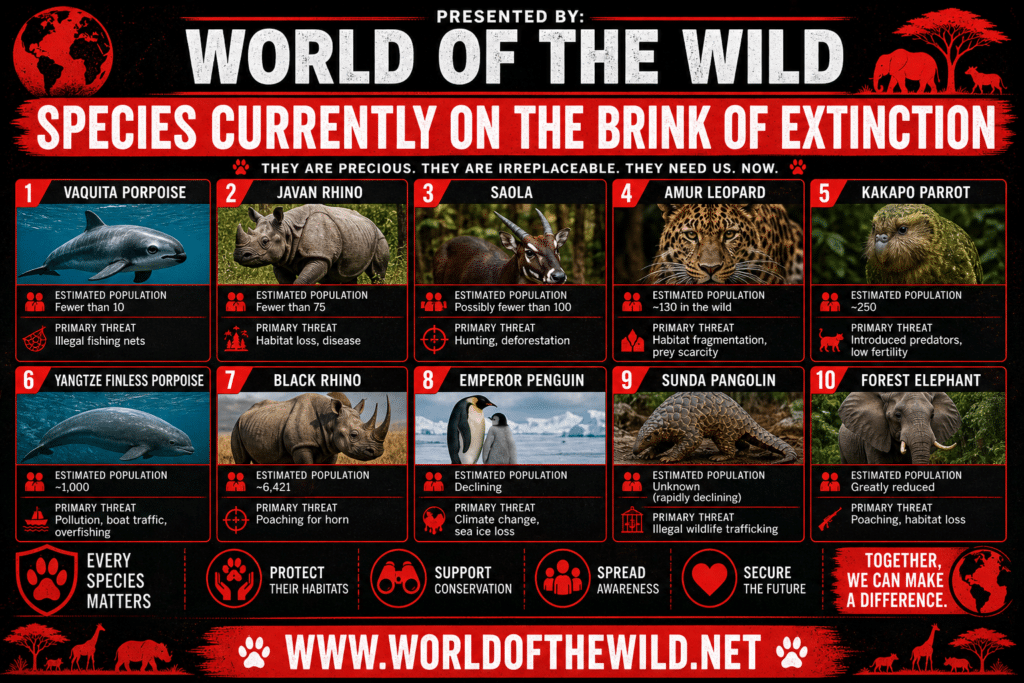
A Snapshot: Species Currently on the Brink
The following are among the most critically endangered species on Earth today:
| Species | Estimated Population | Primary Threat |
|---|---|---|
| Vaquita Porpoise | Fewer than 10 | Illegal fishing nets |
| Javan Rhino | Fewer than 75 | Habitat loss, disease |
| Saola | Possibly fewer than 100 | Hunting, deforestation |
| Amur Leopard | ~130 in the wild | Habitat fragmentation, prey scarcity |
| Kakapo Parrot | ~250 | Introduced predators, low fertility |
| Yangtze Finless Porpoise | ~1,000 | Pollution, boat traffic, overfishing |
| Black Rhino | ~6,421 | Poaching for horn |
| Emperor Penguin | Declining | Climate change, sea ice loss |
| Sunda Pangolin | Unknown (rapidly declining) | Illegal wildlife trafficking |
| Forest Elephant | Greatly reduced | Poaching, habitat loss |
Beyond these iconic animals, it is worth remembering that more than half of all critically endangered species are plants — 6,445 plant species carry the CR designation. The loss of plant species triggers cascading effects throughout entire ecosystems, as countless animals depend on specific plants for food, shelter, and reproduction.
Conclusion
The numbers are sobering: over 44,000 species threatened, more than 10,000 critically endangered, and an extinction rate running thousands of times above what nature would produce on its own. We are witnessing, in real time, the unraveling of the web of life that took billions of years to weave.
Yet the story is not one of pure despair. Every species pulled back from the edge — every rhino population stabilized, every forest restored, every protected area expanded — is proof that human action can reverse the damage human action has caused. The tools exist. The knowledge exists. What is needed is the collective will to use them.
The question of how many species are endangered is ultimately a question about what kind of planet we choose to leave behind. The answer is still being written — and all of us have a hand in writing it.
Sources: IUCN Red List (March 2026), WWF, World Animal Foundation, Animal Welfare Institute, Nature World News