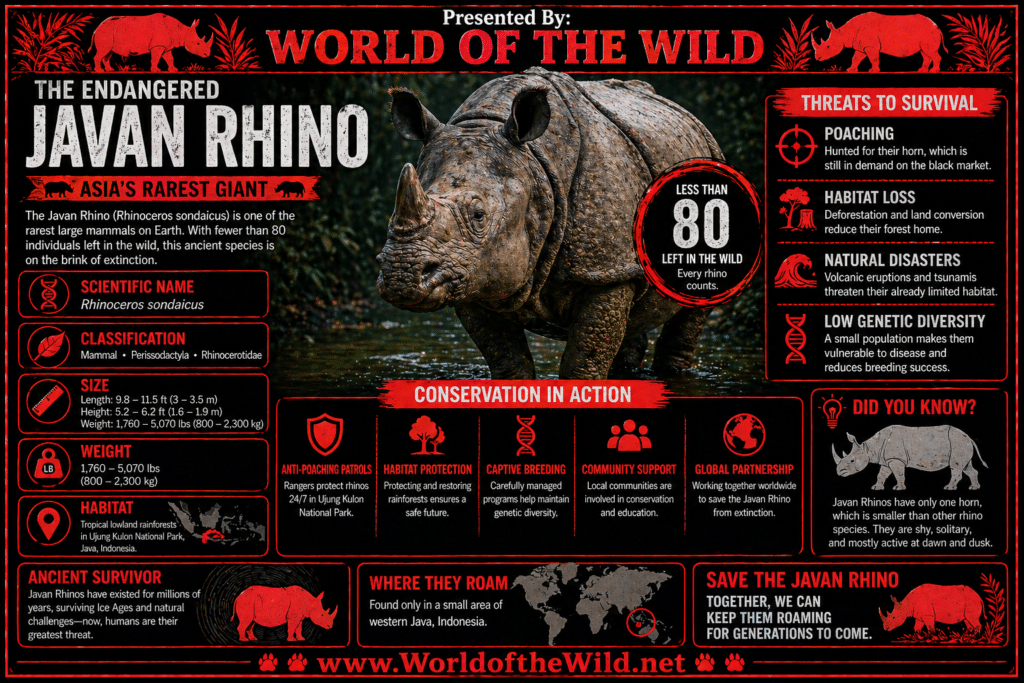

World of the Wild — Endangered Species Series
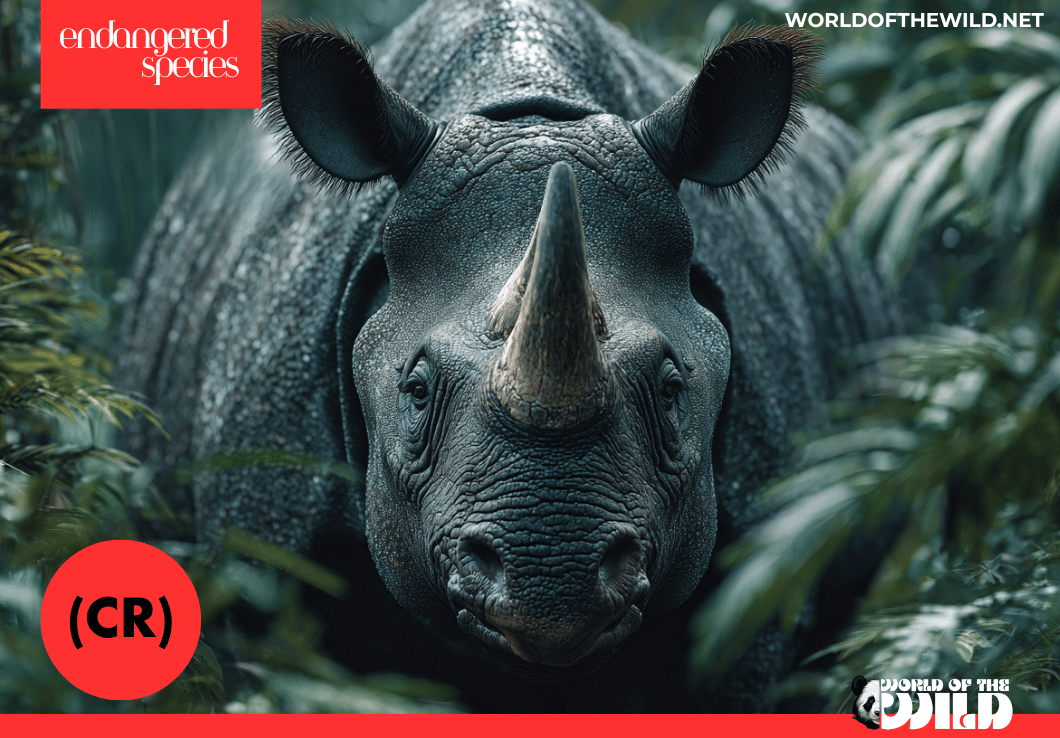
The Ghost of Ujung Kulon National Park
The jungle exhales before dawn.
Somewhere deep inside the Ujung Kulon Peninsula — a remote tongue of land on Java’s westernmost tip, bracketed by the Java Sea to the north and the Indian Ocean to the south — the forest is already awake. The air is thick with the smell of rot and renewal: decomposing leaf litter, the mineral bite of volcanic soil, the faint sweetness of wild ginger blooming where a tree fell months ago and let in a crack of sky. Humidity sits on everything like a second skin.
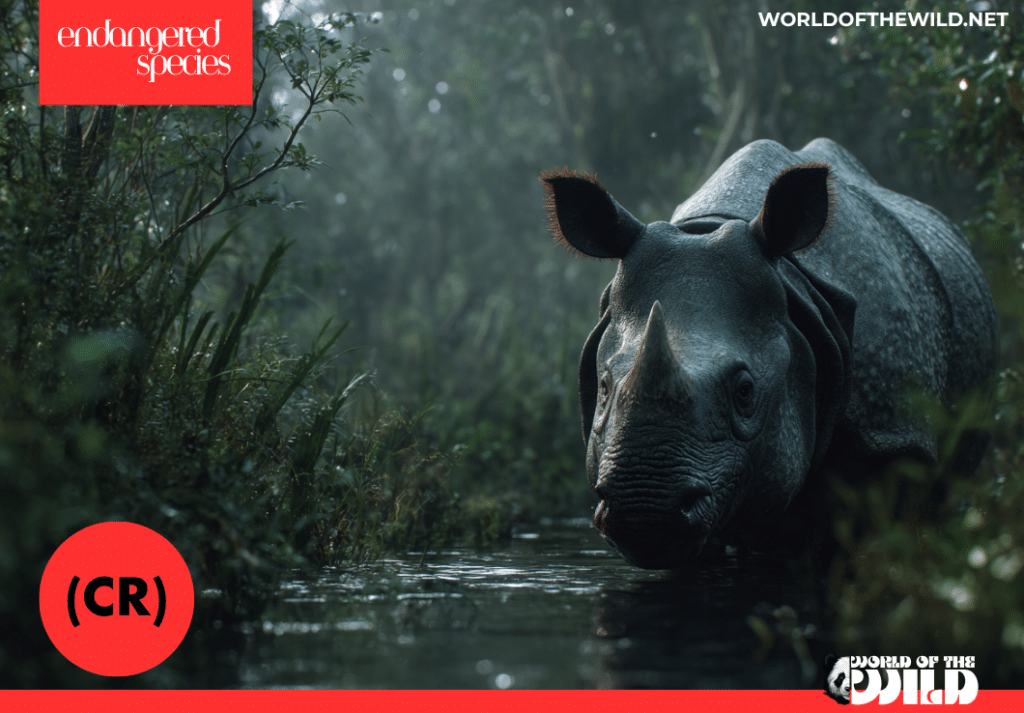
And then — a sound. Not a crash, not a trumpet, not the bellowing charge you might associate with rhinoceros from the African savanna. This is something quieter: the slow, deliberate displacement of undergrowth. A branch bends. Mud gives way. Something enormous moves through the forest with an almost meditative patience, following paths worn smooth over decades — perhaps over generations.
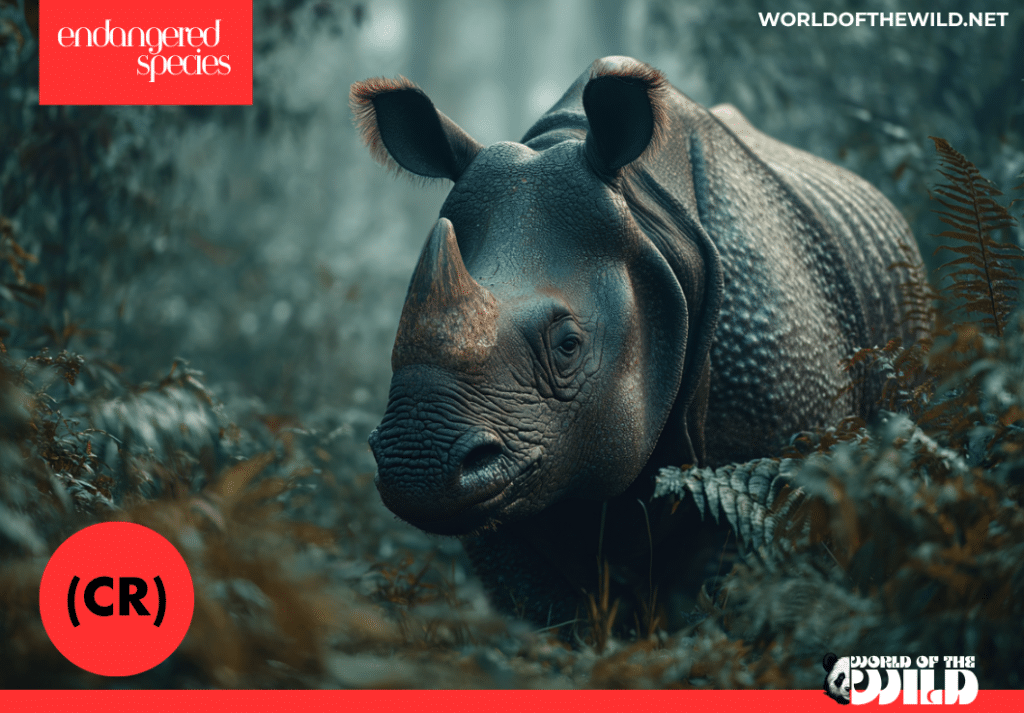
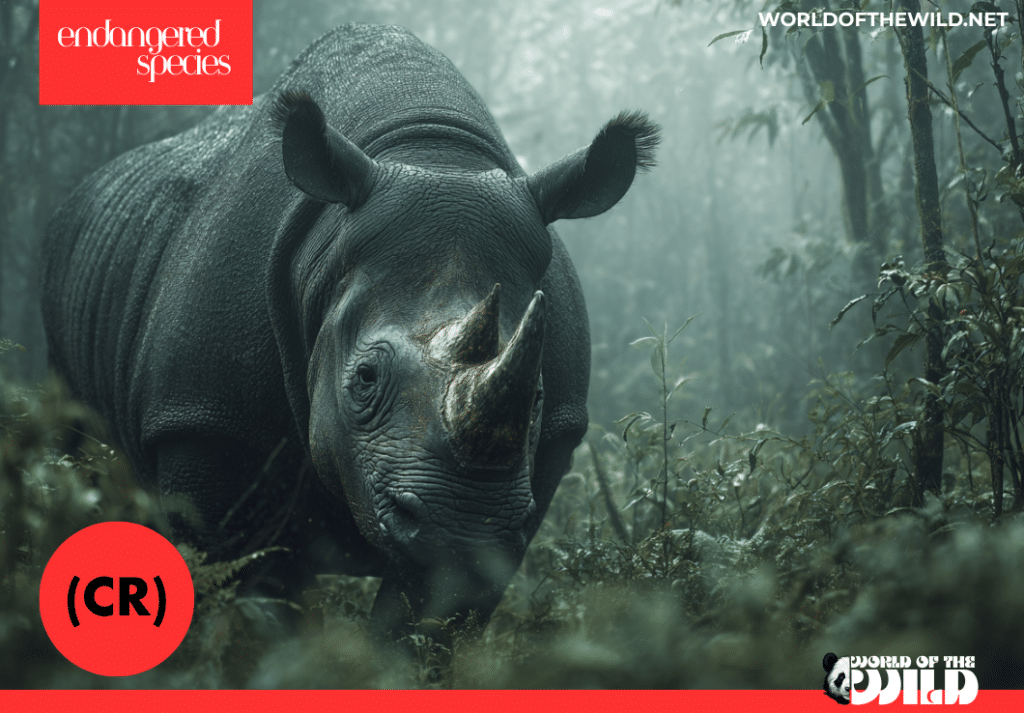
She is somewhere between 800 and 2,300 pounds of armor-plated muscle, and she moves like she owns this jungle. Because, in the truest ecological sense, she does. Her single horn — that curved keratin tower rising from her nasal ridge — sweeps low-hanging vines aside as she approaches the wallow she visited two days ago. She enters the murky, tea-brown pool with a slow satisfaction, her wrinkled, mosaicked skin — grey-brown and folded into overlapping plates at the shoulder and flank — drinking in the cool mud. She is doing what her kind have done in this forest for millennia: regulating her body temperature, coating herself in mineral-rich mud to protect against parasites, resting in the one place where she feels completely safe.
Her name, in the database of the Rhino Protection Unit that monitors her, is nothing romantic. She is identified by a camera trap image, a behavioral profile, a pattern of mud wallows. But to the biology she carries — to the 63 or so remaining members of her species in this forest — she is essential. She is irreplaceable. She is Rhinoceros sondaicus, the Javan Rhino. And the world has never been closer to losing her forever.
By full light, she has already vanished back into the forest, a ghost in a landscape that is itself increasingly ghostly — a last fortress surrounded by the rising tide of a world that forgot these animals existed until it was almost too late. Almost.
Status of Survival
Critically Endangered: What the Numbers Actually Mean
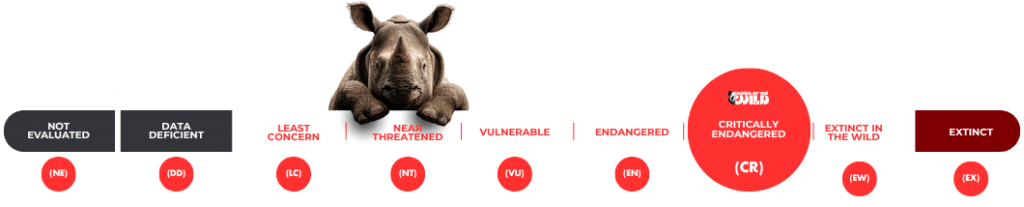
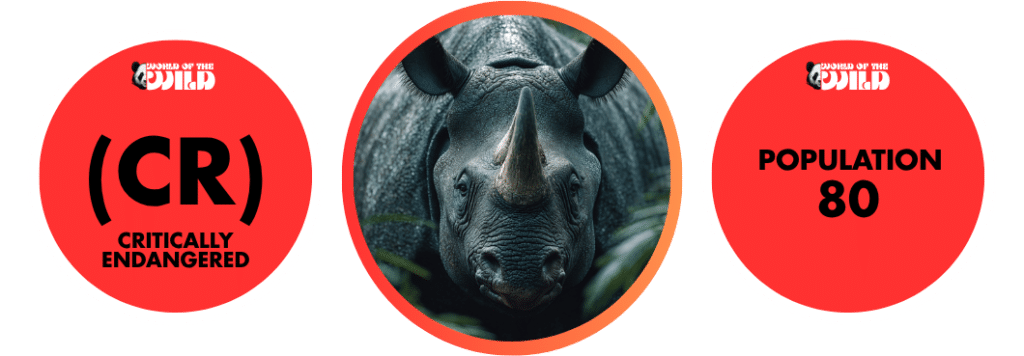
The International Union for Conservation of Nature (IUCN) Red List — the global authority on species conservation status — classifies the Javan Rhino as Critically Endangered (CR), the highest category of threat before Extinct in the Wild. This classification is not a bureaucratic formality. It is a species-level emergency signal.
As of the most recent population surveys conducted through camera trap monitoring in Ujung Kulon National Park — the only confirmed wild population on Earth — the estimated number of living Javan Rhinos stands at approximately 76 individuals, according to data compiled through 2023–2024 surveys by WWF-Indonesia and the Indonesian Ministry of Environment and Forestry (KLHK). Some analyses in 2025 and early 2026 have suggested that figure may have slightly increased, with cautious optimism placing the number closer to 77–82 individuals, though the uncertainty range remains significant given the animals’ extraordinary elusiveness.
To understand why these numbers matter beyond their shocking smallness, you need to understand what biologists call the Minimum Viable Population (MVP). This is the threshold below which a population begins losing the genetic diversity it needs to adapt to disease, environmental change, and developmental stress. Most conservation geneticists place the MVP for large mammals at somewhere between 500 and 5,000 individuals, depending on the species. The Javan Rhino is operating at roughly 15% of the lowest end of that range.
The consequences are already measurable in theory and feared in practice:
- Inbreeding depression: With such a small gene pool, harmful recessive alleles accumulate over generations. Fertility rates drop. Immune function weakens. Developmental abnormalities increase.
- Demographic vulnerability: A single disease outbreak, a volcanic event (Anak Krakatau lies just 50 kilometers offshore), or a poaching surge could eliminate double-digit percentages of the entire species in weeks.
- Catastrophic loss of uniqueness: Javan Rhinos are not simply “smaller Asian rhinos.” They represent a distinct evolutionary lineage — Rhinoceros sondaicus — that diverged from its closest relative, the Indian One-Horned Rhino (Rhinoceros unicornis), roughly 11 million years ago. Their loss would be the permanent erasure of tens of millions of years of evolutionary history.
There are currently zero Javan Rhinos in captivity. Every effort in the 20th century to maintain the species in zoological settings ended in failure. The last known captive individual — held in Hanoi Zoo, Vietnam — died in 2010. This means no insurance population exists. No backup. When conservationists say the Javan Rhino lives on the knife’s edge, they mean it with a clinical, unromantic precision.
The Map of the Vanishing
A Kingdom Reduced to a Peninsula
There was a time — not long ago in geological terms — when the Javan Rhino ranged across a vast arc of tropical Asia. Fossil records and historical accounts place Rhinoceros sondaicus across the Indian subcontinent, through Myanmar, Thailand, Cambodia, Laos, Vietnam, and down through the Malay Peninsula into Sumatra and, of course, Java. Ancient Chinese texts describe the rhino’s horn as a prized medicinal ingredient. Colonial-era hunting records from the 19th century document their presence across landscapes that today bear no trace of them at all.
Today, the entire species exists within a single protected area: Ujung Kulon National Park, a UNESCO World Heritage Site covering approximately 1,206 square kilometers on the southwestern tip of Java, Indonesia. Of that total area, the rhinos inhabit primarily the Ujung Kulon Peninsula itself — a dense lowland rainforest environment that accounts for roughly 443 square kilometers of suitable habitat.
This is not a forest of open plains and dramatic vistas. It is a claustrophobic, dripping cathedral of lowland tropical jungle: dense stands of Arenga palms, tangled undergrowth, river floodplains, and coastal mangroves. The Javan Rhino is a browsing species, not a grazer. It feeds on the leaves, shoots, fallen fruits, and twigs of hundreds of plant species — moving through the forest like a slow, selective harvesting machine, folding its prehensile upper lip around preferred vegetation with a delicacy that belies its bulk. It uses its horn not primarily for combat but for scraping bark, pulling down branches, and digging for mineral-rich soil to lick.
The Keystone Factor: What Disappears When the Rhino Does
The Javan Rhino is what ecologists call a keystone megaherbivore — a species whose feeding behavior disproportionately shapes the structure of the ecosystem around it. In Ujung Kulon, this role is profound and poorly understood until you walk through the forest and see the evidence:
- Trail creation: Rhinos forge and maintain networks of paths through dense undergrowth, creating corridors used by dozens of other mammal species — including leopards, deer, wild pigs, and small carnivores.
- Seed dispersal: Their massive digestive systems process and deposit seeds across wide areas, directly influencing which tree and shrub species regenerate in which locations.
- Habitat heterogeneity: Their wallowing behavior creates muddy depressions that become vital water sources and microhabitats for amphibians, invertebrates, and wading birds during dry seasons.
- Vegetation management: By preferentially browsing certain plant species — particularly invasive ones — they perform a natural form of forest maintenance that keeps the ecosystem from being dominated by a handful of aggressive plants.
Remove the Javan Rhino from this equation and you do not simply lose a species. You initiate a trophic cascade — a chain reaction of ecological consequences that can fundamentally alter the structure of Ujung Kulon’s forest over decades. The trails close. The wallows dry up. The seed dispersal network fractures. The forest, in a very real biological sense, becomes less itself.
The Descent: How We Got Here
A Century of Catastrophic Decline
The Javan Rhino’s collapse from an animal that roamed across continental Asia to a population of fewer than 80 animals in a single peninsula did not happen overnight. It happened through a relentless, compounding accumulation of human pressure — each wave finishing what the last one started.
Phase One: Colonial-Era Hunting (1800s–1940s)
The most devastating single period for Javan Rhino populations was the era of European colonial rule in Southeast Asia. British, Dutch, and French colonial administrators actively encouraged the hunting of large wildlife — including rhinos — as a means of “clearing” land for agriculture and eliminating perceived threats to livestock. Rhinoceros horn, simultaneously prized in traditional Chinese medicine as a fever treatment and carved as luxury cups and ornaments for the aristocratic trade, fetched enormous prices. The result was industrial-scale slaughter.
By the early 20th century, populations that had once numbered in the thousands across their range were fragmented, collapsing, and regionally extinct in large swaths of their former territory. The last Javan Rhino in India was recorded dead by 1910. In Malaysia, they were gone by the 1930s. On mainland Southeast Asia, a small, isolated population clung on in the Cat Tien region of southern Vietnam — and was declared extinct when the last individual was found dead from a poacher’s bullet in 2010.
Phase Two: Habitat Destruction (1950s–Present)
Java is one of the most densely populated islands on Earth, home to more than 150 million people. As Indonesia’s postwar development accelerated through the mid-20th century, lowland rainforest — the precise habitat the Javan Rhino requires — was converted for agriculture, logging, and human settlement at catastrophic rates. By the 1980s, the rhino’s range had been compressed to the single peninsula it occupies today.
Even within Ujung Kulon, habitat quality has been degraded by the aggressive spread of the invasive Arenga palm (Arenga obtusifolia), a species that forms dense monoculture thickets that shade out the diverse understory plants the rhinos depend on for food. Today, Arenga palm infestations cover significant portions of the peninsula’s interior, effectively reducing the amount of high-quality rhino habitat — and potentially limiting the carrying capacity of the park to support a growing population, even under the best conservation conditions.
Phase Three: Poaching’s Long Shadow
While rhino poaching in Ujung Kulon has been dramatically reduced through intense anti-poaching operations (more on this below), it has not been eliminated. Regional demand for rhinoceros horn — driven primarily by traditional medicine markets in Vietnam and China, where a kilogram of horn can fetch prices exceeding $60,000 USD — has not collapsed. Global criminal networks remain active, and the financial incentive to kill one of the world’s rarest animals is, grotesquely, amplified by that rarity itself. The fewer Javan Rhinos that exist, the more valuable each horn becomes on the black market.
Phase Four: The Geological Wild Card
The proximity of Anak Krakatau — the active volcanic island that rose from the caldera of the 1883 Krakatau eruption — to Ujung Kulon represents a threat that no conservation program can fully mitigate. In December 2018, Anak Krakatau’s flank collapsed into the sea, triggering a devastating tsunami that killed more than 400 people along the Sunda Strait coastline. While the Ujung Kulon peninsula itself largely escaped direct inundation, the event served as a stark reminder: the entirety of the Javan Rhino’s wild population occupies a low-lying coastal peninsula within a major seismic and volcanic zone. A sufficiently large eruption or tsunami could theoretically damage or destroy a significant portion of their habitat — and there would be no population elsewhere to absorb the loss.
The Front Lines of Conservation
The People and Programs Holding the Line
The fight to save the Javan Rhino is one of the most intensive — and in some ways, most innovative — conservation campaigns on Earth. Precisely because the stakes are so absolute, the response has had to be equally unconditional.
Rhino Protection Units (RPUs): The Human Shield
Since 1995, WWF-Indonesia, in partnership with the Indonesian government’s Ministry of Environment and Forestry (KLHK) and the International Rhino Foundation (IRF), has maintained a network of Rhino Protection Units (RPUs) — mobile anti-poaching teams deployed throughout Ujung Kulon. These are not park rangers in the conventional sense. RPU members are trained paramilitary conservation officers who conduct regular forest patrols, dismantle snares and traps, gather intelligence on poaching networks, and maintain a physical presence in the park’s most remote areas.
The results have been measurable. Documented poaching incidents within Ujung Kulon have fallen to near zero in recent years — a remarkable achievement given the financial incentives involved. The RPUs have become a model for intensive protection programs across Southeast Asia, demonstrating that with sufficient resources and political will, even the most endangered populations can be shielded from direct human predation.
Camera Trap Monitoring: Eyes Everywhere
Because Javan Rhinos are nocturnal, solitary, and inhabit some of the densest jungle on Earth, direct observation is essentially impossible. The primary tool for monitoring the population — counting individuals, tracking breeding events, assessing health, and identifying new calves — is an extensive camera trap network maintained throughout the peninsula.
Hundreds of motion-activated cameras are positioned along rhino trails, near wallows, and at key forest junctions. Each year, the image data from these cameras is analyzed by a team of researchers who can identify individual rhinos by their unique patterns of skin folds, horn shape, and body markings. This patient, painstaking work has produced the most comprehensive census data in the species’ history — and has documented something genuinely hopeful: calves. New births. Proof that this population, against all odds, is still reproducing.
Habitat Restoration: Fighting the Arenga Palm
One of the most active interventions currently underway is a large-scale program to remove invasive Arenga palm from critical rhino habitat within Ujung Kulon. Teams of conservation workers — supported by WWF, IRF, and KLHK — have been physically clearing Arenga from key areas since the early 2010s, with the goal of restoring diverse, nutritious understory vegetation that rhinos can browse. This is slow, labor-intensive, and expensive work in some of the most difficult terrain on Earth. But in treated areas, surveys have already shown increasing rhino use — a direct behavioral response to improved habitat quality.
The Case for a Second Population: A Conservation Hero’s Vision
Among the most significant debates in Javan Rhino conservation is the question of establishing a second population — moving a small number of individuals to a second protected area to reduce the catastrophic risk of a single-site extinction event. The Ujung Kulon National Park Task Force, under the direction of senior researchers and government planners, has identified several candidate sites on Java and Sumatra as potential second habitat locations.
The leading candidate as of 2025–2026 is a protected area on eastern Java whose name has been kept deliberately vague in official communications to prevent poaching intelligence. Habitat surveys suggest sufficient carrying capacity, and a multi-agency feasibility study is ongoing. The translocation of even 10 to 15 individuals to a second site would dramatically reduce the species’ extinction risk from a single catastrophic event.
The foremost champion of this effort has been Dr. Widodo Ramono, the former director of Yayasan Badak Indonesia (YABI) — the Indonesian Rhino Foundation — whose decades of advocacy for Javan Rhino conservation have shaped the modern protection framework. Under his influence and that of colleagues like Dr. Nico van Strien of the Asian Rhino Project, the case for proactive population management has moved from the margins of conservation debate to the center of Indonesia’s official wildlife policy.
The Drone Revolution
Beginning in 2021 and expanding significantly through 2024–2025, conservation teams in Ujung Kulon have deployed thermal imaging drones for population monitoring and anti-poaching surveillance. These aircraft — capable of operating at night and detecting heat signatures through dense canopy — have transformed the ability to locate rhinos in real-time, confirm suspected poaching activity, and monitor habitat condition from above. Early results have been promising enough that the KLHK has committed to expanding the drone fleet as a permanent component of Ujung Kulon’s management infrastructure.
A Success Story Written in Camera Trap Images
In 2022, camera trap analysts reviewing footage from a wallow in Ujung Kulon’s interior made a discovery that caused researchers to stop, rewind, and watch again: a female rhino — identified as an established adult — accompanied by a calf, no more than a few months old, tentatively approaching the mud. It was the sixth confirmed calf recorded in a five-year span. The population, however slowly, however precariously, was growing. Against every statistical expectation, in the face of every threat catalogued above, the Javan Rhinos of Ujung Kulon were fighting their way forward — one birth at a time.
The Odds of Tomorrow
A Realistic Assessment of the Next 50 Years
Honesty compels us to say this clearly: the Javan Rhino will not be saved by hope alone. The mathematics of small-population biology are unforgiving. The threats are real, ongoing, and in some cases — climate change, volcanic risk — beyond any program’s power to eliminate. What follows is not pessimism or optimism, but the clearest-eyed accounting science currently allows.
Best Case Scenario (2026–2076)
Under the most favorable conditions — conditions that are achievable but will require sustained political will, significant funding, and a measure of ecological good fortune — the Javan Rhino survives and begins a genuine recovery arc.
The pathway looks like this:
- A second population is established by 2030. A carefully planned translocation of 10–15 individuals to a second protected site on Java or Sumatra succeeds. Both populations begin to reproduce independently, reducing the single-site extinction risk from catastrophic to manageable.
- Habitat restoration reaches a tipping point. The Arenga palm removal program, sustained over the next decade, restores sufficient high-quality habitat within Ujung Kulon to support a population ceiling of 120–150 individuals — approaching the lower thresholds of genetic viability.
- Genetic management becomes feasible. If captive breeding technology advances to the point where Javan Rhino cell lines can be maintained, or where assisted reproductive techniques (AI, IVF) become viable for the species — as they have begun to with the Northern White Rhino through San Diego Zoo Wildlife Alliance’s work — a genetic insurance policy becomes possible.
- Global demand for rhino horn collapses. Sustained international pressure, domestic legal enforcement in Vietnam and China, and behavioral change campaigns reduce market demand for horn sufficiently to eliminate poaching as a meaningful threat.
By 2076 under this scenario: The Javan Rhino population stands at approximately 250–350 individuals across two or more sites. It remains Critically Endangered by any rigorous standard, but it is no longer hurtling toward extinction. It is, tentatively, recovering.
Worst Case Scenario (2026–2076)
The worst case does not require a volcanic eruption or a mass poaching event, though either would accelerate it. It requires only the slow erosion of attention, funding, and political commitment — the quiet failure mode that has claimed dozens of species before this one.
The pathway looks like this:
- The second population initiative stalls indefinitely. Political and logistical obstacles — land rights conflicts, bureaucratic delay, insufficient funding, inter-agency disagreements — prevent the establishment of a second site for another decade or more.
- A catastrophic event strikes Ujung Kulon. A tsunami, a major disease outbreak (bovine tuberculosis has devastated rhino populations elsewhere), or a sustained poaching incursion kills 15–20 individuals in a short period. At a population of ~80, this is not a setback. It is potentially a death sentence.
- Inbreeding depression accelerates. Without genetic management, successive generations of a closed, small population produce increasing rates of reproductive failure, infant mortality, and immune compromise. The population’s growth rate — already razor-thin — turns negative.
- Arenga palm continues to expand. Without consistent, well-funded habitat management, the invasive palm reconquers cleared areas within years, reducing carrying capacity and increasing nutritional stress on the rhinos.
By 2076 under this scenario: The Javan Rhino is extinct. Not dramatically — no last stand, no final trumpet in the jungle. Simply: the camera traps stop triggering. The wallows go still. The trails close over with vegetation that no longer has a reason to part.
What the Next Decade Decides
The window between these two futures is not 50 years wide. It is, by most conservation assessments, closer to 10 years. The decisions made between now and approximately 2035 — about the second population, about funding levels, about international policy on horn trade, about the expansion of protective infrastructure — will largely determine which of these trajectories becomes reality.
The Javan Rhino asks nothing of us it hasn’t earned through 50 million years of evolutionary persistence. It survived the arrival of Homo sapiens, the end of the Pleistocene megafaunal extinctions, and the transformation of Asia’s landscapes. It survived the 1883 eruption of Krakatau, which darkened the skies of the entire northern hemisphere. It has survived everything — until us, and the specific, modern form of destruction we have brought.
The question is not whether the Javan Rhino is worth saving. That was answered the moment we understood what we were losing. The question — the only question that matters now — is whether the systems, institutions, and commitments of the next decade will be equal to what this animal demands of us.
In the predawn darkness of Ujung Kulon, somewhere beneath a canopy that has stood for ten thousand years, a rhino moves through the forest. Mud-caked and ancient and utterly real. She does not know she is the last of almost everything. She does not know that cameras track her, that scientists analyze her dung, that governments negotiate over her future in rooms she will never enter. She only knows the wallow, the browse, the mineral-rich soil, and the quiet that comes before the jungle wakes.
For now — she is still here. And for now, that is everything.
Sources & Further Reading: IUCN Red List (Rhinoceros sondaicus, 2024 assessment); WWF Indonesia Rhino Programme Reports 2023–2025; International Rhino Foundation Annual Conservation Reports; KLHK Ujung Kulon Population Monitoring Data; Asian Rhino Project; Save the Rhino International.
World of the Wild — Endangered Species Series. All population data current as of Q1 2026.