
World of the Wild | Endangered Species Series

The Ghost of the Savanna
It begins with sound — a high, almost birdlike twittering that ripples through the predawn dark like a current of electricity. It is not the sound of a dog you know. It is something older, something that belongs to a world before leashes and hearths and the comfort of domestication. The sound is called a “hoo call,” and when twelve throats produce it simultaneously, the effect is nothing short of eerie — a choir of ghosts tuning up before a performance that only Africa gets to witness.
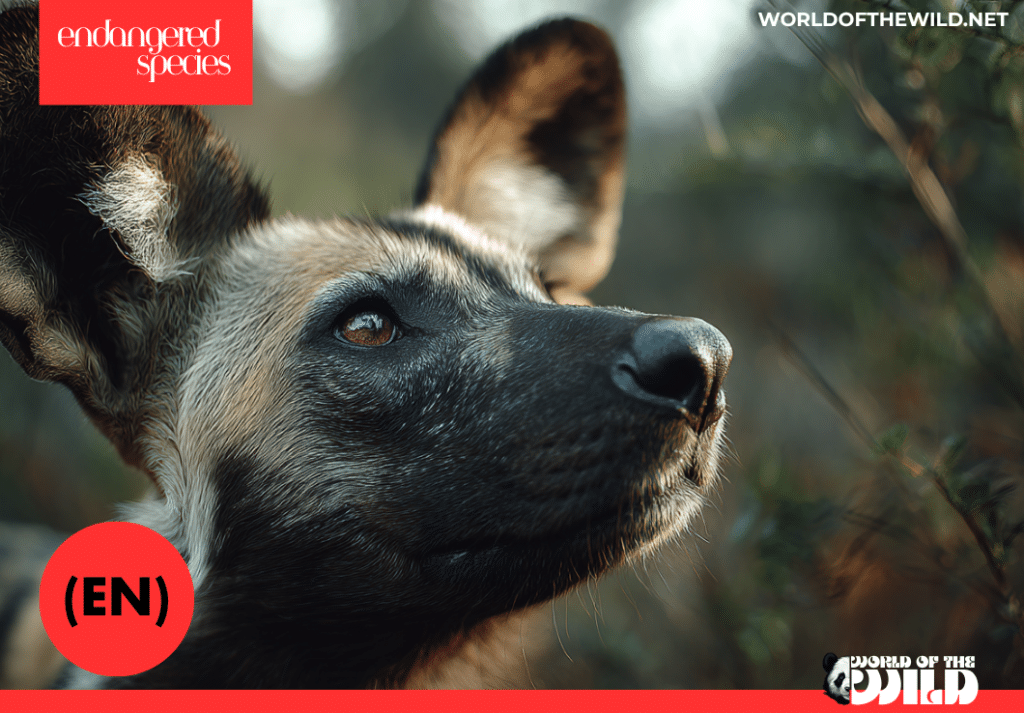
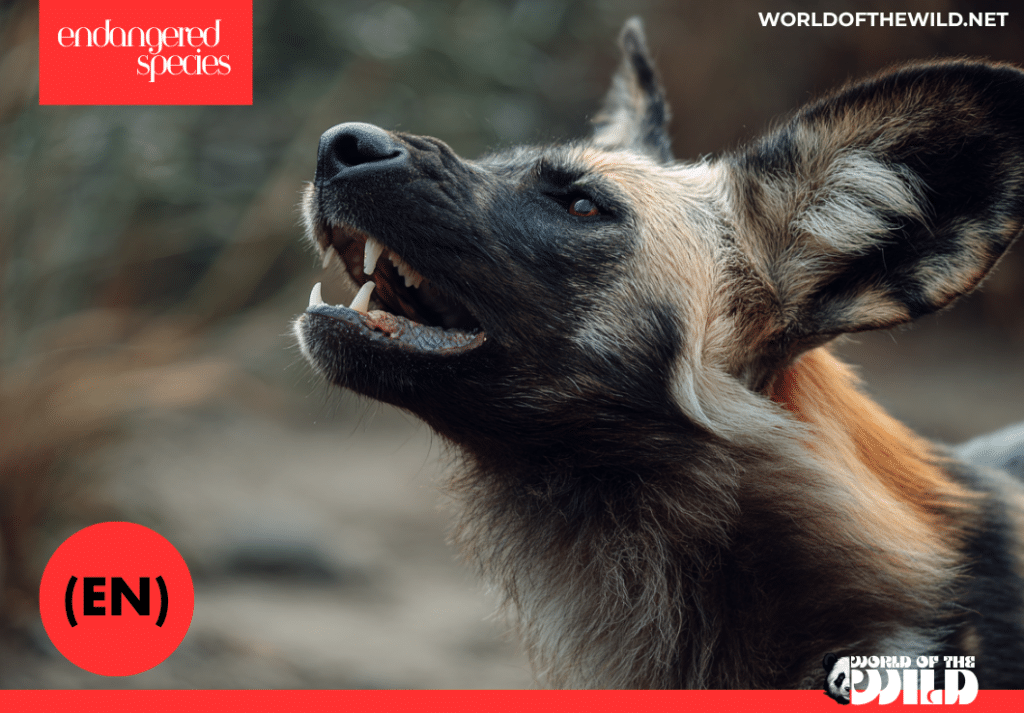
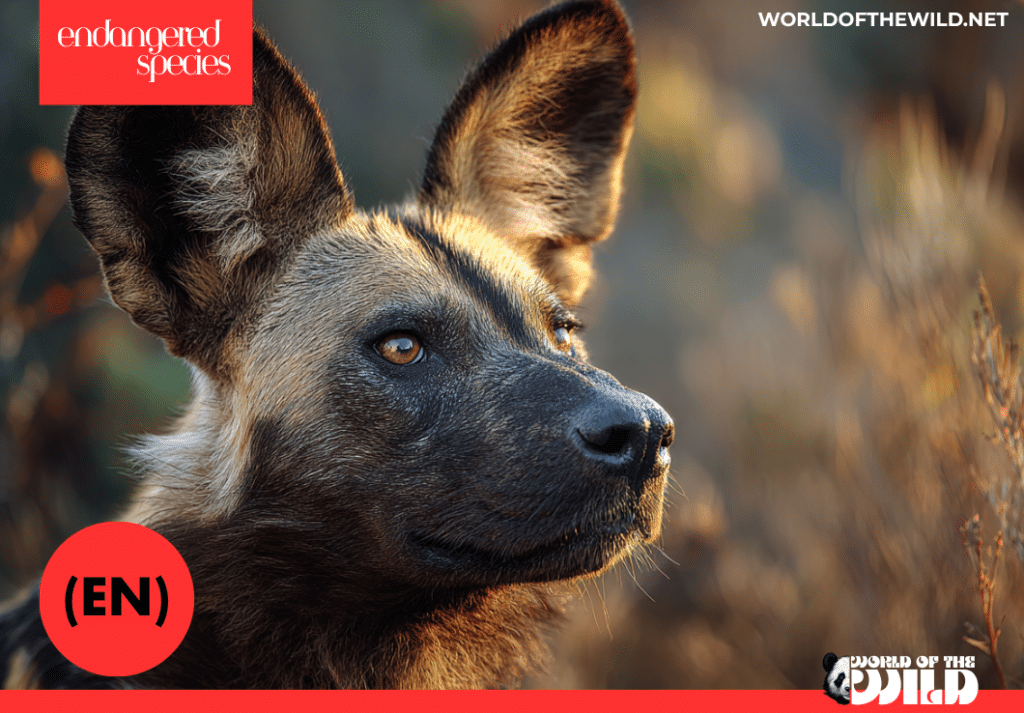
The pack rises from its sleeping hollow in stages. First one painted wolf lifts its enormous, satellite-dish ears — ears that can pivot independently, scanning frequencies from a termite mound’s rustle to a lion’s cough a kilometer away. Then another. Then all of them, simultaneously, in that uncanny way that suggests the pack does not simply communicate; it thinks as a single organism.
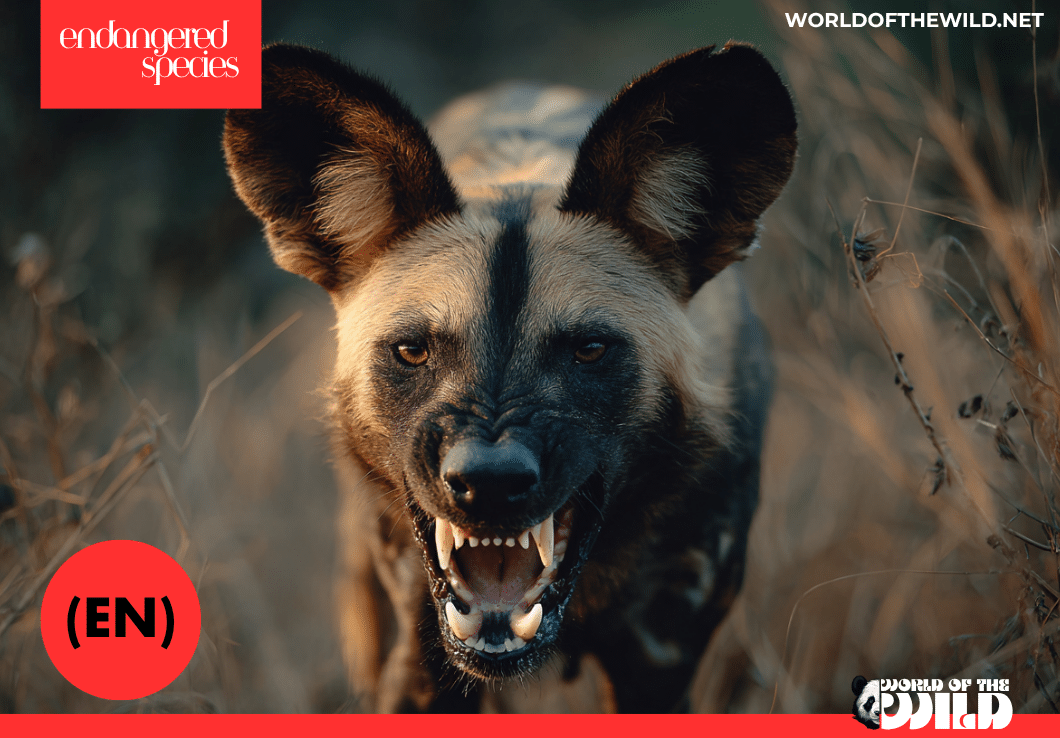
In the grey pre-light, their coats read as chaos — a splatter-paint riot of black, white, amber, and chocolate that seems to make no evolutionary sense until you understand that no two African wild dogs (Lycaon pictus) carry the same pattern. Each coat is as unique as a fingerprint, a biological ID tag worn across muscle and sinew. In the flattened light of dawn, a full pack of them looks like something a child painted with wild, joyful abandon.
The greeting ceremony is brief but intensely physical. Pack members press their muzzles into one another’s flanks, lick faces, whine softly, and spin in tight circles. There is no hierarchy display here — no bared teeth, no mounting, no posturing. This is pure affirmation: We are here. We are together. We are ready. Ethologists who have spent decades watching wolves and domestic dogs describe African wild dog greetings as the most democratically affectionate behavior in any canid.
Then — a shift. One dog, the alpha female, points her narrow muzzle north and begins to trot. The pack falls in without a command, without a signal a human eye could catch. Within thirty seconds, twelve animals are moving as a liquid body across the open grassland, paws barely disturbing the dew-heavy grass, breath steaming in the cool October air of the Okavango Delta.
The hunt unfolds over forty minutes and covers nearly six kilometers. The target is an impala herd grazing near a seasonal waterhole, and the dogs do not chase immediately. They circle. They wait. They assess with those amber eyes — eyes built for distance and movement, wired to a brain running calculations that a cheetah, for all its speed, cannot match. When the chase begins, it is not an explosion of muscle but a sustained, tactical dismantling. One dog flushes, two more angle to cut off escape routes, the rest distribute themselves in a net no prey animal instinctively understands how to escape.
The kill, when it comes, is swift. And then the feast — explosive, communal, joyful even. The pack eats together, and when the alpha female begins to regurgitate food for the pups waiting back at the den, the behavior is so tender, so deliberately nurturing, it takes your breath away.
Status of Survival
The IUCN Red List Verdict
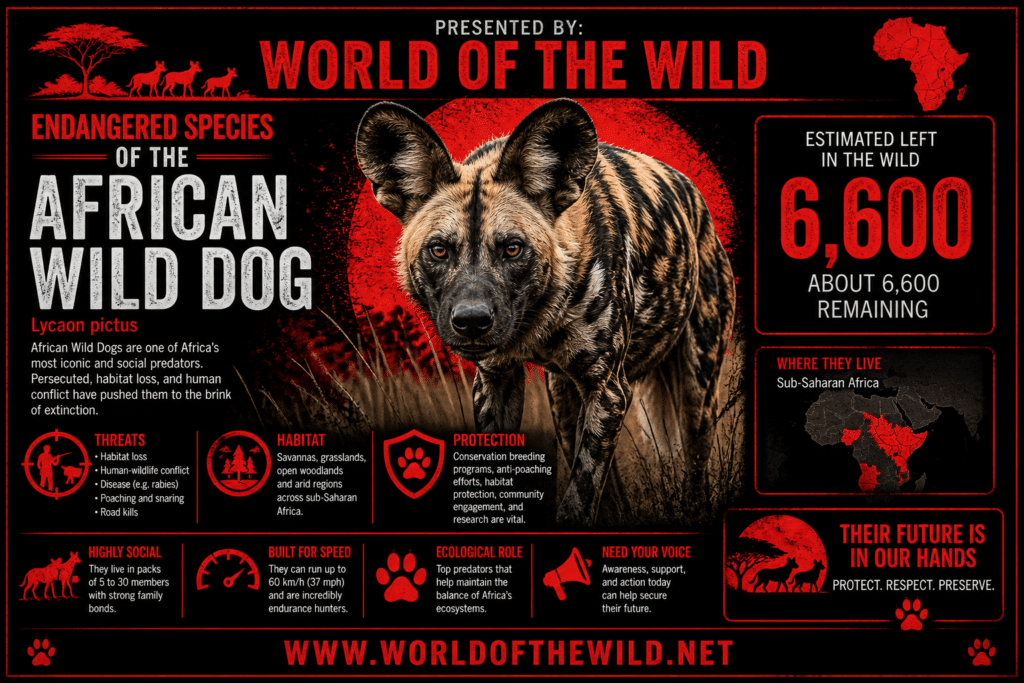
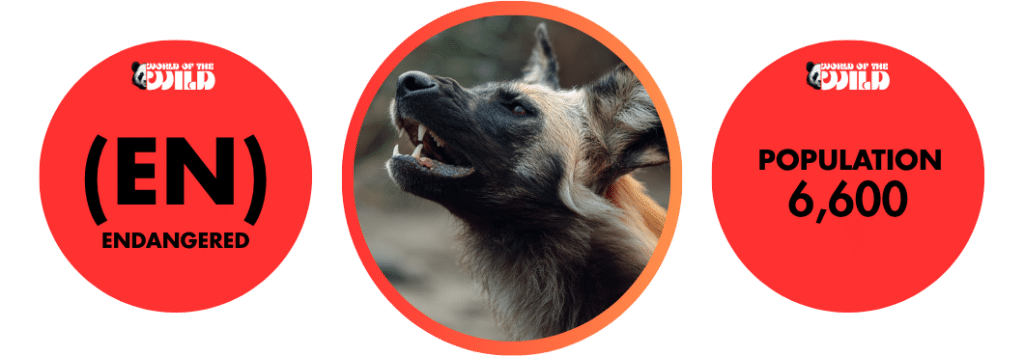
The African wild dog (Lycaon pictus), also called the painted wolf or painted hunting dog, carries one of conservation’s heaviest designations: Endangered on the IUCN Red List, a status it has held continuously since 1990. But a classification on a list is an abstraction. The numbers beneath it are where the true gravity lives.
Current estimates place the global wild population at approximately 6,600 individuals across all age classes, with only around 1,400 of those being breeding adults. To put this in context: there are more wild tigers alive on Earth today than there are reproductively active African wild dogs. There are more snow leopards. There are even more Amur leopards — the world’s rarest big cat — than there are breeding-age painted wolves.
The species once ranged across 39 sub-Saharan African countries in populations numbering in the hundreds of thousands. Today, stable, self-sustaining populations exist in perhaps six to eight countries, with the three core strongholds being Tanzania (particularly the Selous-Niassa ecosystem), Botswana (the Okavango-Chobe system), and Zimbabwe (Hwange National Park and surrounding areas). The vast majority of wild dogs — over 70 percent — now live in just these three ecosystems.
What the Numbers Mean for Genetic Viability
Population genetics does not deal in hope; it deals in mathematics. And the mathematics, for Lycaon pictus, are sobering.
A species requires a minimum effective population size — typically expressed as Ne — to maintain the genetic diversity necessary for long-term evolutionary resilience. Conventional conservation biology suggests a minimum Ne of 500 to prevent the accumulation of inbreeding depression and maintain adaptive potential over centuries. African wild dogs fall dramatically short of this threshold when fragmented populations are examined individually.
Because wild dogs require enormous home ranges — a single pack can roam 500 to 1,000 square kilometers — even nominally “protected” populations become genetically isolated as the human-dominated matrix surrounding national parks grows denser. Isolated populations inbreed. Inbreeding reduces immune function, reproductive success, and pup survival rates. This is not a future risk; researchers have already documented reduced genetic diversity in isolated southern African populations compared to larger East African ones.
The clock is not running out. For some subpopulations, it has already run out. Several small, isolated packs in West and Central Africa — in Nigeria’s Yankari Game Reserve, in Cameroon’s Bénoué complex — are functionally extinct in a genetic sense, surviving as remnants with no realistic path to recovery without active human intervention.
The Map of the Vanishing
A Continental Footprint, Reduced to Fragments
Imagine a map of sub-Saharan Africa. Now shade every country where African wild dogs once roamed in viable numbers. The entire map turns dark — from Senegal in the west to Somalia in the east, from Ethiopia in the north to the Cape of Good Hope in the south. Wild dogs were not a regional animal; they were a continental one.
Now erase all but a handful of isolated green islands. A cluster around the Okavango. A wedge of Tanzania’s southern plains. A strip along Zimbabwe’s western border. Scattered, disconnected fragments in Kenya, Zambia, Mozambique, and South Africa. That is the map of Lycaon pictus today — not a range, but a series of refuges, each one surrounded by an ocean of unsuitable or hostile terrain.
Ultimately, the fate of the African Wild Dog depends on human action.
The species favors open and semi-open habitats: short-grass savannas, open woodlands, and scrub-lands where visibility is high enough for a coursing predator to operate. It thrives in low-to-medium prey density ecosystems — not the thick prey concentrations of the Serengeti plains (which also support lions in densities that crush wild dog populations), but the sparser, more dispersed ungulate communities of places like the Selous or the Limpopo. This specialization makes the wild dog exquisitely sensitive to habitat transformation.
The Keystone Question: What Happens If They Vanish?
African wild dogs are not merely apex predators; they are ecosystem engineers in a subtler, less celebrated way than lions or leopards.
Their hunting style — long-distance coursing that selectively targets weakened, old, or diseased individuals — acts as a quality filter on prey populations. Unlike ambush predators, which often take the most accessible animal regardless of condition, wild dogs consistently pursue individuals that flee awkwardly or tire quickly. This “culling of the weak” suppresses the spread of diseases like bovine tuberculosis and foot-and-mouth disease through ungulate herds, keeping prey populations robust and disease-resistant.
Beyond disease suppression, the landscape of fear that wild dogs create shapes how prey animals use terrain. Impala herds in wild dog range avoid specific corridors and valley systems — behavioral changes that reduce overgrazing of vulnerable riparian vegetation and allow riverine forests to regenerate. Remove the dogs, and herbivores redistribute. Vegetation patterns shift. Bird communities dependent on specific plant structures decline. The cascade is slow, measured in decades, but it is real.
Perhaps most critically, wild dogs exist as a sentinel species — their presence indicates an ecosystem of sufficient scale, connectivity, and prey diversity to sustain a wide-ranging social predator. Where wild dogs persist, wilderness persists. Where they vanish, the wilderness has already been compromised beyond a threshold that most other megafauna can detect but none can articulate.
The Descent — How We Got Here
A Century of Systematic Destruction
The story of the African wild dog’s decline is not a simple tale of poaching or habitat loss in isolation. It is a compound collapse — multiple pressures arriving simultaneously, amplifying each other in ways no single intervention could have stopped.
The first act was persecution. For most of the twentieth century, African wild dogs were systematically exterminated across their range. Colonial-era game management programs classified them as “vermin” — destructive, cruel, and valueless. South Africa’s game rangers shot them on sight. Botswana’s livestock protection programs offered bounties. Kenya eradicated them from most of the country by the 1970s. The Serengeti ecosystem — which once held hundreds of dogs — was reduced to functionally zero by the mid-1990s, a collapse driven in part by a distemper outbreak but accelerated by decades of direct killing.
The logic behind the persecution was both economically motivated and aesthetically driven. Wild dogs kill messily. Their prey animals die in minutes, but the method — disembowelment and consumption while still living — horrified European observers who romanticized the lion’s suffocating bite as somehow “noble.” The painted wolf was cast as a villain in Africa’s wildlife narrative, and that vilification had lethal consequences.
The second act was habitat fragmentation. Africa’s human population growth through the latter half of the twentieth century was among the fastest in recorded history. Between 1950 and 2000, the continent’s population quadrupled. Agricultural expansion, particularly the conversion of savanna to smallholder and commercial farmland, chewed through wild dog range at a pace conservation infrastructure could not match.
Wild dogs are extraordinarily sensitive to fragmentation because of their spatial requirements. A pack of ten animals needs a functioning home range of 400 to 900 square kilometers — an area larger than Singapore — to sustain itself across seasonal prey fluctuations. When that range is bisected by a fence line, a road, a village, or a cattle post, the pack doesn’t simply shift. It fractures. Sub-adults who would normally disperse to form new packs find no viable territory. The pack’s genetic pipeline collapses.
The third act is disease. Rabies and canine distemper virus (CDV) represent existential threats to small, isolated populations of wild dogs. Both diseases are maintained in domestic dog populations that increasingly overlap with wild dog range as rural communities expand into buffer zones. A single rabies outbreak in a small pack — particularly one in which the alpha pair is lost — can eliminate a unit that took years to establish. The Serengeti’s wild dog population suffered at least two catastrophic disease events in the 1990s from which it never recovered.
A landmark 1992 study in Hwange National Park documented an outbreak that killed 52 of 54 animals in a single pack within weeks — a mortality rate that makes the species’ dependence on multi-pack metapopulation dynamics viscerally clear. One bad event, in one isolated population, can erase years of reproduction.
The fourth act is human-wildlife conflict, and it remains the most politically intractable driver of decline. Wild dogs range widely and do not respect the invisible lines of national park boundaries. A pack that sleeps in the Kruger at night may hunt cattle on communal land in the morning. Retaliatory killing by farmers is not the act of villains; it is the rational economic response of people for whom a single lost cow represents 20 percent of annual household income.
The fifth, and most recent act is climate change. Long-term temperature increases across southern and eastern Africa are compressing the thermal window within which wild dogs can hunt. As a coursing predator that relies on sustained physical exertion, Lycaon pictus is highly susceptible to heat stress. Studies published in the 2010s demonstrated that rising ambient temperatures are already reducing daily hunting time in the Kalahari, forcing packs to hunt less frequently than prey population dynamics require. Pup survival in packs with restricted hunting windows is measurably lower. In a warming world, this pressure will only intensify.
The Front Lines of Conservation
Who Is Fighting — and How
The conservation of African wild dogs is not a single campaign. It is a decentralized war fought on a dozen fronts simultaneously, by organizations and individuals who have dedicated careers — in some cases, entire lives — to preventing the extinction of a species most of the world has never heard of.
The Endangered Wildlife Trust (EWT) in South Africa operates one of the continent’s most sophisticated wild dog conservation programs, combining GPS-collar monitoring of every known pack in southern Africa with a comprehensive livestock compensation scheme that pays farmers market value for livestock lost to wild dog predation. The compensation scheme is not charity; it is a calculated investment in removing the economic incentive for retaliatory killing. Since its expansion in the 2010s, retaliatory killing of collared packs in EWT’s coverage area has dropped by more than 60 percent.
The African Wildlife Foundation (AWF) has pioneered community-based conservation corridors in Tanzania and Kenya, working with Maasai communities to establish wildlife-friendly grazing agreements that preserve movement corridors between protected areas. These corridors — sometimes only a few kilometers wide — allow dispersing wild dogs to traverse human-dominated landscapes and reach suitable habitat in adjacent protected areas, maintaining the genetic connectivity that isolated populations desperately need.
Painted Dog Conservation (PDC), based adjacent to Hwange National Park in Zimbabwe, has combined anti-snare patrols, community education, and a rehabilitation center for snare-injured dogs into one of Africa’s most integrated single-species conservation operations. Since 1992, PDC has removed more than 50,000 wire snares from Hwange and the surrounding landscape — snares set primarily for bushmeat, which kill wild dogs as non-target bycatch with brutal efficiency.
Radical Science on the Savanna
Beyond traditional conservation, a wave of technological and biological interventions is reshaping what is possible for wild dog recovery.
Drone monitoring has transformed survey capacity in areas too remote or dangerous for ground teams to cover reliably. Conservation organizations in the Selous-Nyerere ecosystem are now using long-range fixed-wing drones equipped with thermal imaging to track pack movements, identify new den sites, and detect signs of disease within days rather than weeks. Early disease detection is particularly critical — a pack showing behavioral changes consistent with rabies can now be identified, and emergency oral rabies vaccination deployed, before the outbreak spreads.
Oral rabies vaccination programs represent one of the most cost-effective interventions available. Rather than capturing wild dogs for injection — a stressful, logistically complex procedure — researchers embed vaccine-laced bait in a wild dog’s favorite food (typically a chicken carcass) and drop it along known pack routes. Uptake rates in trial programs in South Africa have exceeded 70 percent, dramatically reducing pack vulnerability to this most immediate disease threat.
Metapopulation management — the deliberate, coordinated management of multiple small populations as a single, interconnected unit — is perhaps the most ambitious scientific program underway. Pioneered in South Africa under the coordination of the EWT and SANParks (South African National Parks), the program manages more than 30 packs across 48 reserves as if they were a single, structured breeding population. Animals are translocated between reserves to prevent inbreeding, establish new packs, and reinforce declining populations. The program has increased South Africa’s wild dog population from approximately 400 animals in the early 2000s to over 700 today — a near-doubling that would have been impossible without centralized genetic management.
Hero of the Species: Dr. Rosie Woodroffe
If any single scientist can be said to have reshaped the trajectory of wild dog conservation, it is Dr. Rosie Woodroffe of the Zoological Society of London. Over a career spanning more than three decades, Woodroffe has conducted landmark research dismantling almost every false assumption that drove historical wild dog persecution.
Her work on the relationship between wild dog pack size and hunting success demonstrated that dogs are not the livestock-killing machines that farmers feared — in most ecosystems, livestock depredation accounts for less than 2 percent of wild dog diet. Her research on the impact of protected area boundaries — published in the journal Science in 1998 and still cited as foundational — showed that edge effects killed more wild dogs outside park boundaries than any other single factor, transforming how conservation managers think about buffer zone management.
More recently, Woodroffe’s research has focused on the use of livestock protection methods — including flashing light systems, community livestock corrals (bomas), and guard dog programs — to reduce conflict at the wild dog-human interface. Her collaboration with pastoral communities in Kenya has demonstrated that non-lethal deterrence can reduce livestock losses by up to 80 percent without requiring the removal of wild dogs from the landscape.
In a discipline often defined by its pessimism, Woodroffe is notable for a measured, evidence-based optimism. “Wild dogs are resilient,” she has said in multiple interviews. “They just need space, and they need us to stop killing them. If we can provide those two things, they will do the rest.”
The Odds of Tomorrow
A Realistic Reckoning
Fifty years is both a long time and an eyeblink in conservation terms. It is long enough for a species to recover; it is also long enough for the last viable populations to collapse. For African wild dogs, the trajectory of the next half-century will be determined by decisions made in the next decade — decisions about land use, disease management, climate policy, and the fundamental question of whether humanity is willing to share a continent with one of its most extraordinary predators.
Best Case Scenario
The optimistic projection is not fantasy — it is biology operating under improved conditions.
In the best case, the southern African metapopulation continues to grow under coordinated genetic management, reaching 1,200 to 1,500 animals in South Africa alone by 2075. Transfrontier conservation areas — enormous cross-border wilderness blocks like the Kavango-Zambezi Transfrontier Conservation Area (KAZA), which already spans 520,000 square kilometers across five countries — achieve sufficient protection and connectivity to allow wild dogs to function as a self-sustaining metapopulation across Botswana, Zimbabwe, Zambia, Namibia, and Angola simultaneously.
Oral rabies vaccination programs, scaled with improved drone delivery systems, suppress disease outbreaks to isolated, non-lethal incidents. Community compensation schemes, funded by a combination of government wildlife taxes and eco-tourism revenue, eliminate the economic incentive for retaliatory killing across the species’ core range. Climate adaptation programs protect critical hunting habitat through the preservation of woodland cover that reduces ambient temperatures in key territories.
In this scenario, the global wild population could reach 12,000 to 15,000 individuals by 2075 — still a fraction of historical abundance, but sufficient for genetic viability and with genuine prospects of continued growth. The IUCN Red List status could be downlisted from Endangered to Vulnerable, representing one of conservation’s genuine success stories.
The preconditions for this outcome are not impossible. They require sustained political will, continued eco-tourism revenue flowing into range-state conservation budgets, and the expansion of community-based conservation frameworks that make wild dogs economically valuable to the people who live alongside them.
Worst Case Scenario
The pessimistic projection is also not fantasy. It is simply the current trajectory, extended forward without meaningful intervention.
In the worst case, climate change intensifies drought cycles across southern and eastern Africa, compressing prey populations and increasing livestock-herder conflicts throughout wild dog range. Human population growth — Africa is projected to reach 4 billion people by 2100 — converts the remaining buffer zones surrounding wild dog strongholds into agricultural and pastoral land. Eco-tourism revenue, increasingly vulnerable to geopolitical instability and the economics of long-haul travel, declines as a conservation funding mechanism. Range-state governments, facing impossible tradeoffs between wildlife and human food security, divert conservation resources elsewhere.
In this scenario, the southern African metapopulation fragments into genetically unviable isolates by the 2040s. East African populations, already hanging by the thread of the Selous-Niassa ecosystem’s integrity, suffer catastrophic disease events from which they cannot recover given reduced pack connectivity. West and Central African populations — already functionally extinct in genetic terms — disappear entirely.
By 2075, fewer than 2,000 wild dogs remain globally, all confined to intensively managed reserves in southern Africa and surviving only through permanent human life support. The species would exist, technically, but as a conservation artifact — present in the database but absent from the ecosystem function that makes its presence meaningful.
The Variable That Decides Everything
Between these two trajectories lies a single variable that no model can quantify with precision: political and economic will. The science of wild dog conservation is, in its broad outlines, understood. The biology is known. The interventions — disease management, conflict mitigation, corridor protection, metapopulation management — are proven. What remains uncertain is whether the countries that harbor wild dogs, and the international community that claims to value biodiversity, will invest the resources necessary to implement these interventions at scale, consistently, for decades.
The African wild dog is not going quietly. It hunts at dawn with intelligence and grace. It raises its pups with a tenderness that rivals any mammal on Earth. It maintains the grasslands that sustain the prey that sustain the larger predators that sustain the ecosystem that sustains us all, in chains of dependency so long and subtle that we rarely follow them to their source.
The question is not whether the painted wolf can survive. The question is whether we will give it the chance.
All population figures and conservation status data current as of early 2026. IUCN Red List classification: Endangered (Lycaon pictus). Key sources: IUCN SSC Canid Specialist Group, Endangered Wildlife Trust, Zoological Society of London Wild Dog Research Programme, African Wildlife Foundation.
World of the Wild | Endangered Species Series Committed to science-based storytelling for the wild places that remain.