
There is a moment — if you are quiet enough, patient enough, and lucky enough — when the tall reeds of a marshy lakeshore seem to breathe. A long, sinuous neck uncoils from the vegetation, and what appeared to be nothing more than a cluster of dead cattails suddenly reveals itself: a Purple Heron, motionless and ancient-looking, watching the water with amber eyes that have not blinked in what feels like forever.
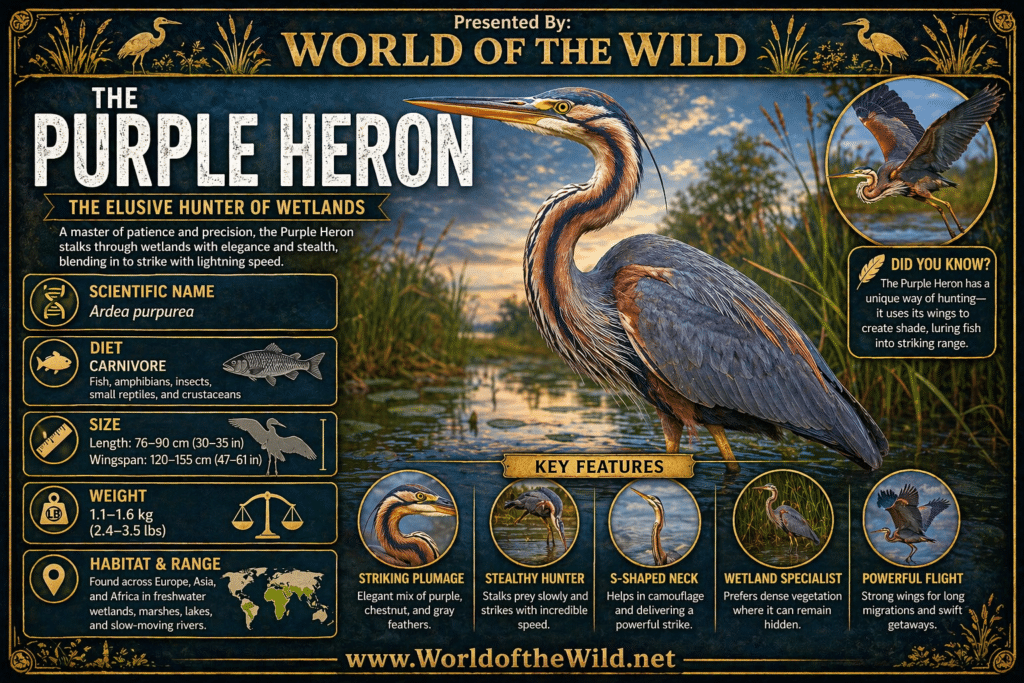
The Purple Heron (Ardea purpurea) is one of those creatures that rewards those who pay attention. Slimmer and darker than its famous cousin the Grey Heron, and considerably more secretive, this bird occupies a strange and beautiful niche in the ecosystems of Europe, Africa, and Asia. It is not purple in the way a violet or a plum is purple — it is something more complex: a deep chestnut, smoky slate, and burnished rust-red that shifts in different lights, the colors of old iron and dried wine. It is a master of disappearing into the landscape, a ghost that stalks the shallow edges of the world’s wetlands.
Yet for all its reticence, the Purple Heron has a story worth telling — one of evolutionary elegance, remarkable adaptation, and quiet resilience in a world that is steadily draining the very habitats it needs to survive.
Facts
- It is not actually purple. Despite its name, the Purple Heron’s plumage is largely a blend of slate-grey, chestnut, and tawny rufous tones. The “purple” refers to the iridescent gloss visible on certain feathers in optimal lighting conditions.
- It has a dramatically thin neck. In proportion to its body, the Purple Heron has one of the most slender necks of any large heron species, which it can compress and contort into an extraordinary S-shape when stalking prey.
- It can stand completely still for 30 minutes or more. This species is renowned for its freeze-response — it will point its bill skyward and stiffen its body to blend into reed beds, sometimes holding the pose long enough to fool even experienced birdwatchers.
- It is a long-distance migrant. European populations travel thousands of miles each year to winter in sub-Saharan Africa, crossing deserts and mountain ranges in the process.
- It nests in enormous colonies. While solitary when feeding, Purple Herons can gather in large mixed-species colonies during the breeding season, sometimes sharing nesting sites with Glossy Ibis, Night Herons, and Little Egrets.
- Its call is a jarring bark. The Purple Heron communicates with a harsh, frog-like “kraak” that sounds decidedly un-birdlike, often startling observers who hear it before they see the bird.
- Chicks are fed by regurgitation. Parent birds carry partially digested fish back to the nest and regurgitate it directly into the mouths of their young — a feeding strategy shared by most heron species but no less extraordinary for it.
Species
The Purple Heron belongs to the following taxonomic hierarchy:
- Kingdom: Animalia
- Phylum: Chordata
- Class: Aves
- Order: Pelecaniformes
- Family: Ardeidae
- Genus: Ardea
- Species: Ardea purpurea
The species was formally described by the Swedish naturalist Carl Linnaeus in 1766. The genus Ardea is one of the most widespread and recognizable in the heron family, containing giants of the avian world such as the Grey Heron (Ardea cinerea), the Goliath Heron (Ardea goliath) — the largest heron on Earth — and the Great Blue Heron (Ardea herodias) of North America.
Within Ardea purpurea, several subspecies are recognized, though taxonomic boundaries remain a subject of ongoing discussion among ornithologists:
- Ardea purpurea purpurea — The nominate subspecies, breeding across Europe, the Middle East, and Central Asia, and wintering largely in sub-Saharan Africa.
- Ardea purpurea bournei — An endangered and sedentary subspecies endemic to the Cape Verde Islands off the west coast of Africa. It is darker and larger than the nominate form and faces significant pressure from habitat degradation.
- Ardea purpurea manilensis — Found across South and Southeast Asia, from the Indian subcontinent through to the Philippines and Indonesia. It is generally considered more resident than migratory.
Some authorities have proposed splitting the Asian populations into a separate species entirely, though this has not yet achieved consensus in the ornithological community. The species’ closest relatives include the Great-billed Heron of Australasia and the Goliath Heron of Africa, both of which share the same broad-shouldered, long-necked silhouette that defines the Ardea lineage.
Appearance
The Purple Heron is a large bird, though it is noticeably more slender and elongated than the Grey Heron with which it is often compared. Adults typically stand between 31 and 38 inches (roughly 2.6 to 3.2 feet) tall, with a wingspan ranging from 35 to 51 inches. They weigh between 1.3 and 3.5 pounds, making them lighter than their bulk might suggest — a testament to the hollow bone structure common across birds.
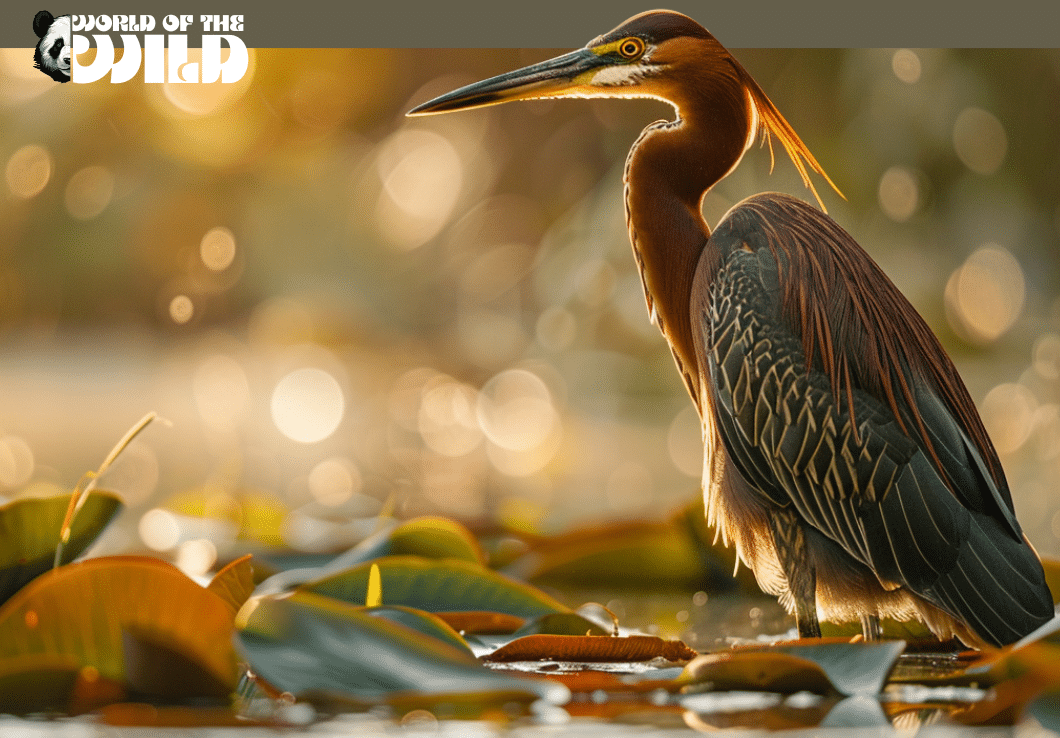
The plumage of an adult Purple Heron is a layered tapestry of color. The crown is a deep black, from which drooping black plumes hang at the rear, giving the head a crested, somewhat ominous appearance. The sides of the neck are a rich chestnut-rufous, streaked with bold lines of black and white that run vertically along the throat — a pattern that is highly distinctive and unlike any other European heron. The back and wings are a blue-grey tinged with darker slate, and in strong sunlight, the wing coverts can show that subtle purplish iridescence that lends the bird its name. The underparts are a warm buff-chestnut, shading into darker maroon tones along the flanks.
The bill is long, dagger-shaped, and yellow-orange — a formidable hunting tool adapted to spearing fish with explosive speed. The legs are yellow-brown to reddish, and the feet are impressively large, spread wide to distribute the bird’s weight across soft, muddy, or floating vegetation. During the breeding season, the bare skin around the eye and at the base of the bill flushes a vivid pinkish-red.
Juvenile birds are considerably duller — sandy brown above and streaked pale below — and lack the bold neck markings of the adults. They can be confusing in the field and are sometimes mistaken for immature Bitterns (Botaurus stellaris), a species that shares similar marshy habitats and neck-pointing defensive behaviors.

Behavior
The Purple Heron is predominantly a solitary hunter, and this is where its character truly emerges. Unlike the Grey Heron, which stands conspicuously in open water or fields, the Purple Heron is a creature of cover. It hunts from the margins of dense reed beds, moving with extraordinary deliberateness through tangled vegetation, placing each foot slowly and deliberately before committing its weight — a style of locomotion that minimizes ripples and vibrations that could alert prey.
When hunting, it employs the classic heron strategy of “stand and wait” — positioning itself at the water’s edge and remaining utterly still until a fish, frog, or invertebrate comes within striking range. The strike itself is almost impossibly fast: the S-curved neck straightens in a fraction of a second, and the bill hits the water with surgical precision. The bird then typically manipulates the prey — tossing it into the air and catching it headfirst before swallowing.
One of the Purple Heron’s most striking behavioral adaptations is its cryptic posturing. When alarmed, it will stretch its neck vertically, compress its feathers tightly against its body, and point its bill upward at a sharp angle — aligning its streaked neck plumage with the vertical lines of the surrounding reeds. In this posture, a large heron can become effectively invisible to predators and observers alike.
The species is largely crepuscular and diurnal in its feeding habits, though it will forage at dawn and dusk when insect activity peaks. Communication is primarily through harsh vocalizations at the breeding colony — a cacophony of croaks, grunts, and bill-clattering during territorial disputes and courtship displays.
In terms of intelligence, herons as a family have demonstrated problem-solving abilities in studies, including the use of “bait fishing” — dropping small objects onto the water’s surface to attract fish — though this behavior has been documented more frequently in Green Herons (Butorides virescens) than in the Purple Heron specifically.
Evolution
Herons belong to the ancient family Ardeidae, which fossil evidence suggests diverged from other waterbirds during the Eocene epoch, roughly 50 million years ago. The family has remained remarkably morphologically consistent across this vast span of time — a sign that the body plan of a long-legged, long-necked wading bird is an extraordinarily effective solution to the ecological problem of hunting in shallow water.
The genus Ardea itself appears in the fossil record by the Miocene (around 10 to 20 million years ago), and the lineages that would eventually produce today’s large herons were likely already diverging during this period, shaped by the repeated expansion and contraction of wetland habitats as global climates shifted.
The Purple Heron’s closest evolutionary relatives — the Grey Heron, Goliath Heron, and Great Blue Heron — suggest a cosmopolitan ancestor that colonized multiple continents over millions of years. Molecular phylogenetic studies have confirmed that the large Ardea herons form a coherent evolutionary group, with the Purple Heron representing a lineage that specialized particularly in denser, more vegetated freshwater habitats compared to the more open-water preferences of the Grey Heron.
The species’ remarkable cryptic adaptations — its streaked neck, freeze-response, and preference for reed-bed hunting — are believed to represent derived traits that evolved in response to both predation pressure and the energetic advantages of ambush-style hunting in sheltered microhabitats. These traits are convergently echoed in the unrelated Eurasian Bittern, which independently evolved virtually identical strategies in the same ecological niche.
Habitat
The Purple Heron is intimately tied to freshwater wetlands, and more specifically to habitats dominated by tall emergent vegetation — principally common reed (Phragmites australis), bulrushes (Typha spp.), and papyrus (Cyperus papyrus). It is a bird of the reed bed in a way that few other large waterbirds truly are, using dense vegetation not just as cover but as a structural element of its hunting, roosting, and nesting strategy.
Its geographic range is vast. In Europe, breeding populations are found across the Mediterranean basin, France, the Netherlands, Germany, and eastward through Central Asia. These populations are strongly migratory, departing for sub-Saharan Africa — particularly the Sahel zone, the Congo Basin wetlands, and East African lakes — in late summer and returning in spring. Year-round resident populations exist across much of South and Southeast Asia, from the Indian subcontinent through Sri Lanka, Indochina, Indonesia, and the Philippines, where the bird occupies river margins, rice paddies, mangroves, and coastal lagoons in addition to freshwater reed beds.
Key habitat features include slow-moving or still water (rivers, lakes, reservoirs, floodplains, deltas, marshes), water depths typically between 4 and 20 inches — shallow enough for wading — and the presence of dense bankside vegetation for cover. The species is somewhat more tolerant of disturbed habitats than many wetland birds, and has been recorded in rice paddy fields and irrigation channels across Asia, provided sufficient cover exists nearby.
Diet
The Purple Heron is a carnivore, and a highly capable one. Its diet is dominated by fish, which form the core of its nutritional intake across most of its range and throughout most of the year. Species taken typically depend on local availability and include small cyprinids, eels, perch, and various other freshwater fish generally measuring between 1 and 6 inches in length — prey small enough to be swallowed whole.
Beyond fish, the Purple Heron is an opportunistic feeder with a broad palate. Frogs and toads are frequently taken, particularly during the breeding season when high protein demands coincide with amphibian breeding activity. Aquatic invertebrates — dragonfly larvae, water beetles, and crustaceans — supplement the diet, as do small mammals (voles and mice are occasionally recorded), lizards, and even small birds and their eggs during periods of food stress.
The hunting technique is primarily “stand and wait” ambush predation, as described above, though the bird will also wade slowly through shallow water in a deliberate stalking movement, or use a “wing-spreading” technique occasionally documented in the species — spreading the wings outward to create a canopy of shade over the water, reducing surface glare and making fish below more visible, while simultaneously attracting fish seeking shade.

Predators and Threats
Natural Predators
Adult Purple Herons face relatively few predators given their size, wariness, and cryptic behavior. Foxes (Vulpes vulpes), Marsh Harriers (Circus aeruginosus), and White-tailed Eagles (Haliaeetus albicilla) have been recorded predating nesting adults and eggs in European populations. Nests — particularly those built at low heights in reed beds — are vulnerable to ground predators including mink (Neovison vison), a significant invasive predator in Europe. Chicks face higher mortality from aerial predators, and siblicide (the killing of weaker nestlings by stronger siblings) is not uncommon within the nest.
Human-Caused Threats
The most significant threats to the Purple Heron are human-driven and structural:
- Wetland drainage and degradation remain the primary driver of population decline across its range. The conversion of wetlands to agriculture, urban development, and water management for irrigation has eliminated enormous areas of reed-bed habitat across Europe and Asia over the past century.
- Reed bed management — the cutting, burning, or flooding of reed beds — can destroy nesting sites and foraging cover with little warning.
- Drought and climate change are altering the water levels and seasonal dynamics of the wetlands the Purple Heron depends on, particularly in its African wintering grounds. Prolonged droughts in the Sahel have been linked to population declines in European breeding populations.
- Pollution — including agricultural runoff, heavy metal accumulation in fish, and pesticide use — degrades water quality and reduces prey availability.
- Hunting and disturbance remain localized threats in parts of Asia and Africa, though they are not considered major drivers of population change at a global level.
- Invasive species, particularly American Mink in Europe, have increased predation pressure at nesting colonies.
Reproduction and Life Cycle
The Purple Heron is a seasonally monogamous species, forming pair bonds anew each breeding season. In European populations, birds return to breeding colonies in April and May after their long migration from Africa. Courtship is an elaborate affair — males arrive at the colony first and establish territories within the reed bed or adjacent scrub, performing ritualized displays that include stretching the neck upward, raising the ornamental plumes on the back and breast, and making a series of croaking calls to attract females.
Nest building or refurbishment begins once a pair forms. The nest itself is a substantial platform of reed stems, sticks, and aquatic vegetation, built within dense reed beds or occasionally in low willows and alder scrub overhanging water. Nests are typically positioned 3 to 6 feet above the waterline and measure 20 to 30 inches across — large enough to accommodate a growing brood.
The female lays a clutch of 3 to 5 eggs (occasionally up to 8), which are a distinctive pale blue-green color. Both parents share incubation duties over a period of approximately 25 to 28 days. Chicks hatch asynchronously — not all at the same time — which means older, stronger chicks have a developmental advantage over later-hatching siblings, and in lean food years, the youngest chicks may not survive.
The young are altricial at hatching — helpless, downy, and entirely dependent on parental feeding. They grow rapidly, however, and fledge at approximately 45 to 50 days of age. Juveniles reach sexual maturity at around 2 years old, though first breeding is often not successful.
In the wild, Purple Herons have been recorded living up to 23 years, though average lifespan in wild populations is considerably lower — likely in the range of 5 to 10 years — due to the high mortality of first-year birds during migration and their first African winter.

Population
The Purple Heron is currently assessed as a species of Least Concern on the IUCN Red List, reflecting its wide global distribution and large overall population. Global population estimates are difficult to pin down precisely given the species’ range across three continents, but figures typically cited range from 170,000 to 590,000 mature individuals worldwide.
However, this relatively stable global status masks significant regional variation. European breeding populations — which are among the best monitored — declined substantially across the 20th century due to wetland loss and hunting, though many populations have partially recovered since the 1970s and 1980s following legal protection and wetland restoration initiatives. The Netherlands, France, and Spain now hold some of the most significant European breeding populations.
The Cape Verde subspecies (A. p. bournei) remains a matter of serious concern, with only a few hundred individuals believed to persist on the islands. It is considered one of the most threatened island heron populations in the world.
In Asia, populations remain large and largely stable across the Indian subcontinent and Southeast Asia, though localized declines have been documented where wetland conversion is most severe. Across sub-Saharan Africa — both as a wintering ground for European birds and as a year-round home for resident populations — habitat trends are mixed, with some areas experiencing significant wetland loss and others remaining relatively intact.
The overall trajectory for the species is one of cautious stability, contingent on continued wetland conservation and management across all parts of its range.
Conclusion
The Purple Heron is a bird that asks something of us: patience, attention, and a willingness to look more carefully at a world we often assume we already understand. In the reeds where it hunts — coiled, unhurried, and extraordinarily precise — it embodies something essential about the logic of wild places: that concealment and survival are inseparable, and that the most extraordinary things are often hiding in plain sight.
Its story is also, unavoidably, a conservation story. The wetlands this bird calls home are among the most threatened ecosystems on Earth — drained, polluted, and shrinking at a rate that has accelerated with climate change and growing agricultural demand. Every reed bed restored, every seasonal flood allowed to run its natural course, every drainage scheme reconsidered represents not just a habitat saved but a thread retained in the complex ecological fabric that the Purple Heron — and thousands of other species — depend upon.
The next time you stand at the edge of a marsh at dawn, watch the reeds. Watch them carefully. Something ancient and patient may be watching back.
Quick Reference
| Field | Detail |
|---|---|
| Scientific Name | Ardea purpurea |
| Diet Type | Carnivore (fish, amphibians, invertebrates, small mammals) |
| Size | 31–38 inches tall (approx. 2.6–3.2 feet); wingspan 35–51 inches |
| Weight | 1.3–3.5 pounds |
| Region Found | Europe, sub-Saharan Africa, South Asia, Southeast Asia, Cape Verde Islands |