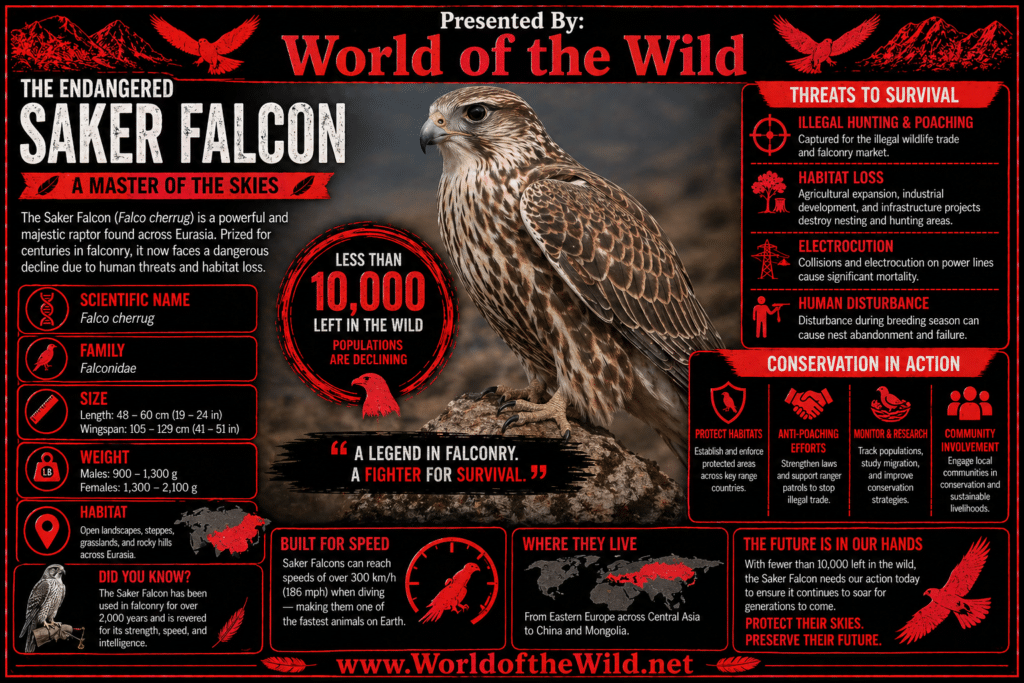

World of the Wild | Endangered Species Series
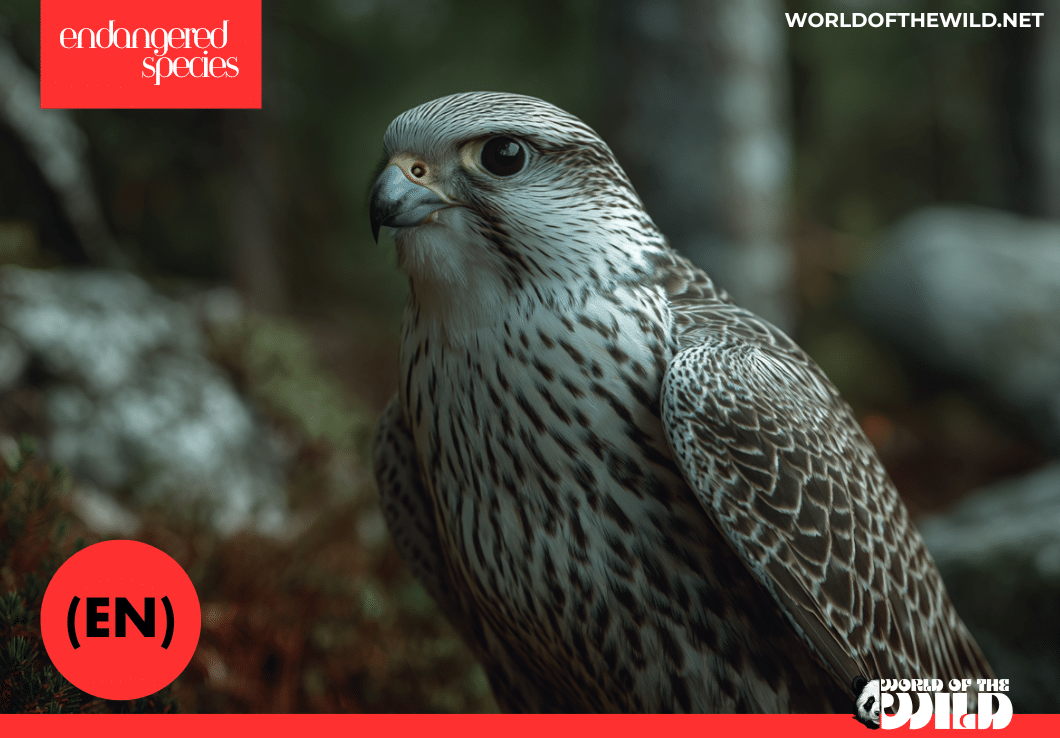
The Ghost of the Palearctic
The steppe at dawn does not announce itself. It simply arrives — a slow tide of amber rolling across an ocean of grass, stretching from the Pannonian plains of Hungary to the wind-scoured plateaux of Mongolia, a distance so vast that it swallows nations whole. In the last cold minutes before sunrise, the land is silent in the way that only genuinely wild places can be: a silence thick with the smell of frost-bitten soil, dried artemisia, and the faint musk of prey animals that passed through in the night.
And then, from a limestone outcrop above a river bend, something moves.
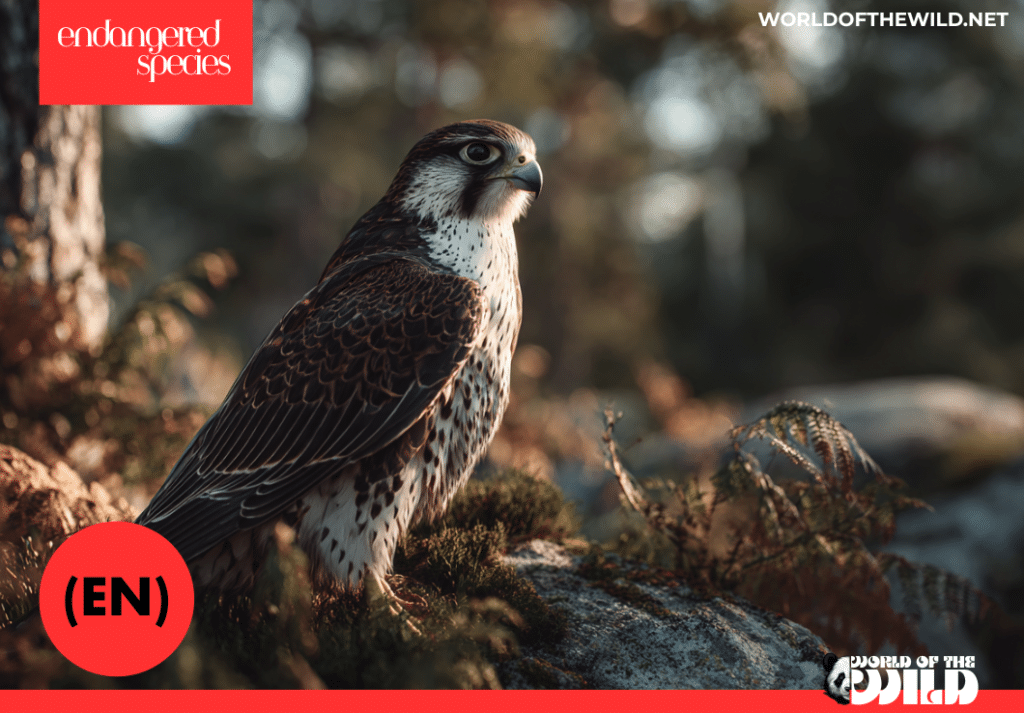
She has been awake for nearly an hour already — a large female Saker Falcon (Falco cherrug), her back the colour of dark chocolate and old rust, her cream-coloured breast streaked like a manuscript in a forgotten language. Her eyes, which perceive ultraviolet light invisible to any human observer, are already mapping the terrain 400 metres below. A suslik — a small ground squirrel — has emerged from its burrow. It sits upright on its haunches, nose twitching, utterly unaware that it has just become the centre of the most sophisticated targeting system in the natural world.
She does not dive. Not yet.
The Saker hunts with patience as much as speed. She watches the suslik move, gauging its trajectory, calculating wind, measuring the exact angle of attack required. There is no wasted energy here, no theatrical circling. The Palearctic is an unforgiving accountant, and every calorie spent must be earned back. She adjusts her weight almost imperceptibly on the rock ledge — a feather’s shift, left talon to right — and the decision is made.
The stoop begins with a fold. Both wings compress against her body, and what was a bird becomes a missile. She crosses 300 metres in under eight seconds. The sound of her passage is a low, tearing whistle — like silk ripped in a cathedral — and then there is a single, sharp crack of impact, and the steppe returns to silence.
This is the Saker Falcon at the height of her power: a creature of pure, distilled function, shaped by millions of years of evolutionary pressure into something that feels less like biology and more like physics. She is the apex predator of open landscapes, the enforcer of balance across a biome that spans a dozen time zones. Her kind have been patrolling these grasslands since before the last ice age receded, before the first human scratched the first petroglyph into a Central Asian rock face.
But something is missing from this scene. Something that would have been unremarkable as recently as thirty years ago.
Around the limestone outcrop, there is no second bird. There is no nest platform on the cliff face, no calling male spiralling high above, no cluster of immatures working the thermals to the east. There should be. Once, this territory would have supported multiple pairs within visual range of one another, a loose sovereign guild of hunters each commanding their own swathe of steppe. Now there is only her — and the vast, aching emptiness of a landscape that has learned to live with less.
The Saker Falcon is disappearing. And the world, for the most part, is not watching.
Status of Survival
The Numbers That Define a Crisis
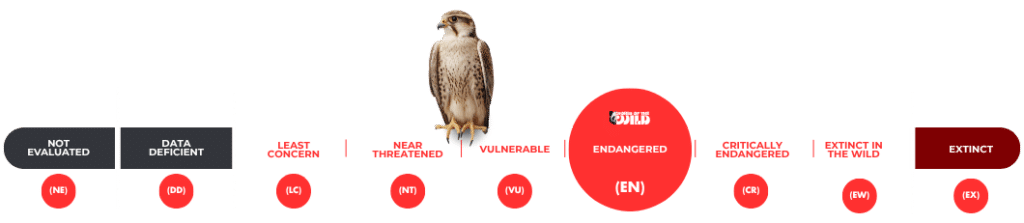
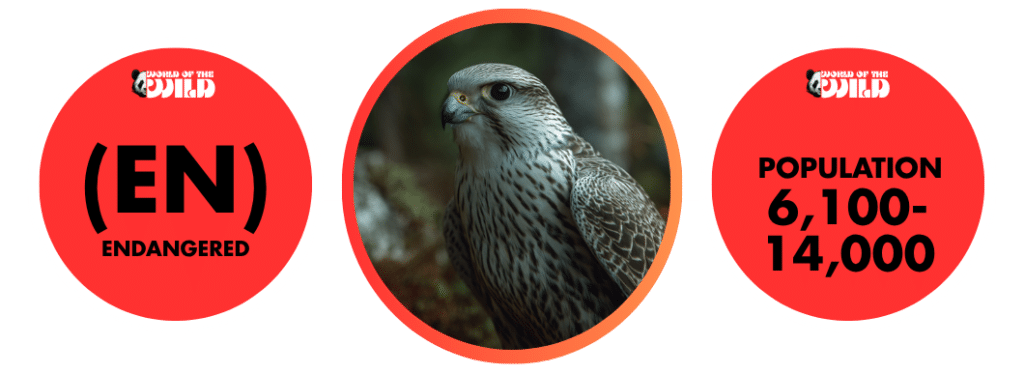
The Saker Falcon (Falco cherrug) currently holds Endangered status on the IUCN Red List — a classification it has carried since 2012, having been downlisted briefly and then relisted as population surveys refined the picture. That picture is not encouraging.
The most current global population estimates, drawing on data compiled through 2024 by BirdLife International and the Saker Falcon Global Action Plan (SakerGAP) consortium, place the number of mature individuals at approximately 12,400 to 28,900 birds. The wide confidence interval is itself a statement about how difficult these animals are to count: they range across some of the remotest terrain on Earth, nest in dispersed, low-density pairs, and have highly variable breeding success from year to year. The more conservative estimates from range-state surveys in Kazakhstan, Russia, and Mongolia tend toward the lower end of that bracket.
What do these numbers actually mean?
- Population trend: Decreasing. This is not a stabilized species tentatively clawing back ground. Across its Eurasian range, the Saker is losing approximately 8–15% of its breeding population per decade in some areas, with particularly severe contractions in Eastern Europe and the western steppe belt.
- Breeding pairs: Estimated at 6,200 to 14,450 globally, placing annual recruitment under intense pressure when combined with adult mortality rates driven by electrocution and illegal trapping.
- Fragmentation index: High. What was once a continuous population across the Palearctic has fractured into semi-isolated subpopulations — the European cluster (Hungary, Slovakia, Czech Republic, Austria), the Central Asian core (Kazakhstan, Russia, Uzbekistan), and the eastern population centered on Mongolia and western China. These populations have increasingly limited genetic exchange.
The Genetics Beneath the Numbers
Here is where the crisis deepens beyond a simple headcount. Population genetics research, including landmark studies published by the Raptor Research Foundation and collaborators in Central Asia, has demonstrated that genetic diversity in Saker populations is measurably declining. The effective population size — the number of individuals actually contributing to the next generation — is significantly smaller than the census population, likely no more than 3,000–5,000 individuals contributing meaningfully to gene flow.
At this scale, the species begins to enter what conservation geneticists call an inbreeding depression spiral: reduced genetic variability leads to lower immune function, reduced adaptability to changing environments, and declining reproductive fitness. In practical terms, this means that even if habitat pressures were removed tomorrow, the Saker might struggle to recover to historical population densities purely on the basis of compromised genetic health.
A population of 12,000 birds is not a safe population. It is a fragile one.
The Map of the Vanishing
A Kingdom Measured in Horizons
The Saker Falcon is a creature of open landscapes. Its geographic range — from Central Europe east through Russia, the Caucasus, Central Asia, and into Mongolia and western China, with a distinct population in the Middle Eastern montane zones — reads like a map of the world’s most spectacular emptiness. In migration, birds from breeding grounds in Russia and Kazakhstan travel south through the Arabian Peninsula, the Horn of Africa, and into the Sahel.
Core breeding range:
- European strongholds: Hungary, Slovakia, Czech Republic, Romania, and Austria — where re-introduction programs have partially stabilized small populations
- Central Asian core: Kazakhstan (particularly the Kazakh steppe), southern Russia, Uzbekistan, and Kyrgyzstan — the numerical heart of the global population
- Eastern populations: Mongolia and Xinjiang province in China, where birds breed in rugged semi-desert terrain and mountain edges
- Caucasian and Middle Eastern populations: Georgia, Azerbaijan, Armenia, and Turkey, where the species occupies a distinct ecological niche in upland rocky terrain
The Saker’s habitat preference is fundamentally defined by three intersecting variables: open hunting terrain, available elevated nest sites, and healthy prey populations — particularly ground squirrels (Spermophilus and Citellus spp.) and other small to medium-sized mammals and birds. It does not require trees. It does not require water bodies. It requires space, and it requires prey, and it requires the absence of human interference — three things that are becoming simultaneously rarer across its range.
The Keystone Effect: What Disappears With the Falcon
Remove the Saker from the steppe, and the steppe does not simply carry on.
The Saker Falcon is a keystone predator in grassland and semi-desert ecosystems. Its role is not merely to eat — it is to regulate. Ground squirrel populations, left unchecked, overgraze steppe vegetation, accelerate soil erosion, and can collapse the fine-tuned vegetation structure that dozens of other species depend upon. The Saker, alongside the Steppe Eagle and other raptors, acts as the pressure valve that prevents these small mammal populations from irrupting destructively.
Furthermore, Sakers perform critical carrion clearance by driving other scavengers into competition, and their nest sites — frequently built on cliff ledges or repurposed in old stick nests of corvids and eagles — create secondary habitat for smaller species once abandoned.
There is also the matter of cultural ecology: in Central Asia, the Saker has been the foundation of falconry traditions for over 4,000 years. UNESCO recognized this cultural practice in 2016 as Intangible Cultural Heritage. The legal, sustainable practice of falconry has, paradoxically, become one of the species’ most powerful conservation levers — because falconers have an existential stake in the bird’s survival. But when the falcon goes, so does a living thread connecting human cultures to their own wild heritage.
The Descent — How We Got Here
A Century of Pressure, a Decade of Crisis
The Saker Falcon’s decline does not have a single villain. It has a cast of thousands, operating across time zones and political borders, often unknowingly, occasionally with full knowledge and deliberate intent. Understanding the collapse requires unpacking several distinct but interlocking forces.
Driver 1: Electrocution on Power Lines
This is the Saker’s single largest documented killer, and it is mundane in its brutality. Across Central Asia and Eastern Europe, tens of thousands of kilometres of medium-voltage electricity distribution lines — particularly the Soviet-era infrastructure still prevalent in Kazakhstan, Russia, and Mongolia — feature uninsulated pole-top transformers and crossarms that are fatal to large perching birds.
A Saker sitting atop a power pole — a behaviour encouraged by the fact that poles are often the only elevated perch in an open landscape — simultaneously contacts two live conductors and is instantly electrocuted. Studies conducted in Kazakhstan by the Altai Project and the RSPB have estimated that power line electrocution may account for 50–70% of recorded adult Saker mortality in some regions. In Mongolia, multi-year surveys documented electrocution as the leading cause of death for radio-tagged individuals.
The scale is staggering. Kazakhstan alone has an estimated 60,000 to 80,000 dangerous power poles within prime Saker habitat. Each pole is a potential death trap, operating 24 hours a day, 365 days a year, invisible to the international conservation discourse.
Driver 2: Illegal Trapping for the Falconry Trade
Falconry is legal, regulated, and practiced responsibly by hundreds of thousands of practitioners worldwide. The illegal trade in wild-caught Sakers is something entirely different — a black market that operates in the shadows of legal falconry and has devastated breeding populations across the Central Asian range.
The primary demand comes from the Arabian Peninsula, where the Saker — prized for its size, speed, and trainability — commands extraordinary prices. A prime adult female can fetch between $10,000 and $100,000 on black markets, with exceptional birds allegedly selling for considerably more. TRAFFIC (the wildlife trade monitoring network) and CITES enforcement bodies have documented consistent illegal export from Kazakhstan, Russia, and Mongolia toward Gulf States markets, often transiting through Turkey or Georgia.
The scale is difficult to quantify precisely — by definition — but conservative estimates suggest that hundreds of birds per year are illegally removed from wild populations, with particular pressure on breeding adults and nestlings during the nesting season. Unlike natural mortality, which takes birds across all age classes, trapping selectively removes the most reproductively valuable individuals: large, healthy adults in prime condition.
The consequence is a double wound: the population loses its best breeders while simultaneously being deprived of nest-site fidelity — the tendency of experienced birds to return to successful territories year after year.
Driver 3: Prey Base Collapse
The Saker does not hunt in a vacuum. Its fortunes are inextricably linked to those of its prey — primarily small to medium-sized mammals and birds of open terrain. Across Central Asia, ground squirrel populations have been severely depleted by the combined pressures of agricultural intensification, deliberate poisoning campaigns (some dating to Soviet-era agricultural policies), and habitat simplification.
When susliks and other primary prey disappear from a territory, Sakers face a brutal energetic calculus: expand the home range dramatically (burning more calories, covering more dangerous ground), switch to less preferred, lower-calorie prey, or abandon the territory entirely. In practice, all three outcomes reduce breeding success and increase adult mortality.
Climate change is now accelerating this prey collapse. The Central Asian steppe is experiencing temperature increases of 0.3–0.5°C per decade — faster than the global average — leading to desertification of marginal steppe habitat, alteration of vegetation structure, and disruption of the phenological cues that govern ground squirrel emergence and activity patterns. In effect, climate change is shrinking the Saker’s habitable world from the inside, degrading the quality of remaining habitat even as its extent contracts.
Driver 4: Habitat Loss and Fragmentation
The Palearctic steppe is the most converted biome on Earth by area. An estimated 70% of the original Eurasian steppe has been converted to agriculture since the 19th century, with the sharpest losses occurring during Soviet collectivization in the 20th century. In Eastern Europe, where the Saker’s European populations breed, less than 10% of original open steppe and pseudo-steppe habitat remains, and much of that is under active pressure from agricultural intensification and renewable energy development.
Wind energy installations, while environmentally beneficial in reducing carbon emissions, represent a growing collision risk for large raptors if not carefully sited. Early wind farms across the Kazakh and Mongolian steppe were installed without adequate raptor impact assessments; more recent installations have begun incorporating buffer zones and pre-construction surveys, but the legacy footprint of poorly sited infrastructure remains.
The Front Lines of Conservation
The People Fighting Back
In a world where conservation news trends toward the catastrophic, the story of the Saker Falcon — for all its darkness — contains something unexpected: a genuinely global, multi-institutional effort that has already produced measurable results.
The Saker Falcon Global Action Plan (SakerGAP)
Launched under the coordination of the CMS Raptors MOU (Convention on Migratory Species), SakerGAP is the most comprehensive international conservation plan ever assembled for a single raptor species. Bringing together range-state governments, NGOs, the falconry community, and research institutions across 29 countries, it identifies 13 priority conservation actions organized around population monitoring, threat reduction, and habitat protection.
Key achievements of SakerGAP include:
- Standardized population survey protocols adopted across Central Asian range states, enabling more accurate population trend data for the first time
- Legal frameworks strengthened in Kazakhstan and Mongolia for anti-poaching enforcement
- Cross-border cooperation agreements between Russia, Kazakhstan, and China on migratory corridor protection
The Power Pole Problem: A Technical Solution at Scale
Perhaps the most concrete conservation intervention currently underway is the large-scale retrofitting of dangerous power poles across Central Asia. The RSPB (Royal Society for the Protection of Birds), working in partnership with local NGOs in Kazakhstan — particularly the Association for the Conservation of Biodiversity of Kazakhstan (ACBK) — has retrofitted thousands of dangerous pole-top structures with insulating covers and modified crossarm designs that eliminate the electrocution risk.
In a pilot area of the Kazakh steppe, retrofitting of approximately 15,000 poles resulted in a measurable increase in local Saker breeding density within five years of completion — one of the clearest direct cause-and-effect conservation outcomes documented for any raptor species. The project is now scaling, with ambitions to address 60,000 additional poles across Kazakhstan over the next decade, funded by a combination of international NGO support, development bank financing, and — in a notable development — the Kazakhstani power utilities themselves, which have recognized both the reputational and regulatory risks of continued electrocution mortality.
The Artificial Nest Programme: Giving Birds a Place to Start
Where cliff faces and old eagle nests are unavailable, Sakers have proven remarkably willing to adopt artificial nest platforms. Programs in Hungary, Slovakia, and the Czech Republic — anchored by the Pannonian Steppe Project and local raptor research groups — have installed hundreds of basket-style nest platforms on electricity pylons, purpose-built poles, and isolated trees across the agricultural landscape of Eastern Europe.
In Hungary, where the wild Saker population had collapsed to fewer than five breeding pairs in the 1980s, a combination of nest provision, anti-poisoning enforcement, and habitat management has enabled the population to recover to over 250 breeding pairs by 2023. This is not merely good news — it is a proof of concept for the entire species: given basic protection and infrastructure, Sakers can and will rebuild.
Hero of the Species: Dr. Janusz Krogulec and the Hungarian Recovery
No individual better embodies the front-line reality of Saker conservation than Dr. Janusz Krogulec of the Polish Society for the Protection of Birds (OTOP), who has spent over three decades working across the Pannonian landscape coordinating raptor recovery efforts. His work — building bridges between the farming community, the power utilities, and the conservation sector — created the social licence without which Hungary’s recovery would have been impossible.
By negotiating directly with farmers to prevent disturbance at nest sites, and working with power companies to fund pole retrofitting as part of their corporate responsibility obligations, Krogulec and his colleagues demonstrated that conservation does not have to be adversarial to be effective. His model is now being adapted for use in Kazakhstan and Mongolia, where the same three-stakeholder approach — farmers, industry, and conservationists — is essential to achieving population-level outcomes.
Captive Breeding and Genetic Banking
A smaller but scientifically critical piece of the conservation puzzle is the ex-situ breeding program coordinated through European zoos and specialist raptor facilities. The Abu Dhabi Falcon Hospital, working in close partnership with Emirates Falconers Club and the International Association for Falconry (IAF), maintains a studbook-managed captive population that serves both as a genetic reservoir and a source of birds for reintroduction programs in areas of local extinction.
Advances in cryopreservation of raptor genetic material — semen, blood samples, and feather follicle cells — are being pioneered at the University of Veterinary Sciences in Budapest, creating a frozen genetic archive that could, in theory, support future genetic rescue efforts if wild populations contract further.
The Odds of Tomorrow
Fifty Years in the Balance
Predicting the future of any wild species requires a level of honest uncertainty that sits uncomfortably with the human desire for clear answers. For the Saker Falcon, the next five decades will be defined by the outcome of a race between the speed of its threats and the speed of the response — and right now, that race is genuinely too close to call.
The Best Case: A Falcon That Outlasts Us
In the optimistic scenario — not a utopian fantasy, but a plausible trajectory if current conservation momentum accelerates — the Saker Falcon looks like this in 2075:
The large-scale power pole retrofitting programs in Kazakhstan and Mongolia have been completed, eliminating the single largest source of adult mortality across the core Central Asian breeding range. Breeding density in the Kazakh steppe has rebounded, with population estimates stabilizing above 35,000 mature individuals, comfortably above the IUCN threshold for Vulnerable status, let alone Endangered.
Collaborative falconry community enforcement — driven by the IAF’s own long-term realization that legal, wild-caught birds are economically and ethically unsustainable — has reduced illegal trapping by 80% from peak levels. Black market prices have collapsed as legitimate captive-bred birds, produced under licensing frameworks negotiated with Gulf state governments, fill market demand.
Climate-adaptive management has protected core steppe habitat through a network of protected areas in Kazakhstan, Mongolia, and Russia spanning over 5 million hectares — the largest raptor-specific protected area network on Earth. Within these zones, prey populations have recovered, vegetation structure is monitored and managed, and Saker breeding pairs are a fixture of the landscape rather than a rarity.
This scenario is achievable. Every element of it is already in progress. What it requires is time, sustained funding, and political will across a dozen governments — none of which are guaranteed, but all of which are possible.
The Worst Case: The Silence of the Steppe
In the pessimistic scenario, the conservation effort stalls under the weight of competing priorities: geopolitical instability in Central Asia disrupts cross-border cooperation, climate change accelerates faster than models predicted, and the illegal trade adapts faster than enforcement.
In this scenario, by 2045, the Central Asian breeding population has contracted by 40% from its 2025 baseline, leaving a global population of under 8,000 mature individuals. The European populations — still small, still dependent on active management — are unable to compensate for the losses in the core range. The species passes through what ecologists call a “commitment to extinction” threshold, where the inbreeding depression and Allee effects (reduced reproductive success at very low population densities) create a self-reinforcing spiral from which natural recovery is impossible without massive genetic and demographic intervention.
By 2075, in the worst case, the Saker Falcon exists primarily in captivity: in the aviaries of falconers, in zoo breeding programs, in the climate-controlled genetic archives of veterinary universities. It is not extinct. But it is, in any meaningful ecological sense, no longer wild.
The Verdict: Where Does the Arrow Point?
Here is the honest assessment: the Saker Falcon is not on a straightforward trajectory toward recovery, but neither is it committed to extinction. It exists in the precarious middle zone that defines most of the world’s Endangered species — a zone where human choices, made at the scale of policy and international coordination, will determine the outcome more than any biological factor.
The Hungarian recovery proves it can be done. The Kazakhstani pole retrofitting program proves the interventions scale. The SakerGAP framework proves that the international will, however fragile, exists. What is lacking is not knowledge, not technology, and not even motivation. What is lacking is speed.
Every year of delay in retrofitting dangerous power poles is another year of preventable mortality. Every breeding season in which illegal trapping goes unenforced is another year of reproductive potential extracted from the wild population. Every hectare of steppe converted to monoculture agriculture is another hectare permanently removed from the map of viable Saker habitat.
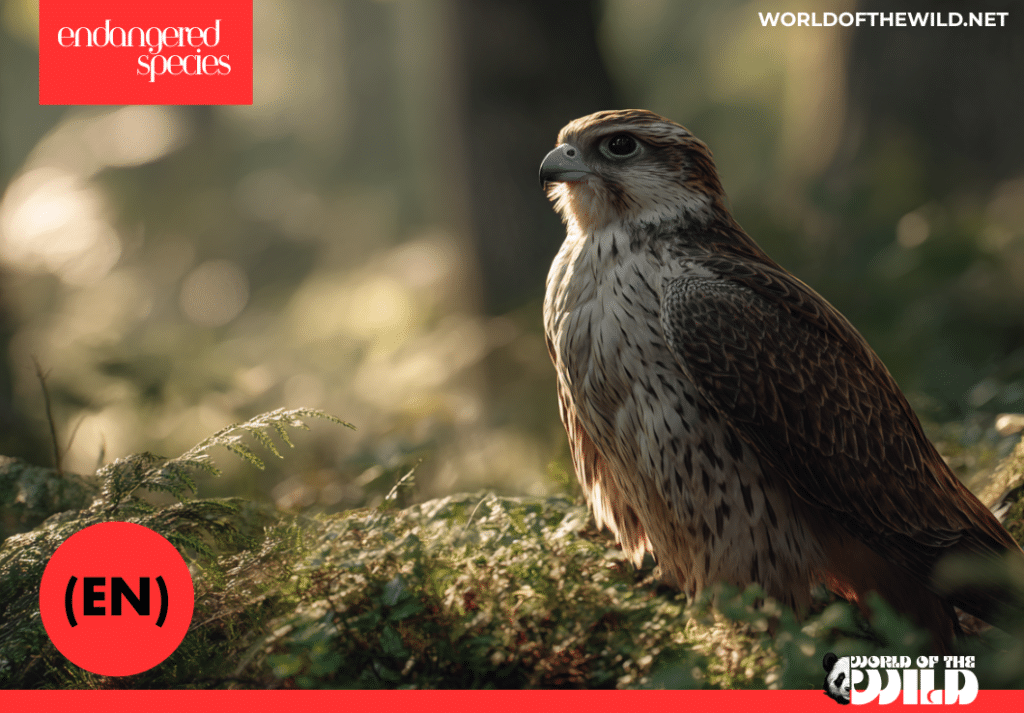
The falcon does not know any of this. Right now, somewhere over the Kazakh steppe, she is climbing a thermal column in the late afternoon light — wings spread, tail fanned, her extraordinary eyes reading the landscape below with a precision no human instrument can match. She is doing what her kind has done for millions of years, and she is doing it magnificently.
The question is whether we move fast enough to deserve her.
What You Can Do
The Saker Falcon’s survival is not inevitable. Neither is its extinction. Support the following organizations working directly on its recovery:
- BirdLife International (birdlife.org) — funds coordinated international conservation across the entire range
- RSPB Kazakhstan Program (rspb.org.uk) — leads power pole retrofitting and population monitoring in the core range
- Association for the Conservation of Biodiversity of Kazakhstan (ACBK) — on-the-ground Kazakh conservation
- International Association for Falconry (falconry.org) — leads sustainable falconry practice and anti-illegal-trade advocacy
- WWF Mongolia (wwf.mn) — habitat protection in the eastern range
Share this article. The Saker Falcon does not have the luxury of waiting to be discovered.
Sources: IUCN Red List (2024), BirdLife International Saker Falcon Species Factsheet, SakerGAP Global Action Plan (CMS), RSPB Kazakhstan Power Line Reports (2019–2024), TRAFFIC Illegal Wildlife Trade Monitoring Reports, Raptor Research Foundation publications, Hungarian Ornithological and Nature Conservation Society (MME) annual raptor census data.
World of the Wild | Endangered Species Series Protecting the wild through the power of story.